Zhang Xin-Yu, Li Yu-Ying, Zhou Yi-Min, Chen Wei, Xie Lu-Lu, Hu Yan-Qing, Qin Yan, Huang Hai-Xin, Zhou Lin, Lan Tian, Sun Wen-Chao
Wenzhou Key Laboratory for Virology and Immunology, Institute of Virology, Wenzhou University, Wenzhou 325035, China.
College of Animal Sciences, Institute of Preventive Veterinary Medicine, Zhejiang University, Hangzhou 310000, China.
Microorganisms. 2025 May 26;13(6):1209. doi: 10.3390/microorganisms13061209.
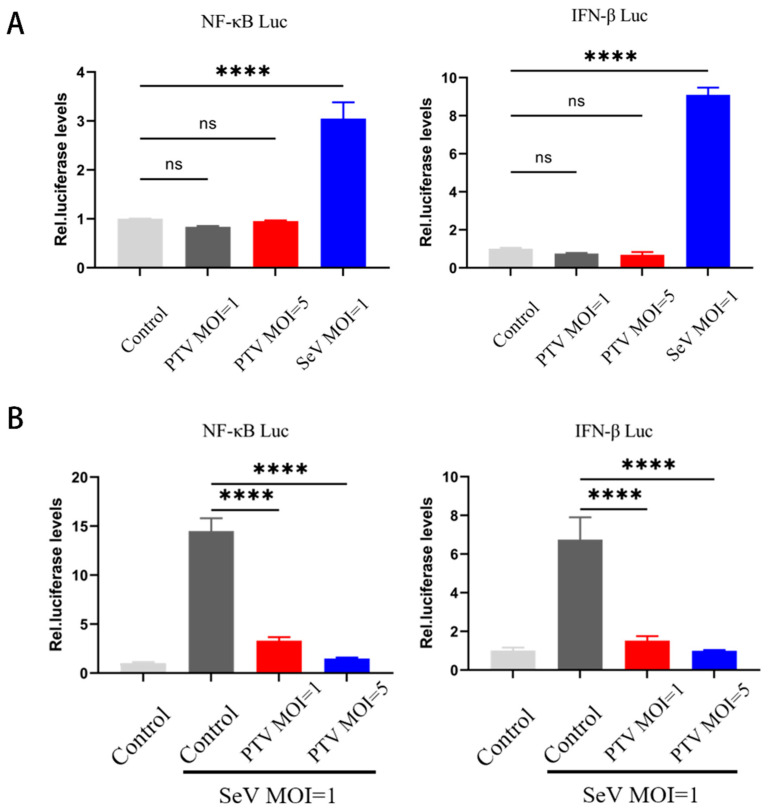
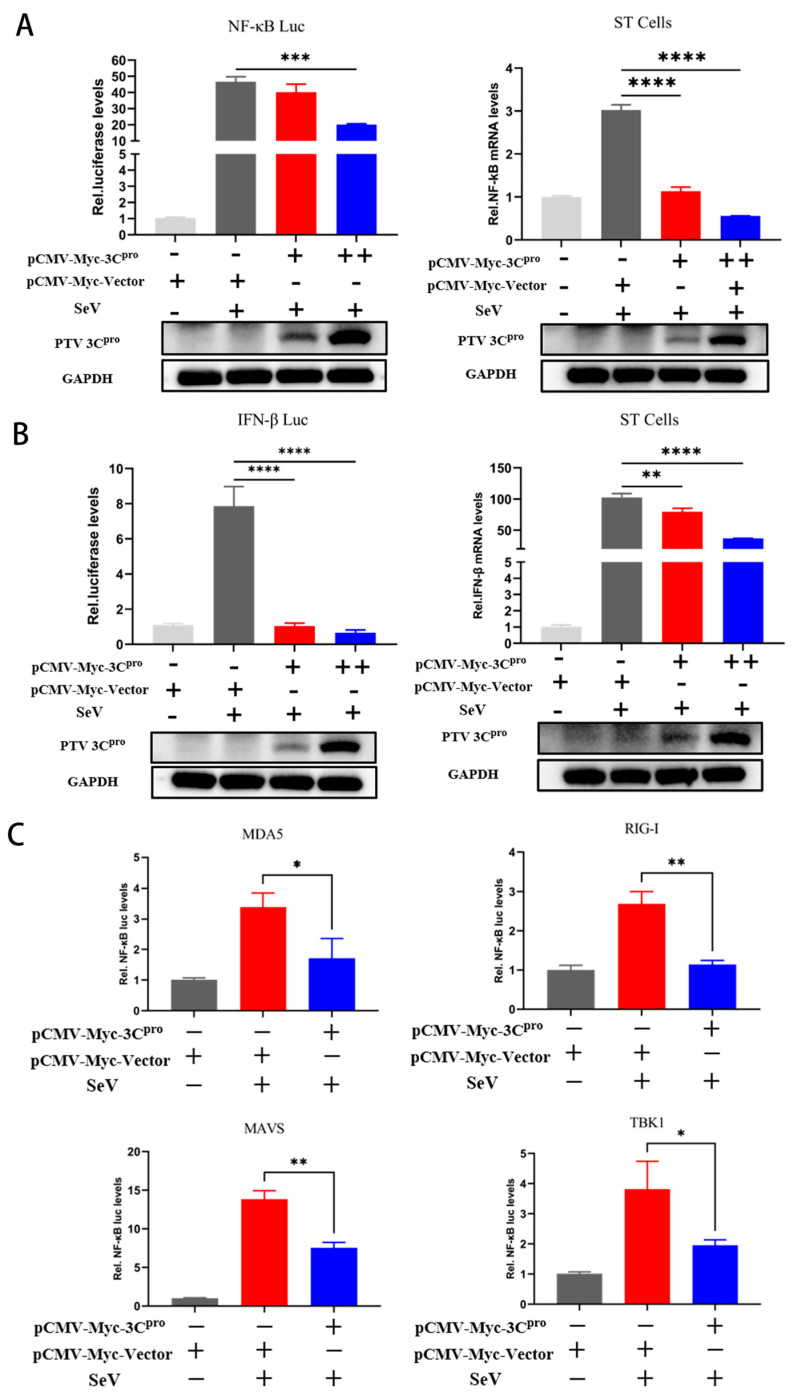
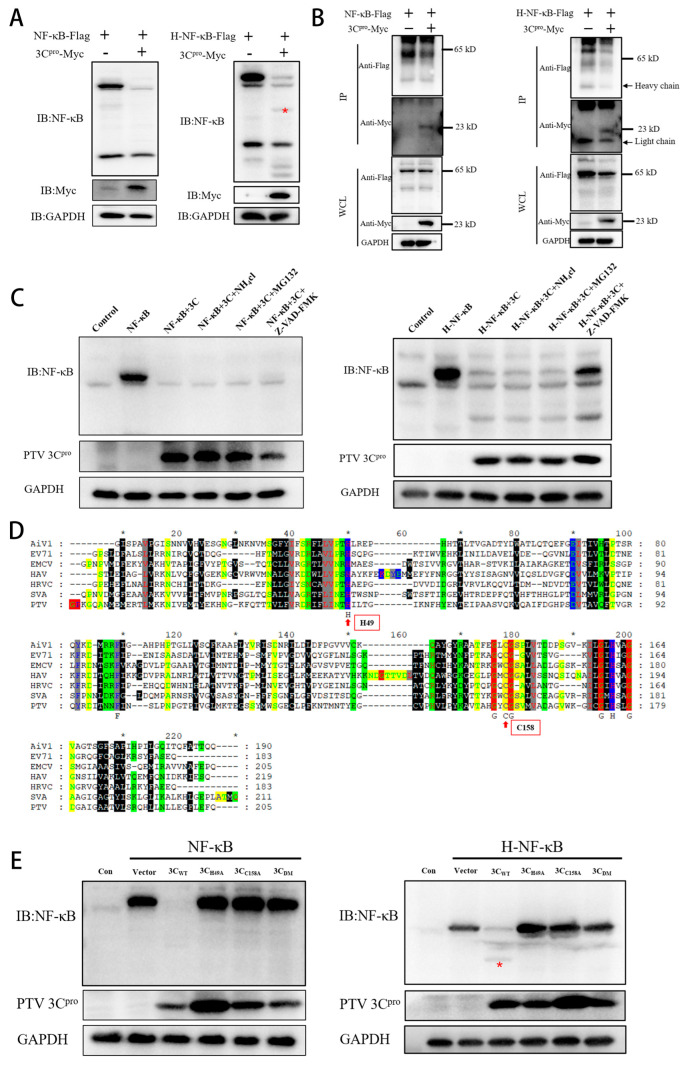
Porcine teschovirus (PTV) circulates in pig populations, causing clinical diseases such as poliomyelitis, reproductive disorders, and pneumonia. However, the molecular mechanisms underlying the pathogenesis of PTV infection have not been fully elucidated. Here, we found that PTV infection does not activate the promoters of NF-κB or IFN-β. The expression of PTV 3C inhibits the promoter activity of NF-κB and IFN-β stimulated by SeV and inhibits the downstream transcription of NF-κB and IFN-β by blocking the phosphorylation and nuclear translocation of NF-κB. Coimmunoprecipiation (co-IP) experiments demonstrated that 3C and NF-κB interact. The degradation of NF-κB was unaffected by inhibitors targeting lysosomes (NH4Cl), proteasomes (MG132), or caspases (Z-VAD-FMK). The protease activity of 3C, which relies on its catalytic active site, is vital for NF-κB cleavage and degradation. Loss of proteolytic activity in mutants abolished NF-κB degradation, impairing the ability of 3C to suppress SeV-induced innate immunity and restore VSV-GFP replication, thereby underscoring its critical role in immune evasion by targeting NF-κB. This study reveals novel mechanisms underlying PTV-mediated suppression of host innate immunity.
猪捷申病毒(PTV)在猪群中传播,可引发诸如脊髓灰质炎、繁殖障碍和肺炎等临床疾病。然而,PTV感染发病机制的分子基础尚未完全阐明。在此,我们发现PTV感染不会激活NF-κB或IFN-β的启动子。PTV 3C的表达抑制了由仙台病毒(SeV)刺激的NF-κB和IFN-β的启动子活性,并通过阻断NF-κB的磷酸化和核转位来抑制NF-κB和IFN-β的下游转录。免疫共沉淀(co-IP)实验表明3C与NF-κB相互作用。NF-κB的降解不受靶向溶酶体的抑制剂(NH4Cl)、蛋白酶体的抑制剂(MG132)或半胱天冬酶的抑制剂(Z-VAD-FMK)的影响。依赖其催化活性位点的3C的蛋白酶活性对于NF-κB的切割和降解至关重要。突变体中蛋白水解活性的丧失消除了NF-κB的降解,损害了3C抑制SeV诱导的固有免疫和恢复水疱性口炎病毒糖蛋白(VSV-GFP)复制的能力,从而突出了其通过靶向NF-κB在免疫逃逸中的关键作用。本研究揭示了PTV介导的宿主固有免疫抑制的新机制。