Miklaszewski Piotr, Gadamer Anna Maria, Janiszewska-Bil Dominika, Lyssek-Boroń Anita, Dobrowolski Dariusz, Wylęgała Edward, Grabarek Beniamin Oskar, Koss Michael Janusz, Krysik Katarzyna
Department of Ophthalmology, St. Barbara Hospital, Trauma Centre, 41-200 Sosnowiec, Poland.
Department of Ophthalmology, Faculty of Medicine, Academy of Silesia, 40-555 Katowice, Poland.
Pharmaceuticals (Basel). 2025 Jun 11;18(6):868. doi: 10.3390/ph18060868.
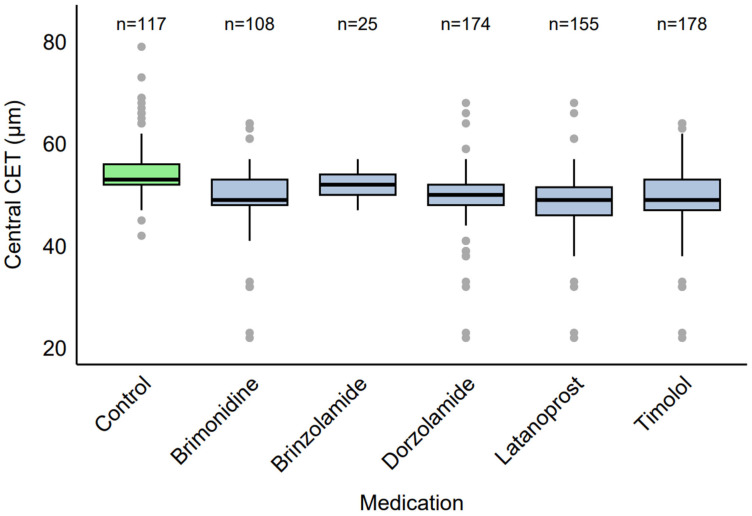
The corneal epithelium plays a vital role in maintaining corneal transparency and ocular surface integrity. Chronic topical use of antiglaucoma medications may induce epithelial changes, especially with the concurrent use of multiple agents. This study aimed to evaluate the association between the number and class of antiglaucoma medications and central corneal epithelial thickness (CET), measured using a spectral-domain optical coherence tomography (SD-OCT) device. This cross-sectional study included 456 eyes from 242 adults (median age 72 years), grouped by the number of antiglaucoma agents used (0-4 medications). All pharmacologically treated participants had received the same regimen for ≥6 months. CET was measured using SD-OCT (SOLIX, Optovue). Generalized estimating equations (GEEs) accounted for inter-eye correlation. Two models were constructed: one evaluating specific medication effects and another assessing CET reduction per additional drug used. Age and sex were included as covariates. CET progressively decreased with the number of medications, ranging from 53 µm in controls to 48 µm with quadruple therapy. Multivariable GEE analysis confirmed a cumulative thinning effect, with each additional medication associated with further CET reduction (β = -2.83 to -9.17 µm, < 0.001). Latanoprost exerted the most pronounced single-drug effect (β = -3.01 µm, < 0.001). Age was a modest negative predictor, while sex showed no significant effect. The cumulative number and specific class of antiglaucoma medications have a significant impact on corneal epithelial thickness. These results emphasize the need for vigilant ocular surface evaluation in patients on multi-drug regimens and propose CET as a surrogate marker for the burden of topical therapy.
角膜上皮在维持角膜透明度和眼表完整性方面起着至关重要的作用。长期局部使用抗青光眼药物可能会引起上皮变化,尤其是同时使用多种药物时。本研究旨在评估抗青光眼药物的数量和种类与使用光谱域光学相干断层扫描(SD-OCT)设备测量的中央角膜上皮厚度(CET)之间的关联。这项横断面研究纳入了242名成年人(中位年龄72岁)的456只眼睛,根据使用的抗青光眼药物数量(0 - 4种药物)进行分组。所有接受药物治疗的参与者均接受相同治疗方案≥6个月。使用SD-OCT(SOLIX,Optovue)测量CET。广义估计方程(GEEs)考虑了两眼之间的相关性。构建了两个模型:一个评估特定药物的作用,另一个评估每增加一种使用药物时CET的降低情况。将年龄和性别作为协变量纳入。CET随着药物数量的增加而逐渐降低,从对照组的53 µm降至四联疗法时的48 µm。多变量GEE分析证实了累积变薄效应,每增加一种药物使用,CET会进一步降低(β = -2.83至-9.17 µm,< 0.001)。拉坦前列素产生的单药效应最为显著(β = -3.01 µm,< 0.001)。年龄是一个适度的负预测因子,而性别无显著影响。抗青光眼药物的累积数量和特定种类对角膜上皮厚度有显著影响。这些结果强调了对接受多药治疗方案的患者进行眼表评估的必要性,并提出将CET作为局部治疗负担的替代标志物。