Melake Addisu, Mengstie Misganaw Asmamaw
Department of Medical Biochemistry, College of Health Science, Debre Tabor University, Debre Tabor, Ethiopia.
Front Endocrinol (Lausanne). 2025 Jun 12;16:1567716. doi: 10.3389/fendo.2025.1567716. eCollection 2025.
Many studies have shown that vitamin D deficiency and vitamin D receptor TaqI gene polymorphisms are associated with susceptibility to diabetic nephropathy in various populations. The objective of this study was to determine the impact of vitamin D deficiency and vitamin D receptor gene polymorphism on the risk of diabetic nephropathy complications in T2DM at the Debre Tabor Comprehensive Specialized Hospital, Northwest Ethiopia.
A total of 210 participants, including 70 diabetic patients with nephropathy, 70 diabetic patients without nephropathy, and 70 healthy controls, participated in an age-and sex-matched hospital-based case-control study. Demographic and clinical data were assessed to determine the related risk factors. DNA was extracted from blood samples and subjected to polymerase chain reaction and agarose gel electrophoresis analysis to determine the genotypes.
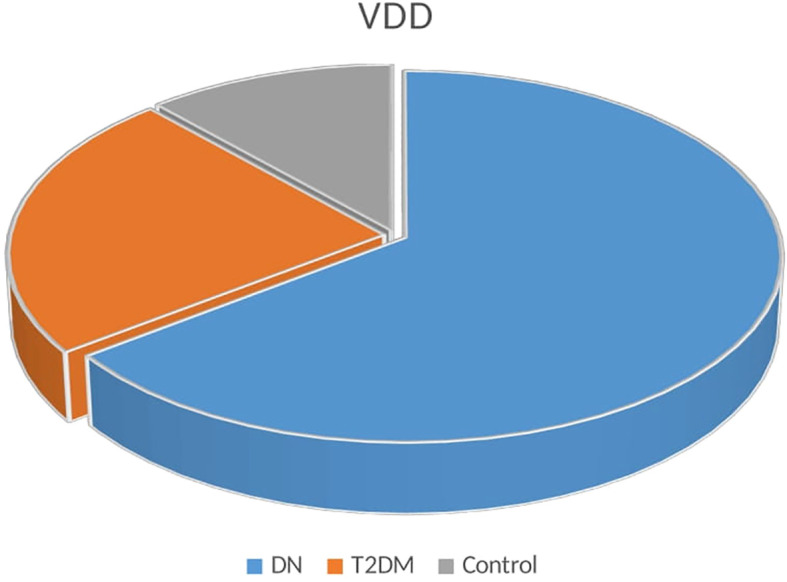
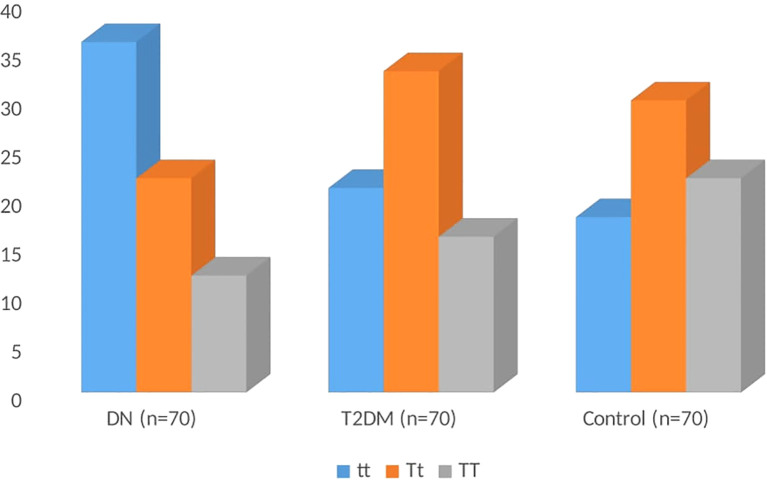
Vitamin D deficiency was detected in our investigation, and it was much more prevalent in diabetic nephropathy patients than type 2 diabetic patients and controls (OR = 5.05, 95% CL = 2.03-12.53; 0.001). Moreover, both the tt genotype (OR: 2.48; 95% CL: 1.15-5.37; P=0.020) and t allele (OR: 1.70; 95% CL: 1.13-2.57; P=0.010) were substantially more prevalent in diabetic nephropathy patients than in type 2 diabetic patients and controls, indicating that it may be a major risk factor for the development of diabetic nephropathy.
The findings point to a potential link between vitamin D deficiency and diabetic nephropathy complications. Moreover, gene polymorphisms have been linked to an increased risk of developing the disease in the Ethiopian population under study.
许多研究表明,维生素D缺乏和维生素D受体TaqI基因多态性与不同人群患糖尿病肾病的易感性相关。本研究的目的是在埃塞俄比亚西北部的德布雷塔博尔综合专科医院,确定维生素D缺乏和维生素D受体基因多态性对2型糖尿病患者糖尿病肾病并发症风险的影响。
共有210名参与者,包括70名糖尿病肾病患者、70名无肾病的糖尿病患者和70名健康对照,参与了一项年龄和性别匹配的基于医院的病例对照研究。评估人口统计学和临床数据以确定相关危险因素。从血样中提取DNA,并进行聚合酶链反应和琼脂糖凝胶电泳分析以确定基因型。
在我们的调查中检测到维生素D缺乏,并且在糖尿病肾病患者中比2型糖尿病患者和对照更为普遍(OR = 5.05,95% CL = 2.03 - 12.53;P = 0.001)。此外,tt基因型(OR:2.48;95% CL:1.15 - 5.37;P = 0.020)和t等位基因(OR:1.70;95% CL:1.13 - 2.57;P = 0.010)在糖尿病肾病患者中比2型糖尿病患者和对照明显更普遍,表明它可能是糖尿病肾病发展的主要危险因素。
研究结果表明维生素D缺乏与糖尿病肾病并发症之间可能存在联系。此外,在所研究的埃塞俄比亚人群中,基因多态性与患该疾病的风险增加有关。