House Patrick M, Wiese Lars
Epileptologicum Hamburg, Hamburg, Germany.
Zentrum für Neurologie in Berlin-Charlottenburg, Berlin, Germany.
Front Neurol. 2025 Jun 13;16:1558614. doi: 10.3389/fneur.2025.1558614. eCollection 2025.
Epilepsy poses significant management challenges, particularly in patients with refractory epilepsy where conventional antiseizure medications (ASMs) are ineffective. Cenobamate (CNB), a recently approved third-generation ASM, has shown unprecedented efficacy as an adjunctive therapy in clinic-based practice. However, to date, its use by office-based neurologists in Germany remains relatively limited. One reason for this is its perceived complexity and false perception as a medication of last resort. This study focuses on the logistics of German care pathways, CNB titration, and ASM combinations in a first cohort of office-based outpatients. It also gives a glimpse into which ASMs are being used in the office-based setting in comparison to population and clinic-based data sources.
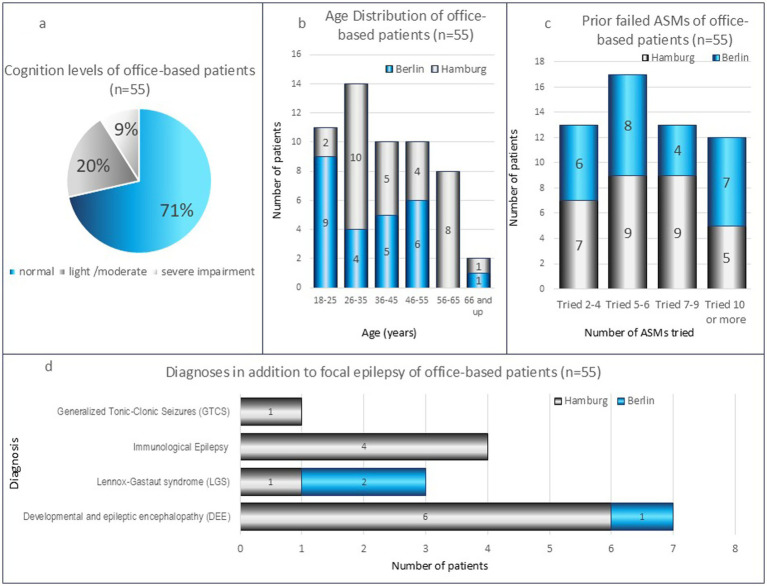
The cohort comprised 55 patients from two office-based outpatient practices () in Berlin ( = 25) and Hamburg ( = 30). All patients had a history of refractory epilepsy despite optimal treatment with existing ASMs. Patients were initiated on CNB from the month of approval (June 2021) to March 2023. Data on prior ASM usage were collated alongside clinical data, which included seizure frequency and drug load reduction outcomes to March 2025.
Prior to CNB initiation, patients at both office-based practices had similar levels of 1-2 concurrent ASMs (Berlin 80%; Hamburg 77%). The most common ASMs were voltage-gated sodium channel blockers (VGSC), Levetiracetam (LEV)/Brivaracetam (BRV) synaptic vesicle protein 2A (SV2A) inhibitors, and Perampanel (PER). CNB titration was configured into a quarterly office-based outpatient schedule. All patients had seizure reductions in-line with published and real-world evidence, and were compliant.
CNB is a valuable adjunctive therapy suitable for refractory epilepsy outpatients attending office-based neurologists. A slow titration schedule helped mitigate most side effects. Despite differences to clinic-based practice, in office-based outpatient practice CNB can be broadly used. It can be prescribed to patients on conventional therapy who are still having seizures and have failed two or more other ASMs. By reporting experiences of CNB titration, seizure, and drug load reduction outcomes in office-based neurology, this study will give German office-based outpatient neurologists evidence to support both CNB and other third-generation ASM use in their practice.
癫痫带来了重大的管理挑战,尤其是在难治性癫痫患者中,传统抗癫痫药物(ASM)无效。司替戊醇(CNB)是最近获批的第三代ASM,在临床实践中作为辅助治疗显示出前所未有的疗效。然而,迄今为止,德国门诊神经科医生对其使用仍然相对有限。原因之一是它被认为复杂,且被错误地视为最后手段的药物。本研究聚焦于德国护理路径的后勤、CNB滴定以及首批门诊患者中ASM的联合使用情况。它还与基于人群和临床的数据来源相比,初步展示了在门诊环境中正在使用哪些ASM。
该队列包括来自柏林(n = 25)和汉堡(n = 30)两家门诊诊所的55名患者。所有患者尽管使用现有ASM进行了最佳治疗,但仍有难治性癫痫病史。患者从获批月份(2021年6月)至2023年3月开始使用CNB。整理了先前ASM使用的数据以及临床数据,其中包括截至2025年3月的癫痫发作频率和药物负荷降低结果。
在开始使用CNB之前,两家门诊诊所的患者同时使用1 - 2种ASM的水平相似(柏林80%;汉堡77%)。最常见的ASM是电压门控钠通道阻滞剂(VGSC)、左乙拉西坦(LEV)/布瓦西坦(BRV)突触囊泡蛋白2A(SV2A)抑制剂和吡仑帕奈(PER)。CNB滴定被安排在每季度一次的门诊时间表中。所有患者的癫痫发作均减少,符合已发表的和实际的证据,并且依从性良好。
CNB是一种有价值的辅助治疗方法,适用于就诊于门诊神经科医生的难治性癫痫门诊患者。缓慢的滴定时间表有助于减轻大多数副作用。尽管与临床实践存在差异,但在门诊实践中CNB仍可广泛使用。它可以开给仍有癫痫发作且两种或更多其他ASM治疗失败的接受传统治疗的患者。通过报告门诊神经科中CNB滴定、癫痫发作和药物负荷降低结果的经验,本研究将为德国门诊神经科医生提供证据,以支持他们在实践中使用CNB和其他第三代ASM。