Birkenæs Viktoria, Parekh Pravesh, Shadrin Alexey, Jaholkowski Piotr, Ystaas Lars A R, Makowski Carolina, Bakken Nora R, Hagen Espen, Frei Evgeniia, Oliver Dominic, Fusar-Poli Paolo, Dale Anders, John John P, Havdahl Alexandra, Sønderby Ida E, Andreassen Ole A
Oslo University Hospital.
University of California, San Diego.
Res Sq. 2025 Jun 20:rs.3.rs-6783339. doi: 10.21203/rs.3.rs-6783339/v1.
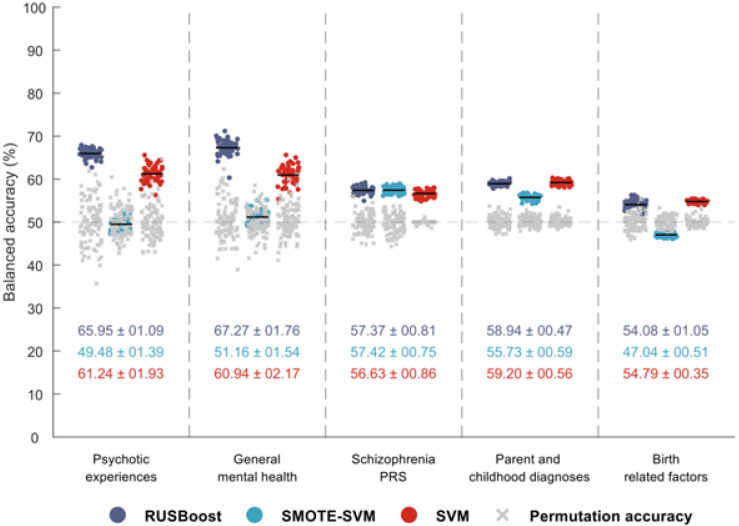
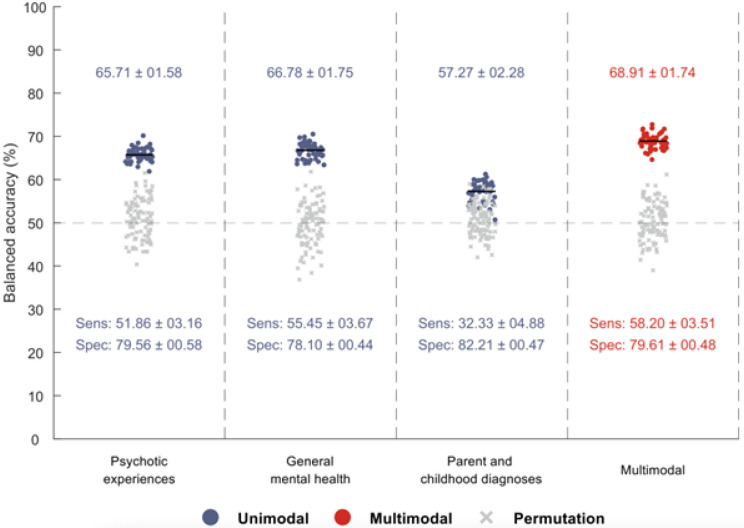
There is a need for improved early psychosis detection beyond the traditional clinical high-risk strategy. Using the Norwegian Mother, Father and Child cohort study, we examined the predictive ability of self-reported psychotic experiences (Community Assessment of Psychic Experiences; CAPE) at age 14, in addition to general mental health factors, parent and childhood psychiatric diagnoses, schizophrenia polygenic risk scores, and birth-related factors, to predict subsequent psychosis onset using three machine learning approaches for imbalanced data. We explored also a multimodal prediction framework. For unimodal classification, we observed best balanced accuracies with general mental health factors (67.27 ± 1.76%), and CAPE (65.95 ± 1.09%). Multimodal models improved classification accuracy (68.38 ± 2.16%). With validation and additional model refinement, these features may be useful for initial screening within clinical stepped assessment frameworks.
除了传统的临床高风险策略外,还需要改进早期精神病检测方法。利用挪威母婴队列研究,我们使用三种针对不平衡数据的机器学习方法,研究了14岁时自我报告的精神病体验(精神体验社区评估;CAPE)以及一般心理健康因素、父母和儿童期精神疾病诊断、精神分裂症多基因风险评分和出生相关因素对预测后续精神病发作的预测能力。我们还探索了一种多模式预测框架。对于单峰分类,我们观察到一般心理健康因素(67.27±1.76%)和CAPE(65.95±1.09%)的平衡准确率最高。多模式模型提高了分类准确率(68.38±2.16%)。通过验证和进一步的模型优化,这些特征可能有助于在临床阶梯评估框架内进行初步筛查。