Ohira Masayuki, Osada Takashi, Kimura Hiroaki, Sano Terunori, Takao Masaki
Department of General Internal Medicine and Clinical Laboratory, National Center of Neurology and Psychiatry, Kodaira, Tokyo, Japan.
Department of General Internal Medicine, National Center of Neurology and Psychiatry National Center Hospital, Kodaira, Japan.
BMJ Neurol Open. 2025 Jun 26;7(1):e000995. doi: 10.1136/bmjno-2024-000995. eCollection 2025.
Sequelae of the acute phase of coronavirus disease-19, termed long COVID, are characterised by numerous indicators, including neurological symptoms. Functional neurological disorder (FND) can occur with or without various structural diseases. No previous study has examined the relationship between long COVID and FND, with positive signs for FND. This study confirmed positive signs of functional limb weakness (hereafter positive signs) in patients with long COVID.
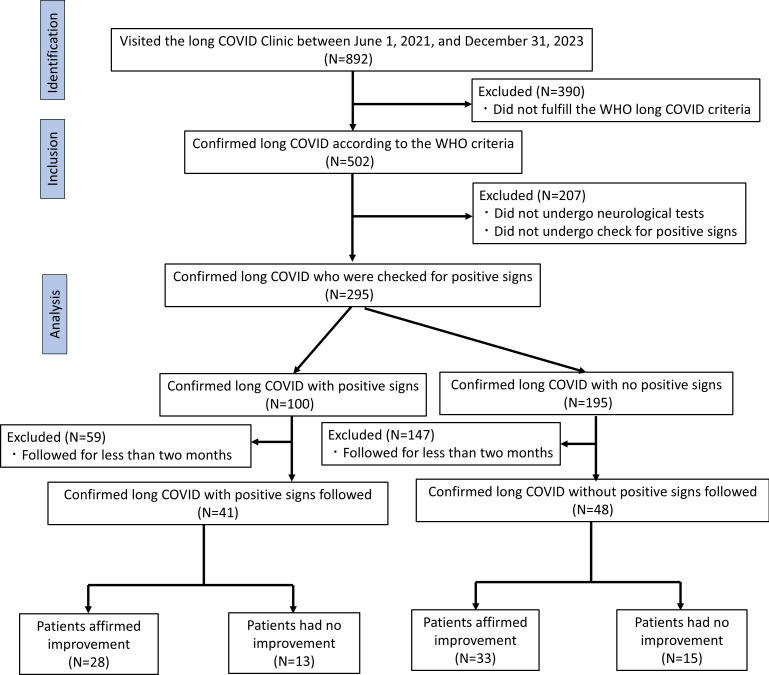
This was an observational, retrospective, single-centre study at an outpatient clinic conducted from 1 June 2021 to 31 May 2024. We collected patients' clinical data, including positive signs. The primary outcome was the prevalence of positive signs. Patients with positive signs were followed up over 2 months, and subjective patient perceptions of symptomatic improvements and changes in positive signs were analysed.
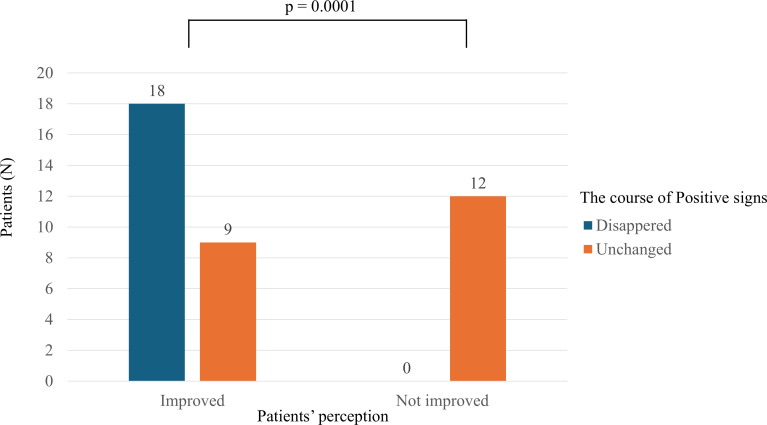
Overall, 502 were diagnosed with long COVID, and 100 assessed patients had positive signs. Female sex, time of infection after 2022, comorbidity of psychiatric diseases, fatigue, headache and muscle weakness were statistically significant in patients with positive signs compared with those in patients without positive signs. 89 patients (41 with positive signs and 48 without positive signs) were followed up, and 28 (68.3%) with positive signs and 33 (68.8%) without positive signs reported improvements. Positive signs disappeared in patients with symptomatic improvements but not in patients without symptomatic improvements (p=0.0001).
Positive signs were found in over one-third of patients (33.9%) who were investigated in this study. Some positive signs disappeared concurrently with their symptomatic improvement.
冠状病毒病19急性期的后遗症,即所谓的“长新冠”,具有众多指标特征,包括神经症状。功能性神经障碍(FND)可伴有或不伴有各种结构性疾病而发生。此前尚无研究探讨“长新冠”与有FND阳性体征的FND之间的关系。本研究证实了“长新冠”患者存在功能性肢体无力的阳性体征(以下简称阳性体征)。
这是一项于2021年6月1日至2024年5月31日在门诊进行的观察性、回顾性、单中心研究。我们收集了患者的临床数据,包括阳性体征。主要结局是阳性体征的患病率。对有阳性体征的患者进行了2个月以上的随访,并分析了患者对症状改善的主观感受以及阳性体征的变化。
总体而言,502例被诊断为“长新冠”,100例接受评估的患者有阳性体征。与无阳性体征的患者相比,有阳性体征的患者中女性、2022年后感染时间、精神疾病合并症、疲劳、头痛和肌肉无力在统计学上具有显著意义。对89例患者(41例有阳性体征,48例无阳性体征)进行了随访,41例有阳性体征的患者中有28例(68.3%)报告症状改善,48例无阳性体征的患者中有33例(68.8%)报告症状改善。有症状改善的患者阳性体征消失,而无症状改善的患者则未消失(p = 0.0001)。
在本研究调查的超过三分之一(33.9%)的患者中发现了阳性体征。一些阳性体征随着症状的改善而同时消失。