Abramson Cancer Center, Department of Medicine, Perelman School of Medicine, University of Pennsylvania, Philadelphia, PA, United States.
Front Immunol. 2020 Nov 10;11:605619. doi: 10.3389/fimmu.2020.605619. eCollection 2020.
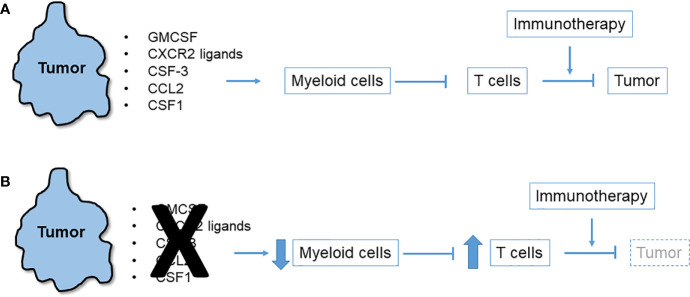
Like many tumor types, pancreatic ductal adenocarcinoma (PDAC) exhibits a rich network of tumor-derived cytokines and chemokines that drive recruitment of myeloid cells to the tumor microenvironment (TME). These cells, which include tumor-associated macrophages and myeloid derived suppressor cells, block the recruitment and priming of T cells, resulting in T cell exclusion within the TME. Genetic or pharmacologic disruption of this chemokine/cytokine network reliably converts the PDAC TME to a T cell-high phenotype and sensitizes tumors to immunotherapy across multiple preclinical models. Thus, neutralization of tumor-derived chemokines/cytokines or blockade of their respective receptors represents a potentially potent strategy to reverse myeloid immunosuppression in PDAC, enabling benefit from checkpoint inhibition not otherwise achievable in this disease. Inhibition of oncogenic pathways that drive tumor-intrinsic expression of chemoattractants may be similarly effective.
与许多肿瘤类型一样,胰腺导管腺癌 (PDAC) 表现出丰富的肿瘤衍生细胞因子和趋化因子网络,这些因子可驱动髓样细胞向肿瘤微环境 (TME) 募集。这些细胞包括肿瘤相关巨噬细胞和髓源性抑制细胞,它们阻止 T 细胞的募集和激活,导致 T 细胞在 TME 中被排斥。遗传或药理学破坏这种趋化因子/细胞因子网络可可靠地将 PDAC TME 转化为 T 细胞高表型,并使肿瘤对多种临床前模型中的免疫治疗敏感。因此,中和肿瘤衍生趋化因子/细胞因子或阻断其各自的受体代表了一种潜在的有效策略,可以逆转 PDAC 中的髓样免疫抑制,使受益于检查点抑制成为可能,否则在这种疾病中无法实现。抑制驱动肿瘤内在趋化因子表达的致癌途径可能同样有效。