Hooft Anneka, Umuhoza Christian, Trawin Jessica, Mfuranziza Cynthia, Uwiragiye Emmanuel, Zhang Cherri, Nguyen Vuong, Kornblith Aaron, Mugisha Nathan Kenya, Ansermino J Mark, Wiens Matthew O
University of California San Francisco Departments of Emergency Medicine and Pediatrics, San Francisco, California, United States of America.
University Teaching Hospital of Kigali, Kigali, Rwanda.
PLOS Glob Public Health. 2025 Jul 1;5(7):e0004606. doi: 10.1371/journal.pgph.0004606. eCollection 2025.
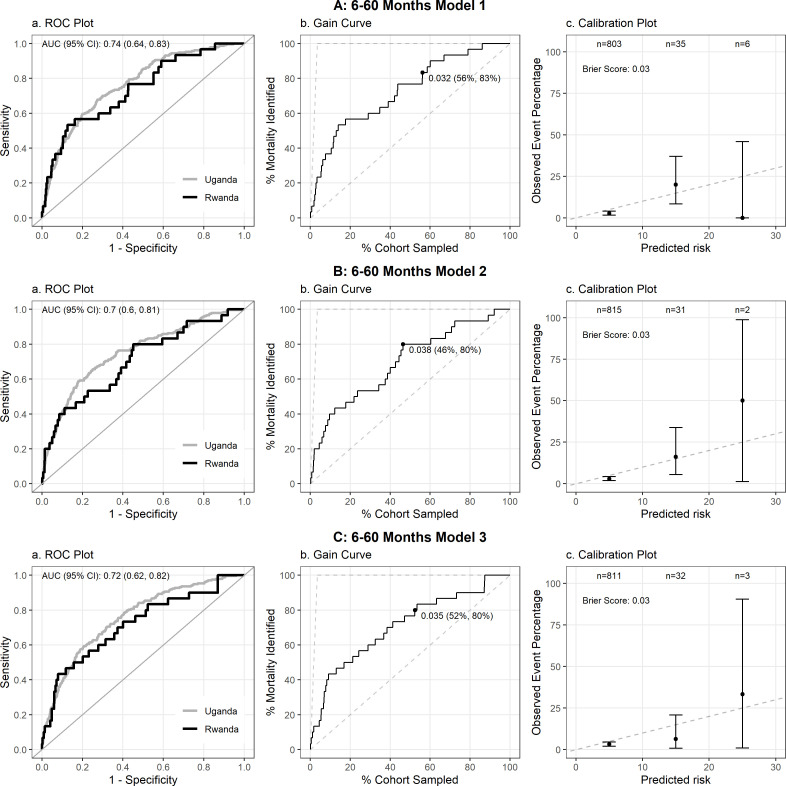
Mortality following hospital discharge remains a significant threat to child health, particularly in resource-limited settings. The Smart Discharges risk-prediction models use simple clinical, socio-behavioral, and point-of-care lab test variables to successfully predict children at the highest risk of death after hospital admission for infection to guide a risk-based approach to post-discharge care. In Rwanda, we externally validated five models derived from the prior Smart Discharges Uganda studies in a new cohort of children ages 0 days to 60 months admitted for suspected sepsis at two hospitals. We evaluated model performance using metrics including area under the receiver operating characteristic curve (AUROC), Brier score, and test characteristics (e.g., sensitivity, specificity). Performance was visualized through ROC and gain curves and calibration plots. Of 1218 total children (n = 413, Kigali; n = 805, Ruhengeri), 1161 lived to discharge (95.3%) and 1123 of those completed 6-month follow-up (96.7%). The overall rate of post-discharge mortality was 4.8% (n = 58). All five prediction models tested achieved an area under the receiver-operating curve (AUROC) greater than 0.7 (range 0.706 - 0.738). Low outcome rates resulted in moderately wide confidence intervals. Model degradation ranged from 1.1% to 7.7%, as determined by the percent reduction in AUROC between the internal validation of the original Ugandan cohort and the external Rwandan cohort. Calibration plots showed good calibration for all models at predicted probabilities below 10%. There were too few outcomes to assess calibration among those at the highest predicted risk levels. Discrimination was good with minimal degradation of the model despite low outcome rates. Future work to assess model calibration among the highest risk groups is required to ensure models are broadly generalizable to all children with suspected sepsis in Rwanda and in similar, resource-limited settings.
出院后的死亡率仍然是儿童健康的重大威胁,在资源有限的环境中尤其如此。智能出院风险预测模型使用简单的临床、社会行为和即时检验实验室测试变量,成功预测因感染入院的儿童中死亡风险最高的儿童,以指导基于风险的出院后护理方法。在卢旺达,我们在两家医院对一组新的0天至60个月大因疑似败血症入院的儿童中,对先前乌干达智能出院研究得出的五个模型进行了外部验证。我们使用包括受试者工作特征曲线下面积(AUROC)、Brier评分和检验特征(如敏感性、特异性)等指标评估模型性能。通过ROC曲线、收益曲线和校准图直观展示性能。在总共1218名儿童中(基加利413名;鲁亨盖里805名),1161名存活至出院(95.3%),其中1123名完成了6个月随访(96.7%)。出院后死亡率为4.8%(n = 58)。测试的所有五个预测模型的受试者工作曲线下面积(AUROC)均大于0.7(范围为0.706 - 0.738)。低结局发生率导致置信区间适度变宽。根据原始乌干达队列的内部验证与卢旺达外部队列之间AUROC的降低百分比确定,模型退化范围为1.1%至7.7%。校准图显示,所有模型在预测概率低于10%时校准良好。在预测风险最高的人群中,由于结局数量过少,无法评估校准情况。尽管结局发生率较低,但模型的区分度良好,退化最小。未来需要开展工作,评估最高风险组中的模型校准情况,以确保这些模型能够广泛适用于卢旺达以及类似资源有限环境中所有疑似败血症的儿童。