
用于热整流的Janus颗粒稳定化不对称多孔复合材料。
Janus particles stabilized asymmetric porous composites for thermal rectification.
作者信息
Jiang Chao, Yang Xiao, He Xingmei, Wang Chunyang, Chen Haisheng, Zheng Xinghua, Liang Fuxin
机构信息
Institute of Polymer Science and Engineering, Department of Chemical Engineering, Tsinghua University, Beijing, China.
Institute of Engineering Thermophysics, Chinese Academy of Sciences, Beijing, China.
出版信息
Nat Commun. 2025 Jul 1;16(1):5650. doi: 10.1038/s41467-025-60792-4.
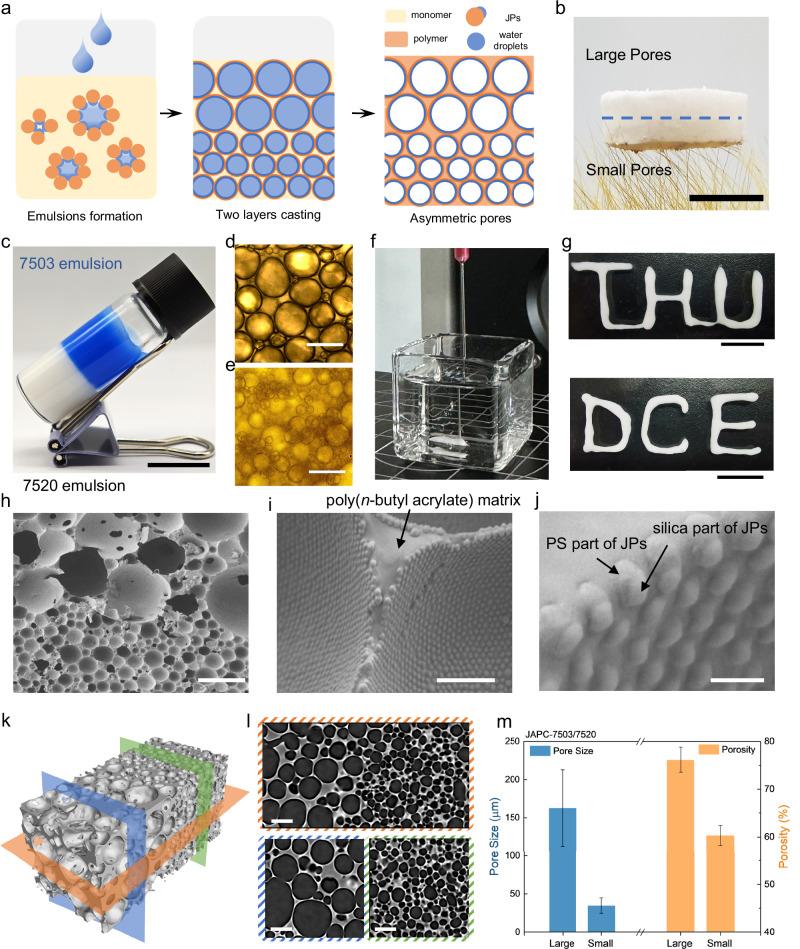
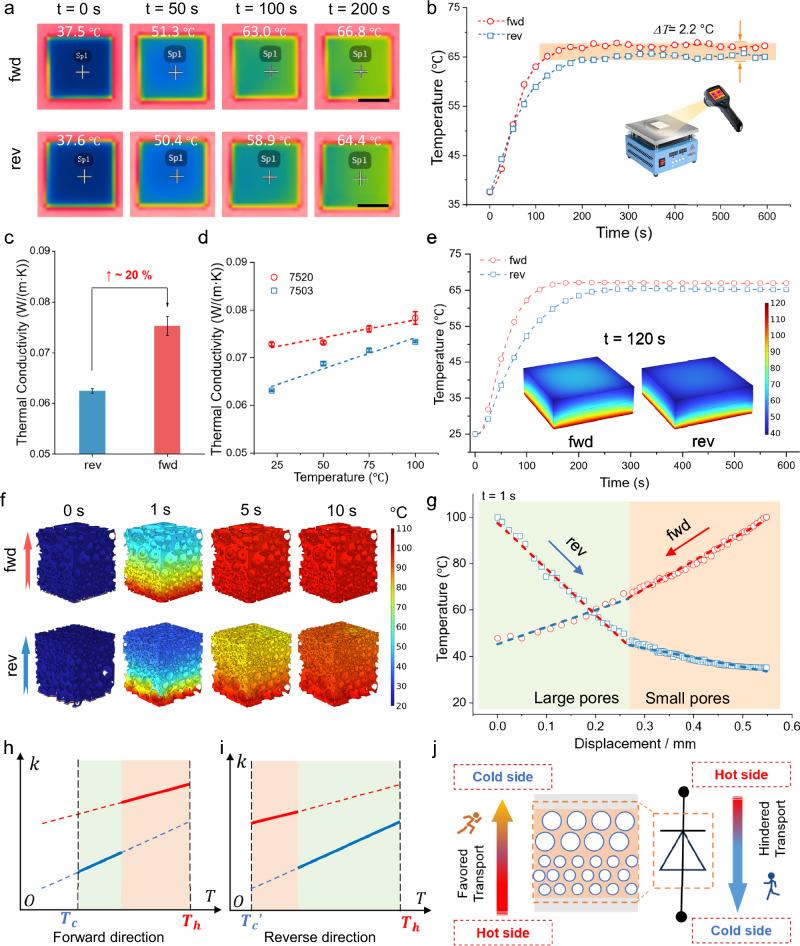
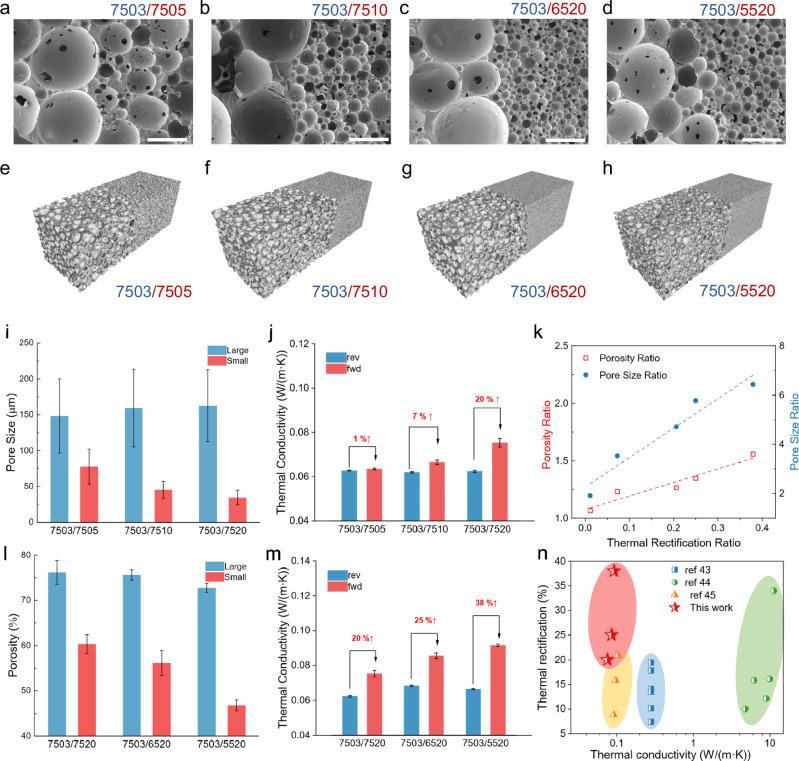
Thermal rectification is a noteworthy phenomenon of asymmetric material, which enables the directional transfer of thermal energy. But the design and construction of such asymmetric thermal conductive materials with complex structures are full of challenges. Here, an additive manufacturing method is proposed to fabricate asymmetric porous composites from layer-by-layer cast emulsions, stabilized with Janus particles (JPs), for thermal rectification. The emulsions are remarkably stable, allowing each layer to be manipulated independently without interference, resulting in a porous structure with significant asymmetry. The thermal rectification of JPs-stabilized asymmetric porous composites (JAPCs) is investigated through both experiments and simulations. It is found that their thermal rectification ratios can be adjusted by altering the contrast between the two layers of the asymmetric porous composites, with a maximum value of 38%. This emulsion casting additive manufacturing method is suitable for large-scale production. A simple model demonstrates the potential of JAPCs to regulate thermal energy in ambient conditions with fluctuating temperatures. It is explored to achieve multilayer alternating porous composites, which cannot be achieved with gradient asymmetric approaches. This method provides a practical way to design and fabricate complicated porous structures with potential applications in additive manufacturing.
热整流是不对称材料的一个值得关注的现象,它能够实现热能的定向传递。但是,设计和构建具有复杂结构的此类不对称热传导材料充满挑战。在此,提出了一种增材制造方法,用于由用Janus颗粒(JPs)稳定的逐层浇铸乳液制造用于热整流的不对称多孔复合材料。这些乳液非常稳定,使得每一层都能独立操作而不受干扰,从而形成具有显著不对称性的多孔结构。通过实验和模拟研究了JPs稳定的不对称多孔复合材料(JAPCs)的热整流性能。研究发现,它们的热整流比可以通过改变不对称多孔复合材料两层之间的对比度来调节,最大值为38%。这种乳液浇铸增材制造方法适用于大规模生产。一个简单的模型展示了JAPCs在温度波动的环境条件下调节热能的潜力。探索实现多层交替多孔复合材料,这是梯度不对称方法无法实现的。该方法为设计和制造具有潜在增材制造应用的复杂多孔结构提供了一条实用途径。


 Zotero 插件