Karhulahti-Nordström Henrika, Väisänen Visa, Petra Saukkonen, Hanna Alastalo, Sinervo Timo
Finnish Institute for Health and Welfare, Welfare State Research and Reform Unit, Health and Social Service System Research Team, Mannerheimintie 166, Helsinki, 00330, Finland.
Department of Health and Social Management, Faculty of Social Sciences and Business Studies, University of Eastern Finland, Yliopistonranta 8 E, Kuopio, 70210, Finland.
BMC Nurs. 2025 Jul 1;24(1):702. doi: 10.1186/s12912-025-03418-w.
In Finnish services for older people, teams (a permanent group with a common task, divided for example by geographical or spatial criteria) have been implemented with the goal of improving the quality of care, individualized care and continuity of care as well as the wellbeing of nurses. Our aim was to describe nurse managers' experiences of using teams in home care and assisted living with 24/7 services.
The qualitative data used in the study was collected in May 2023 as part of a national survey on care organization for all units (n = 2996) offering care services for older people in Finland. Nurse managers working in home care and nurse managers working in assisted living with 24/7 services were asked to describe the benefits and challenges they have faced with the use of teams.
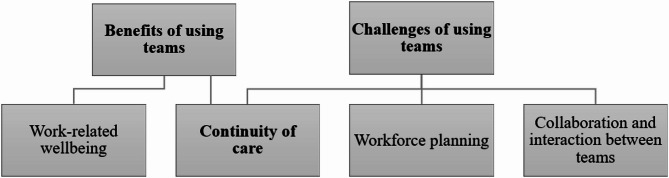
Nurse managers highlighted that using teams enabled better planning and evaluation of client care, nurses' better wellbeing and ability to cope with work demands, and higher quality of care. Perceived challenges were incorporating temporary workforce into teams, the frequent poor collaboration between different teams, and perceived hindrance of professional development.
Teamwork might be beneficial for promoting wellbeing at work and for reducing the psychosocial burden experienced by nurses as well as increasing both the quality and continuity of care. Maintaining and developing the professional skills of nurses needs to be ensured, and adequate collaboration between the teams is required, especially with the rapid increase in the use of temporary workforce.
在芬兰为老年人提供的服务中,已经实施了团队模式(一个有共同任务的常设小组,例如按地理或空间标准划分),目的是提高护理质量、个性化护理和护理连续性以及护士的幸福感。我们的目的是描述护士长在24/7服务的家庭护理和辅助生活中使用团队的经验。
本研究中使用的定性数据于2023年5月收集,作为对芬兰所有为老年人提供护理服务的单位(n = 2996)进行的护理组织全国调查的一部分。要求在家庭护理中工作的护士长和在提供24/7服务的辅助生活中工作的护士长描述他们在使用团队时所面临的益处和挑战。
护士长强调,使用团队能够更好地规划和评估客户护理,提高护士的幸福感和应对工作需求的能力,以及提高护理质量。察觉到的挑战包括将临时工作人员纳入团队、不同团队之间频繁的不良协作以及对职业发展的阻碍。
团队合作可能有利于促进工作中的幸福感,减轻护士所经历的心理社会负担,并提高护理质量和连续性。需要确保维持和发展护士的专业技能,并且团队之间需要进行充分协作,尤其是在临时工作人员使用迅速增加的情况下。