An Songyan, Mi Siyuan, Chen Siqian, Tang Yongjie, Xing Yue, Jing Yi, Yu Ying
National Engineering Laboratory for Animal Breeding, State Key Laboratory of Animal Biotech Breeding, Breeding and Reproduction of Ministry of Agriculture and Rural Affairs, College of Animal Science and Technology, China Agricultural University, Beijing, 100193, China.
BGI Research, Sanya, 572025, China.
BMC Genomics. 2025 Jul 1;26(1):611. doi: 10.1186/s12864-025-11740-5.
Bovine mastitis poses significant hazards to the yield and quality of dairy products, severely hindering the development of the dairy industry. Staphylococcus aureus (S. aureus) and Escherichia coli (E. coli) are well-established as two of the primary pathogens causing the disease. Transposable elements (TEs), occupying a notable proportion of livestock genomes, primarily function as regulatory elements modulating gene expression. Extensive studies have indicated that TEs contribute to transcriptional changes in the host during pathogen invasion. However, despite their potential significance, the key functional TEs associated with bovine mastitis remain unclear, highlighting the need to explore the critical roles of TEs in the immune processes of this disease.
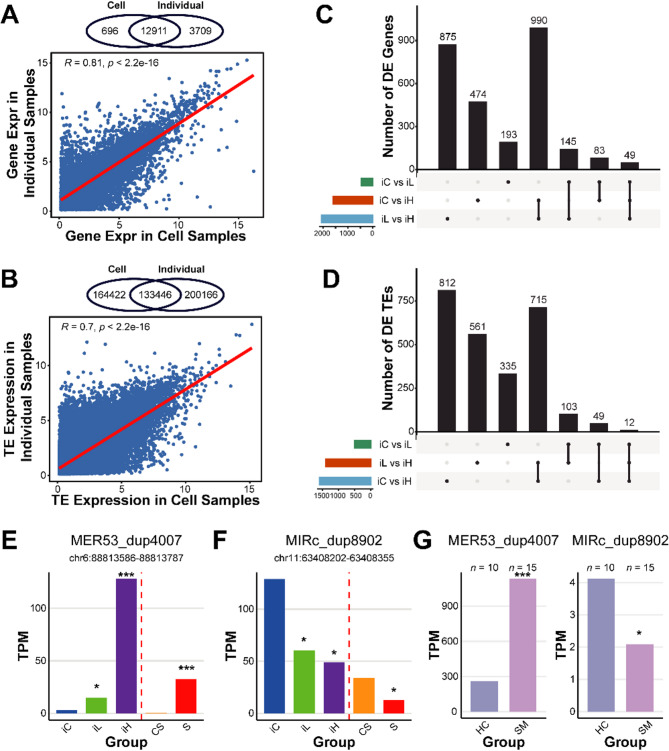
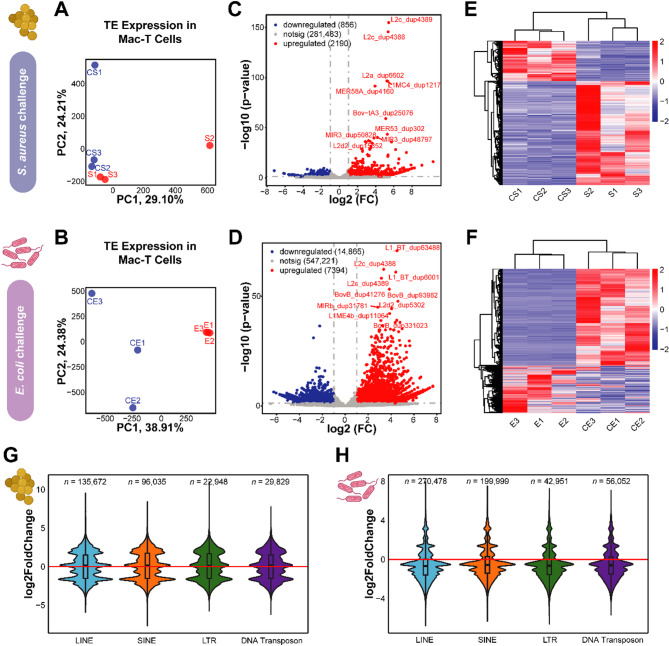
In this study, in vitro and in vivo mastitis models were established using bovine mammary alveolar cells (Mac-T cells) and Chinese Holstein cows, respectively. In vitro findings showed distinct expression profiles of genes and TEs in response to challenges posed by S. aureus and E. coli. Specifically, 1,750 differentially expressed genes (DE Genes) and 3,046 differentially expressed TEs (DE TEs) were identified in the S. aureus challenge, while 2,353 DE Genes and 22,259 DE TEs were identified in the E. coli challenge. TEs were found to regulate the expression of genes primarily within immune-related pathways, including IL-17 and HIF-1 signaling pathways. TE-gene-QTL regulatory networks were established, providing preliminary insights into the molecular genetic mechanisms of TE regulation. By integrating in vitro and in vivo data, we identified and further validated two TE instances from MER53/DNA transposon and MIRc/SINE families as stably activated and repressed transcriptional markers for S. aureus mastitis, respectively.
Our research underscores the potential regulatory roles of TEs in the pathogenesis of bovine mastitis and highlights their applicability as molecular markers for early diagnosis and prevention of this economically significant disease. Our study offers novel insights for the breeding and improvement of resistance to pathogen-induced mastitis in dairy cattle.
奶牛乳腺炎对乳制品的产量和质量构成重大危害,严重阻碍了乳业的发展。金黄色葡萄球菌(S. aureus)和大肠杆菌(E. coli)是已确定的引起该疾病的两种主要病原体。转座元件(TEs)在牲畜基因组中占显著比例,主要作为调节基因表达的调控元件发挥作用。广泛的研究表明,TEs在病原体入侵期间有助于宿主的转录变化。然而,尽管它们具有潜在的重要性,但与奶牛乳腺炎相关的关键功能性TEs仍不清楚,这凸显了探索TEs在该疾病免疫过程中的关键作用的必要性。
在本研究中,分别使用牛乳腺肺泡细胞(Mac-T细胞)和中国荷斯坦奶牛建立了体外和体内乳腺炎模型。体外研究结果显示,在应对金黄色葡萄球菌和大肠杆菌的挑战时,基因和TEs呈现出不同的表达谱。具体而言,在金黄色葡萄球菌攻击中鉴定出1750个差异表达基因(DE基因)和3046个差异表达TEs(DE TEs),而在大肠杆菌攻击中鉴定出2353个DE基因和22259个DE TEs。发现TEs主要在免疫相关途径(包括IL-17和HIF-1信号通路)内调节基因表达。建立了TE-基因-QTL调控网络,为TE调控的分子遗传机制提供了初步见解。通过整合体外和体内数据,我们分别鉴定并进一步验证了来自MER53/DNA转座子和MIRc/SINE家族的两个TE实例,它们分别作为金黄色葡萄球菌乳腺炎的稳定激活和抑制转录标记。
我们的研究强调了TEs在奶牛乳腺炎发病机制中的潜在调控作用,并突出了它们作为这种经济上重要疾病的早期诊断和预防分子标记的适用性。我们的研究为奶牛抗病原体诱导乳腺炎的育种和抗性改善提供了新的见解。