He Yao, Deng Zhike, He Shijiang, Qi Zhaojie, Chang Hengshuo, Liu Peng, Chen Zhong, Zou Chaoying, Shen Yaou, Ma Langlang
State Key Laboratory of Crop Gene Exploration and Utilization in Southwest China, Maize Research Institute, Sichuan Agricultural University, Chengdu, 611130, China.
College of Life Science & Biotechnology, Mianyang Normal University, Mianyang, 621000, China.
BMC Genomics. 2025 Jul 1;26(1):620. doi: 10.1186/s12864-025-11816-2.
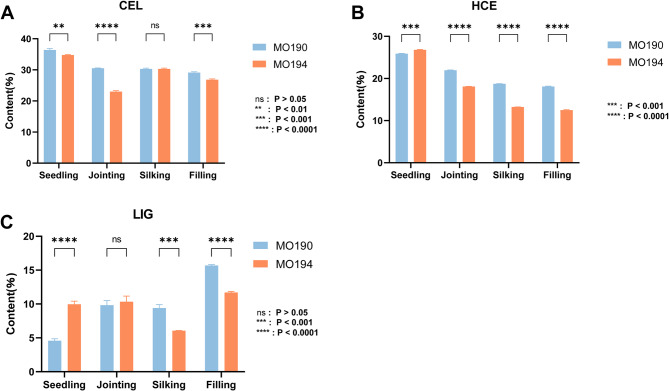
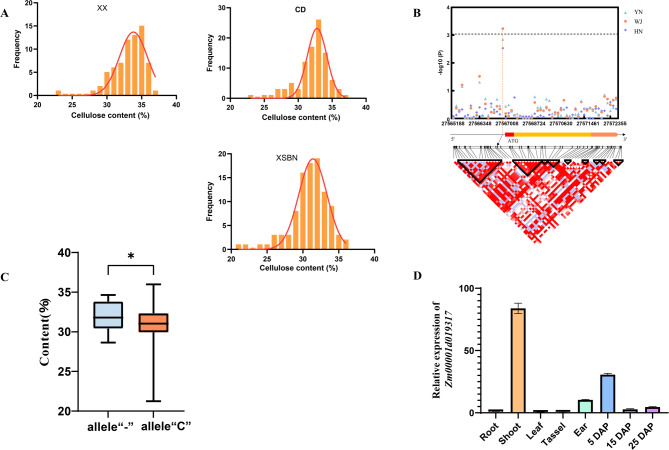
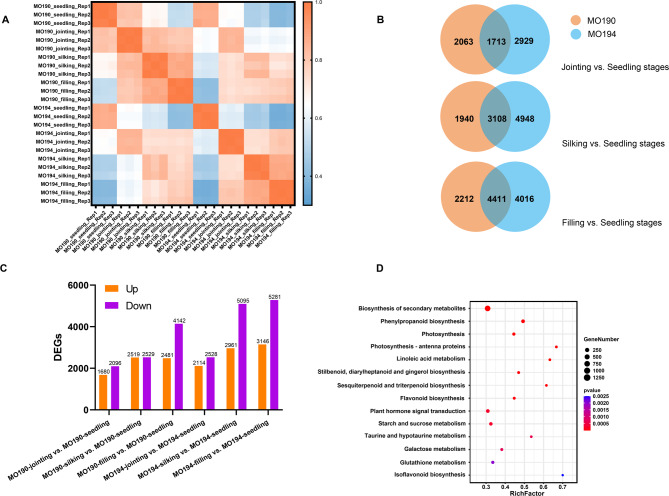
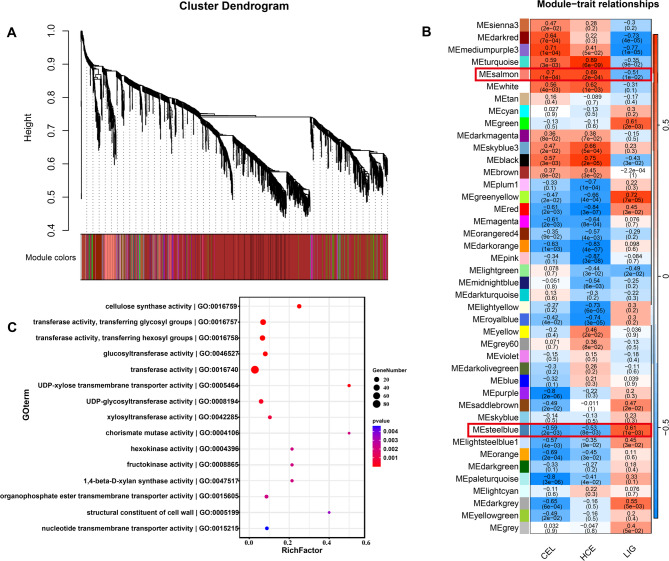
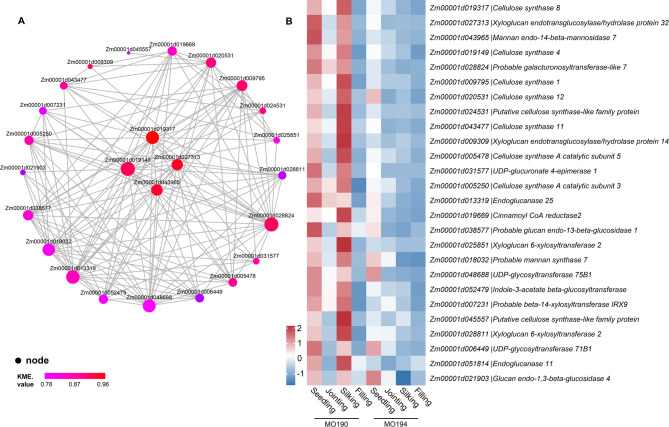
Cellulose (CEL), hemicellulose (HCE), and lignin (LIG) are crucial constituents of the cell wall in maize stalks, significantly influencing stalk resistance to lodging and external stresses. The proportion of these contents also determines the application of maize stalks in animal feed, energy production, and other fields. Herein, two maize inbred lines with contrasting cell wall component contents in the stalk, MO190 (high CEL, HCE, and LIG contents) and MO194 (low CEL, HCE, and LIG contents), were subjected to analysis of transcriptomes at the seedling, jointing, silking, and grain stages. By comparing the differentially expressed genes (DEGs) during stalk development between the two lines, 11,546 genes were identified as the specific DEGs in each line. Using traits-associated WGCNA (weight gene co-expression network analysis), we identified a hub co-expression module and 26 key genes regulating the CEL, HCE, and LIG contents in the stalk. Based on the eigengene-based connectivity value in the module, the four genes , , , and were confirmed as the hub genes affecting these contents. Among these, that encodes CEL synthase-8 was significantly associated with CEL content in the stalk via gene-based association studies. Maize lines carrying the “deletion” allele in the promoter region of exhibited significantly higher CEL content compared to those with the “C” allele. Our study helps to understand the variation mechanism of cell wall component contents in maize stalks and contributes to genetic modification of maize resistance to stalk lodging.
The online version contains supplementary material available at 10.1186/s12864-025-11816-2.
纤维素(CEL)、半纤维素(HCE)和木质素(LIG)是玉米秸秆细胞壁的关键成分,对秸秆抗倒伏能力和外部胁迫有显著影响。这些成分的比例也决定了玉米秸秆在动物饲料、能源生产和其他领域的应用。在此,对两个茎秆细胞壁成分含量不同的玉米自交系MO190(CEL、HCE和LIG含量高)和MO194(CEL、HCE和LIG含量低)在幼苗期、拔节期、抽丝期和灌浆期进行了转录组分析。通过比较两个品系茎秆发育过程中的差异表达基因(DEG),共鉴定出11546个每个品系特有的DEG。利用与性状相关的WGCNA(加权基因共表达网络分析),我们鉴定出一个枢纽共表达模块和26个调控茎秆中CEL、HCE和LIG含量的关键基因。根据模块中基于特征基因的连通性值,确定了四个基因 、 、 和 为影响这些含量的枢纽基因。其中,编码纤维素合酶-8的 通过基于基因的关联研究与茎秆中的CEL含量显著相关。在 启动子区域携带“缺失”等位基因的玉米品系与携带“C”等位基因的品系相比,CEL含量显著更高。我们的研究有助于了解玉米秸秆细胞壁成分含量的变异机制,并有助于玉米抗茎倒伏的基因改良。
在线版本包含可在10.1186/s12864-025-11816-2获取的补充材料。