Roveri Giulia, Gamberini Lorenzo, Borotto Erika, Eisendle Frederik, Festi Luigi, Brugger Hermann, Strapazzon Giacomo, Rauch Simon
Eurac Research, Institute of Mountain Emergency Medicine, Via Ipazia 2, 39100, Bolzano, Italy.
Department of Anesthesia and Intensive Care Medicine, "F. Tappeiner" Hospital Merano, Merano, Italy.
Scand J Trauma Resusc Emerg Med. 2025 Jul 1;33(1):113. doi: 10.1186/s13049-025-01373-8.
Advanced medical procedures in prehospital settings are often performed in hostile environments, where cold temperatures may impair manual and cognitive performance. Although such procedures are essential in mountain rescue missions, the effects of cold conditions on their execution and associated workload and stress are unknown.
This randomized controlled simulation study evaluated differences in performance, perceived workload, and stress during the execution of three advanced emergency medical procedures under cold (- 20 °C) versus control (+ 20 °C) ambient temperatures. Additionally, the study examined the influence of operator experience on these outcomes.
Thirty-six members of the International Medical Commission for Alpine Rescue participated in a crossover study conducted at the terraXcube environmental simulator in Bolzano, Italy. Participants performed orotracheal intubation via videolaryngoscopy (OTI-VLS), mini-thoracostomy, and front-of-neck airway (FONA) procedures under both temperature conditions. Time to procedure completion, number of attempts, and perceived workload and stress (using the NASA Task Load Index and Visual Analogue Scale) were measured. Operators were categorized into high or low experience groups based on self-reported prior procedure frequency.
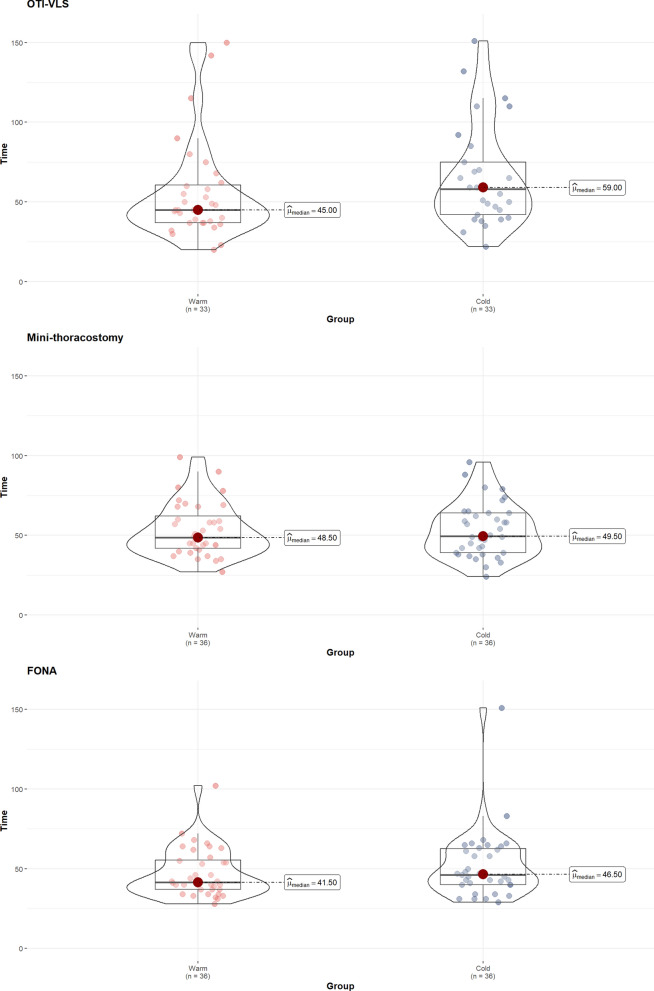
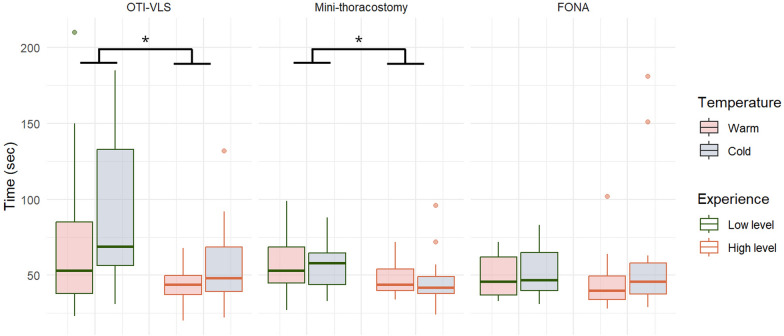
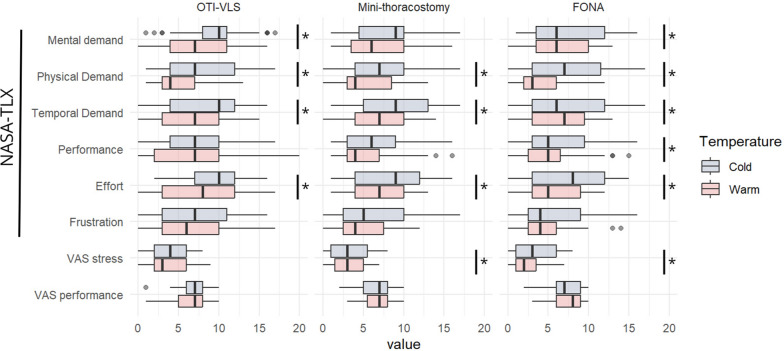
Time to complete the procedures tended to be longer in cold conditions for all procedures, with the largest difference observed for OTI-VLS (14 s, p = 0.076). Success rates exceeded 90% on the first attempt under both conditions. Perceived workload and stress increased significantly in cold environments across all procedures, especially for less experienced participants. Experienced operators completed OTI-VLS and mini-thoracostomy significantly faster and reported lower stress and workload levels compared to their less experienced counterparts.
While cold environments had low impact on procedural time, they significantly increased perceived workload and stress among rescue personnel. Experience mitigated these effects, emphasizing the importance of tailored training programs to enhance both technical and non-technical skills in challenging conditions. While this study has explored the impact of temperature, it would be valuable to investigate how other environmental factors, such as wind and rain, might affect clinical actions.
院前环境中的高级医疗程序通常在恶劣环境中进行,低温可能会损害手动操作和认知能力。尽管这些程序在山地救援任务中至关重要,但寒冷条件对其执行以及相关工作量和压力的影响尚不清楚。
这项随机对照模拟研究评估了在寒冷(-20°C)与对照(+20°C)环境温度下执行三种高级紧急医疗程序时,在操作表现、感知工作量和压力方面的差异。此外,该研究还考察了操作者经验对这些结果的影响。
国际高山救援医学委员会的36名成员参与了在意大利博尔扎诺的terraXcube环境模拟器中进行的交叉研究。参与者在两种温度条件下分别进行了经视频喉镜气管插管(OTI-VLS)、迷你开胸手术和颈部前气道(FONA)操作。测量了完成操作的时间、尝试次数以及感知工作量和压力(使用美国国家航空航天局任务负荷指数和视觉模拟量表)。根据自我报告的既往操作频率,将操作者分为高经验组或低经验组。
在寒冷条件下,所有程序完成时间往往更长,其中OTI-VLS差异最大(14秒,p = 0.076)。两种条件下首次尝试的成功率均超过90%。在寒冷环境中,所有程序的感知工作量和压力均显著增加,尤其是经验较少的参与者。与经验较少的操作者相比,经验丰富的操作者完成OTI-VLS和迷你开胸手术的速度明显更快,报告的压力和工作量水平更低。
虽然寒冷环境对操作时间影响较小,但显著增加了救援人员的感知工作量和压力。经验减轻了这些影响,强调了定制培训计划以在具有挑战性的条件下提高技术和非技术技能的重要性。虽然本研究探讨了温度的影响,但研究其他环境因素(如风和雨)如何影响临床操作将是有价值的。