Alemu Solomon Seyife, Erqu Getu Amsalu, Woyessa Dereje Diriba, Wedajo Lema Fikadu
Department of Midwifery, College of Health Sciences, Madda Walabu University Shashemene Campus, Shashamane, Ethiopia (Alemu and Woyessa).
Department of Midwifery, Mattu University College of Health Sciences, Mattu, Ethiopia (Erqu).
AJOG Glob Rep. 2025 May 23;5(3):100520. doi: 10.1016/j.xagr.2025.100520. eCollection 2025 Aug.
One of the issues that contribute to the increase in home births among mothers is the fear of giving birth in an institution. Although delivery services are free in Ethiopia, about half of women chose not to use them because they were afraid of giving birth in a hospital. Home deliveries are the leading cause of morbidity and mortality among mothers and newborns in Ethiopia. One of the major reasons why mothers choose not to give birth in medical facilities is due to fear of an institutional delivery. Nevertheless, no research has been conducted on Ethiopians' fear of institutional delivery.
This study aimed to assess the prevalence of fear of institutional delivery and associated factors among postnatal mothers.
Between May 1, 2023, and June 1, 2023, 423 postpartum mothers in Ethiopia's Honkolo Wabe district participated in a cross-sectional survey. A straightforward random sampling procedure was used to choose study participants. Data were gathered using a standardized questionnaire that was pretested and given by an interviewer in person. To find factors linked to the fear of institutional delivery, bivariate and multivariate analyses were performed. A value of <.05 with a 95% confidence interval was designated as the level of statistical significance.
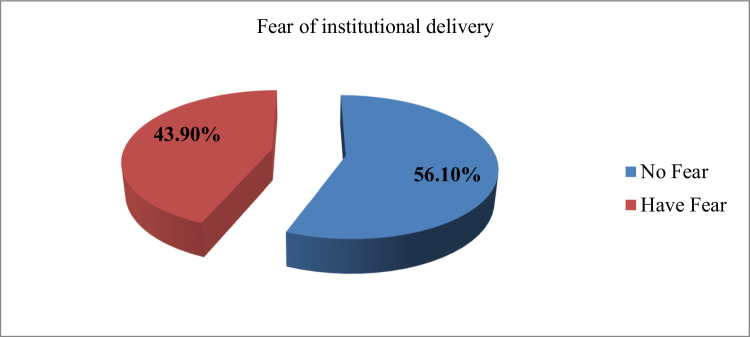
The overall prevalence of fear of institutional delivery was 43.9% (95% confidence interval, 39.9%-48.2%). Obstetrical violence (adjusted odds ratio, 2.42 [95% confidence interval, 1.20-4.19]), number of children (adjusted odds ratio, 0.39 [95% confidence interval, 0.19-0.82]), poor knowledge on the importance of intuitional delivery (adjusted odds ratio, 2.20 [95% confidence interval, 1.39-3.49]), and a negative attitude toward skilled healthcare services (adjusted odds ratio, 2.13 [95% confidence interval, 1.15-3.94]) were significantly associated factors for fear of childbirth at health facilities.
Our study found that the prevalence of fear of institutional delivery is high. Therefore, healthcare providers, health extension workers, and other concerned bodies should work on increasing mothers' knowledge the importance of institutional delivery and their awareness of skilled birth. Similarly, respectful maternity care should be performed in accordance with attracting mothers to health institutions.
导致母亲在家分娩增加的问题之一是对在医疗机构分娩的恐惧。尽管在埃塞俄比亚分娩服务是免费的,但约有一半的女性选择不使用这些服务,因为她们害怕在医院分娩。在家分娩是埃塞俄比亚母亲和新生儿发病和死亡的主要原因。母亲选择不在医疗设施分娩的主要原因之一是害怕在机构分娩。然而,尚未对埃塞俄比亚人对机构分娩的恐惧进行研究。
本研究旨在评估产后母亲对机构分娩的恐惧患病率及相关因素。
在2023年5月1日至2023年6月1日期间,埃塞俄比亚洪科洛瓦贝地区的423名产后母亲参与了一项横断面调查。采用简单随机抽样程序选择研究参与者。数据通过一份经过预测试的标准化问卷收集,由访谈员亲自发放。为了找出与机构分娩恐惧相关的因素,进行了双变量和多变量分析。以P值<0.05且95%置信区间被指定为统计学显著性水平。
对机构分娩的恐惧总体患病率为43.9%(95%置信区间,39.9%-48.2%)。产科暴力(调整后的优势比,2.42[95%置信区间,1.20-4.19])、子女数量(调整后的优势比,0.39[95%置信区间,0.19-0.82])、对机构分娩重要性的了解不足(调整后的优势比,2.20[95%置信区间,1.39-3.49])以及对熟练医疗服务的消极态度(调整后的优势比,2.13[95%置信区间,1.15-3.94])是与在医疗机构分娩恐惧显著相关的因素。
我们的研究发现对机构分娩的恐惧患病率很高。因此,医疗服务提供者、健康推广工作者和其他相关机构应致力于提高母亲对机构分娩重要性的认识以及她们对熟练助产的认识。同样,应提供尊重产妇的护理,以吸引母亲前往医疗机构。