Fonseca Iasmim Maria Pereira Pinto, de Alegria Samantha Gomes, Oliveira Jéssica Gabriela Messias, Rodrigues Thaís Souza, Chagas Carolina Alves Osório da Silva, Carneiro Alícia Sales, Costa Walter, Santos Ana Paula, Mafort Thiago Thomaz, Lopes Agnaldo José
Postgraduate Programme in Medical Sciences, School of Medical Sciences, Universidade do Estado do Rio de Janeiro (UERJ), Rio de Janeiro, Brazil.
Faculty of Physiotherapy, Centro Universitário Augusto Motta (UNISUAM), Rio de Janeiro, Brazil.
J Clin Tuberc Other Mycobact Dis. 2025 Jun 14;40:100542. doi: 10.1016/j.jctube.2025.100542. eCollection 2025 Aug.
As the world moves toward eliminating tuberculosis (TB), there is a large population of TB survivors who still face a significant burden of TB complications. However, basic pulmonary rehabilitation program (PRP) packages for this population are currently lacking. This study aimed to evaluate the effect of home-based PRP (HBPRP) on lung mechanics, exercise capacity, and quality of life (QoL) in people with PTLD (pwPTLD).
This is a quasi-experimental study in pwPTLD who underwent HBPRP for 3 months. Before and after HBPRP, the following assessments were performed: QoL using the St George's Respiratory Questionnaire (SGRQ), general fatigue using the Functional Assessment of Chronic Illness Therapy-Fatigue (FACIT-F), handgrip strength (HGS), pulmonary function, and functional exercise capacity using the Glittre-ADL test (TGlittre) coupled with measurement of dynamic ventilation.
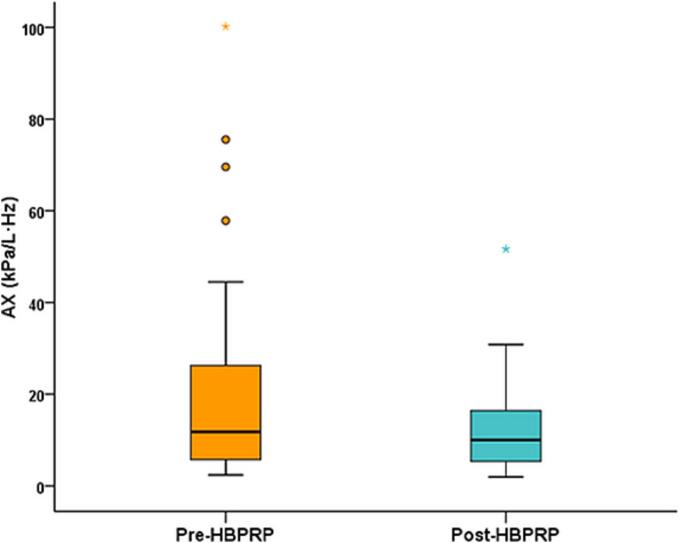
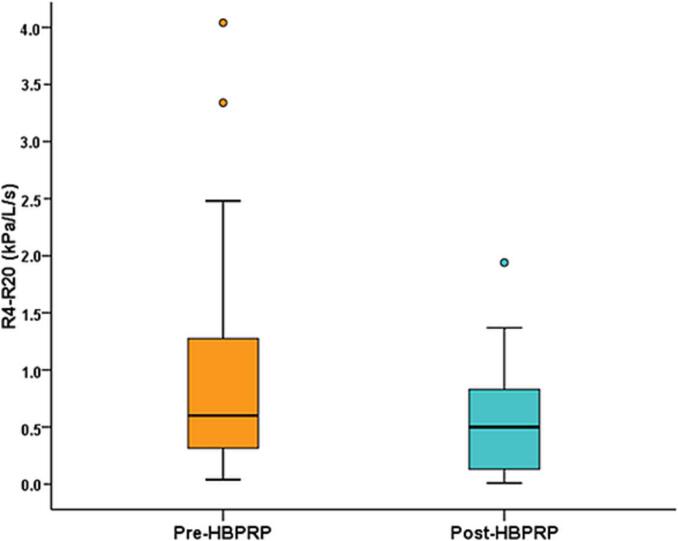
When comparing pre- and post-HBPRP values, there was a significant increase in TGlittre time [208 (194-249) vs. 184 (153-211) seconds, = 0.004] and breathing reserve [56 (34-71) vs. 58 (39-73) %, = 0.032], and a reduction in end-of-test inspiratory capacity [1.4 (0.9-2.3) vs. 1.6 (1.1-2.6) L, = 0.030]. Although no increase in spirometric parameters was observed, there was an improvement in small airway dysfunction (SAD) as measured by respiratory oscillometry. Improvements were observed in the Activity and Impacts domains of the SGRQ. However, no significant changes were noted in FACIT-F or HGS after HBPRP.
In pwPTLD, HBPRP improves exercise tolerance, QoL, and SAD, with no effect on general fatigue and HGS. Therefore, TB programs should ensure the availability of PRP for pwPTLD, including HBPRP.
随着世界朝着消除结核病(TB)迈进,仍有大量结核病幸存者面临着结核病并发症的沉重负担。然而,目前针对这一人群的基本肺康复计划(PRP)方案尚不完善。本研究旨在评估居家肺康复计划(HBPRP)对肺移植后淋巴组织增生性疾病患者(pwPTLD)的肺力学、运动能力和生活质量(QoL)的影响。
这是一项针对接受了3个月HBPRP的pwPTLD患者的准实验研究。在HBPRP前后,进行了以下评估:使用圣乔治呼吸问卷(SGRQ)评估生活质量,使用慢性病治疗功能评估-疲劳量表(FACIT-F)评估一般疲劳程度,测量握力(HGS),评估肺功能,以及使用Glittre-ADL测试(TGlittre)结合动态通气测量来评估功能运动能力。
比较HBPRP前后的值时,TGlittre时间显著增加[208(194 - 249)秒对184(153 - 211)秒,P = 0.004],呼吸储备增加[56(34 - 71)%对58(39 - 73)%,P = 0.032],测试结束时吸气量减少[1.4(0.9 - 2.3)升对1.6(1.1 - 2.6)升,P = 0.030]。虽然肺量计参数未观察到增加,但通过呼吸振荡法测量的小气道功能障碍(SAD)有所改善。在SGRQ的活动和影响领域观察到了改善。然而,HBPRP后FACIT-F或HGS没有显著变化。
在pwPTLD患者中,HBPRP可提高运动耐量、生活质量和SAD,对一般疲劳和HGS无影响。因此,结核病防治项目应确保为pwPTLD患者提供PRP,包括HBPRP。