
阿司匹林可降低与新冠病毒相关的2型糖尿病风险。
Aspirin reduces the risk of type 2 diabetes associated with COVID-19.
作者信息
Trimarco Valentina, Izzo Raffaele, Pacella Daniela, Manzi Maria Virginia, Jankauskas Stanislovas S, Gallo Paola, Rozza Francesco, Giugliano Giuseppe, Spinelli Alessandra, Esposito Giovanni, Piccinocchi Roberto, Piccinocchi Gaetano, Morisco Carmine, Lembo Maria, Santulli Gaetano, Trimarco Bruno
机构信息
Department of Neuroscience, Reproductive Sciences, and Dentistry, "Federico II" University, Naples, Italy.
Department of Advanced Biomedical Sciences, "Federico II" University, Naples, Italy.
出版信息
NPJ Metab Health Dis. 2025 Jun 18;3(1):27. doi: 10.1038/s44324-025-00072-3.
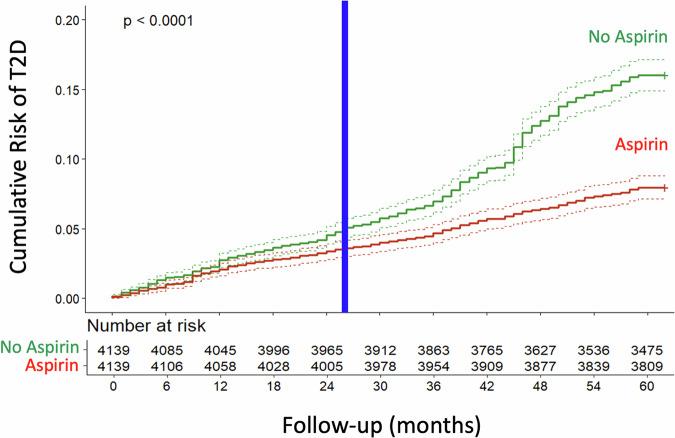
This study aimed to determine whether daily low-dose aspirin reduces the risk of type 2 diabetes (T2D) associated with COVID-19. A longitudinal cohort of 200,000 adults followed from 2018 to 2022 was analyzed, comparing T2D incidence between aspirin users and non-users. Propensity score matching was used to balance the groups. The incidence of T2D was substantially lower in the aspirin group, with Cox regression showing a 52% risk reduction. Kaplan-Meier analysis confirmed a significant divergence in cumulative T2D risk after two years. This protective effect was observed both before and during the COVID-19 pandemic, with a stronger association during the pandemic period. These findings indicate that daily low-dose aspirin significantly reduces the risk of COVID-19-associated new-onset T2D, highlighting the role of inflammation in the pathogenesis of T2D triggered or unmasked by COVID-19.
本研究旨在确定每日低剂量阿司匹林是否能降低与2019冠状病毒病(COVID-19)相关的2型糖尿病(T2D)风险。对2018年至2022年随访的20万名成年人的纵向队列进行了分析,比较了阿司匹林使用者和非使用者之间的T2D发病率。采用倾向评分匹配法平衡各组。阿司匹林组的T2D发病率显著较低,Cox回归显示风险降低了52%。Kaplan-Meier分析证实,两年后累积T2D风险存在显著差异。在COVID-19大流行之前和期间均观察到这种保护作用,在大流行期间关联更强。这些发现表明,每日低剂量阿司匹林可显著降低与COVID-19相关的新发T2D风险,突出了炎症在由COVID-19引发或暴露的T2D发病机制中的作用。

 Zotero 插件