Mihara Keichiro, Kawase Takakazu, Miyama Takahiko, Iwasaki Katsuhiko, Shoji Ayako, Matsumaru Masayuki
International Center for Cell and Gene Therapy Fujita Health University Toyoake Aichi Japan.
Medilead Inc. Shinjuku-ku Tokyo Japan.
EJHaem. 2025 Jul 2;6(4):e70091. doi: 10.1002/jha2.70091. eCollection 2025 Aug.
The understanding of usefulness of immunoglobulin replacement therapy (IgRT) for hypogammaglobulinemia (HGG) in patients with hematologic malignancies (HM) has changed over time. This is mainly caused by the introduction of new treatment, such as B-cell targeted agents. We investigated the real world effectiveness of IgRT on the severe bacterial infection (SBI) incidence in patients with HGG secondary to HMs using a Japanese claims database provided by MDV Inc.
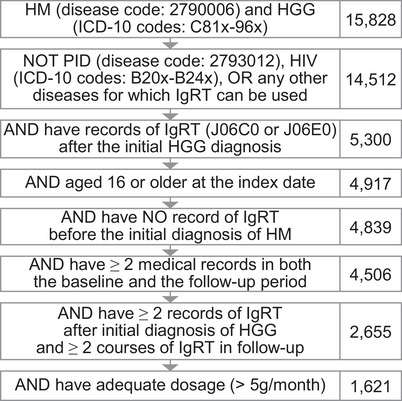
Patients who were diagnosed with both HM and HGG from May 2010 to March 2021 in this database and prescribed IgRT with the dosage of > 5 g/month were eligible. We compared the SBI incidence, which was defined as a prescription of intravenous antibacterial agents during hospitalization, between during 12-month before IgRT initiation (baseline period) and 12-month after IgRT initiation (follow-up period).
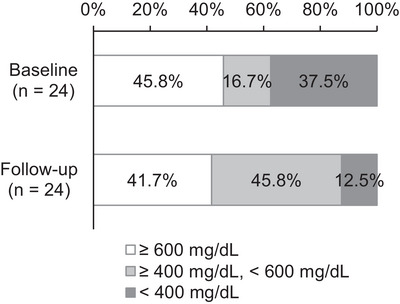
In total 1621 eligible patients, 37.9% and 17.7% of patients were for non-Hodgkin's lymphoma (NHL) and multiple myeloma (MM), respectively. A total of 24.4% of patients were hematopoietic stem cell transplantation (HSCT) recipients. In the follow-up period, SBI incidence significantly decreased than that in the baseline period (2.3 events per person-year vs. 0.9; < 0.001). Similar results were observed in various subgroups such as patients who were diagnosed with NHL or MM, treated with anti-CD20 monoclonal antibody or anti-CD38 monoclonal antibody, or HSCT recipients. In the small number of patients whose baseline serum IgG levels were available ( = 28), decrease of the SBI incidence in the follow-up period was observed regardless of IgG levels. A reduction of the SBI incidence was seen in patients with < 400 mg/dL (2.6 vs. 0.6).
IgRT may decrease the SBI incidence in patients with HGG secondary to HM.
Registered at UMIN Clinical Trials Registry, UMIN000047418.
随着时间的推移,人们对免疫球蛋白替代疗法(IgRT)用于血液系统恶性肿瘤(HM)患者低丙种球蛋白血症(HGG)的有效性的认识发生了变化。这主要是由于新治疗方法的引入,如B细胞靶向药物。我们使用MDV公司提供的日本索赔数据库,研究了IgRT对HM继发HGG患者严重细菌感染(SBI)发生率的实际效果。
在该数据库中,2010年5月至2021年3月期间被诊断为HM和HGG且IgRT处方剂量>5g/月的患者符合条件。我们比较了IgRT开始前12个月(基线期)和IgRT开始后12个月(随访期)期间的SBI发生率,SBI发生率定义为住院期间静脉使用抗菌药物的处方。
总共1621名符合条件的患者中,分别有37.9%和17.7%的患者患有非霍奇金淋巴瘤(NHL)和多发性骨髓瘤(MM)。共有24.4%的患者是造血干细胞移植(HSCT)受者。在随访期,SBI发生率显著低于基线期(每人年2.3次事件对0.9次;<0.001)。在各种亚组中也观察到了类似结果,如诊断为NHL或MM的患者、接受抗CD20单克隆抗体或抗CD38单克隆抗体治疗的患者或HSCT受者。在少数有基线血清IgG水平数据的患者(n = 28)中,无论IgG水平如何,随访期SBI发生率均下降。血清IgG水平<400mg/dL的患者SBI发生率降低(2.6对0.6)。
IgRT可能会降低HM继发HGG患者的SBI发生率。
在UMIN临床试验注册中心注册,UMIN000047418。