Lima Sara Souza, Máximo Roberta de Oliveira, Luiz Mariane Marques, Tofani Patrícia Silva, Silveira Letícia Coelho, Souza Thales Batista de, Silva Thaís Barros Pereira da, Guandalini Valdete Regina, Lima-Costa Maria Fernanda, Oliveira Cesar Messias de, Alexandre Tiago da Silva
Programa de Pós-graduação em Gerontologia, Universidade Federal de São Carlos, São Carlos, Brasil.
Programa de Pós-graduação em Fisioterapia, Universidade Federal de São Carlos, São Carlos, Brasil.
Cad Saude Publica. 2025 Jun 27;41(5):e00155624. doi: 10.1590/0102-311XEN155624. eCollection 2025.
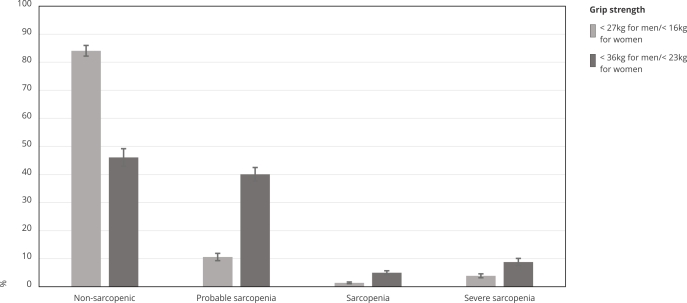
This study aimed to compare the prevalence of sarcopenia and associated factors with the definition of muscle weakness established using two different cut-off points for grip strength. We carried out a cross-sectional study with 7,065 participants (aged 50 or older) from the ELSI-Brazil Study. Sarcopenia was defined by the European Working Group on Sarcopenia in Older People (EWGSOP2) and two different cut-off points for grip strength to define weakness: < 27kg for men/< 16kg for women or < 36kg for men < 23kg for women. The prevalence of different sarcopenia status was estimated, and associations with sociodemographic, behavioral, and clinical factors were investigated using multinomial regression models. The mean age of participants was 61 years; 51.8% were women and 41.5% were at risk of malnutrition. By adopting the higher cut-off points (< 36kg/< 23kg) for the definition of weakness, the prevalence of probable sarcopenia and sarcopenia quadrupled (40.1% versus 10.6%; 5% versus 1.4%, respectively) and the prevalence of severe sarcopenia doubled (8.8 versus 3.9%). Nutritional status was associated with sarcopenia status, however the cut-off points < 36/< 23kg increased substantially the relative risk ratio between malnutrition and severe sarcopenia (RRR = 11.23 versus 6.45). In general, factors associated with sarcopenia status were similar irrespective of the cut-off point adopted. Higher cut-off points for the definition of weakness may be better for identifying sarcopenia, enabling early interventions to avoid adverse outcomes related to the disease.
本研究旨在比较肌肉减少症的患病率及相关因素,以及使用两种不同握力切点来确定肌肉无力的定义。我们对来自巴西ELSI研究的7065名参与者(年龄在50岁及以上)进行了一项横断面研究。肌肉减少症由欧洲老年人肌肉减少症工作组(EWGSOP2)定义,并采用两种不同的握力切点来定义无力:男性<27kg/女性<16kg,或男性<36kg/女性<23kg。估计了不同肌肉减少症状态的患病率,并使用多项回归模型研究了与社会人口学、行为和临床因素的关联。参与者的平均年龄为61岁;51.8%为女性,41.5%有营养不良风险。通过采用较高的切点(<36kg/<23kg)来定义无力,可能的肌肉减少症和肌肉减少症的患病率增加了两倍(分别为40.1%对10.6%;5%对1.4%),严重肌肉减少症的患病率增加了一倍(8.8对3.9)。营养状况与肌肉减少症状态相关,然而,<36/<23kg的切点大幅增加了营养不良与严重肌肉减少症之间的相对风险比(相对风险比=11.23对6.45)。总体而言,无论采用何种切点,与肌肉减少症状态相关的因素都是相似的。采用较高的切点来定义无力可能更有利于识别肌肉减少症,从而能够进行早期干预以避免与该疾病相关的不良后果。