• 文献检索
  • 文档翻译
  • 深度研究
  • 学术资讯
  • Suppr Zotero 插件Zotero 插件
  • 邀请有礼
  • 套餐&价格
  • 历史记录
应用&插件
Suppr Zotero 插件Zotero 插件浏览器插件Mac 客户端Windows 客户端微信小程序
定价
高级版会员购买积分包购买API积分包
服务
文献检索文档翻译深度研究API 文档MCP 服务
关于我们
关于 Suppr公司介绍联系我们用户协议隐私条款
关注我们

Suppr 超能文献

核心技术专利:CN118964589B侵权必究
粤ICP备2023148730 号-1Suppr @ 2026

文献检索

告别复杂PubMed语法,用中文像聊天一样搜索,搜遍4000万医学文献。AI智能推荐,让科研检索更轻松。

立即免费搜索

文件翻译

保留排版,准确专业,支持PDF/Word/PPT等文件格式,支持 12+语言互译。

免费翻译文档

深度研究

AI帮你快速写综述,25分钟生成高质量综述,智能提取关键信息,辅助科研写作。

立即免费体验

由护士主导的应用程序进行生活方式干预对预防产后女性症状的影响:一项随机对照试验。

Effects of lifestyle intervention by a nurse-led app on the prevention of symptoms in postpartum women: a randomized controlled trial.

作者信息

Liang Yulian, Wang Shiying, Tao Jie, Yao Zheng, Yao Yongzi, Zhai Jinguo

机构信息

Department of Obstetrics and Gynecology, Dongguan Hospital of Traditional Chinese Medicine, No. 3, Dongcheng Section, Songshanhu Avenue, Dongcheng Street, Dongguan, Guangdong, 523000, China.

School of Nursing, Southern Medical University, No. 1023, South Shatai Road, Baiyun District, Guangzhou, Guangdong, 510515, China.

出版信息

BMC Nurs. 2025 Jul 3;24(1):829. doi: 10.1186/s12912-025-03379-0.

DOI:10.1186/s12912-025-03379-0
PMID:40611172
原文链接:https://pmc.ncbi.nlm.nih.gov/articles/PMC12224418/
Abstract

BACKGROUND

The incidence of postpartum symptoms such as prolonged lochia, constipation, fatigue, and depression remains high. Providing postpartum lifestyle interventions, including diet and exercise supervision, in clinical practice is challenging. A nurse-led app through diet supervision, exercise supervision and health education is a promising approach to lifestyle intervention.

METHODS

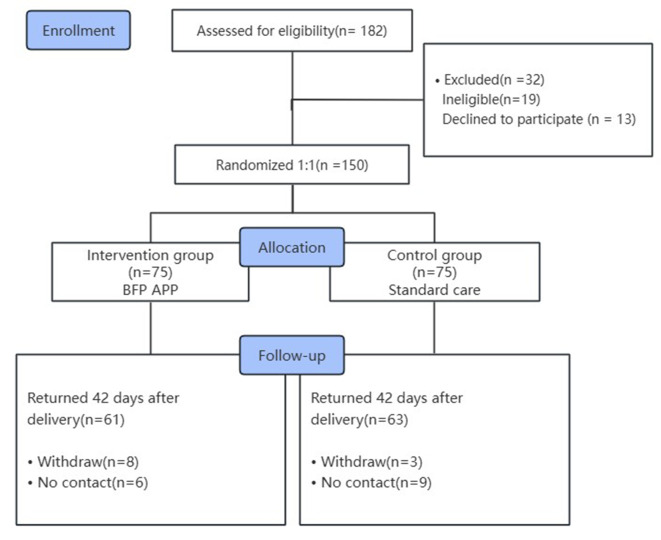
This randomized controlled trial evaluated the effects of lifestyle intervention through app on postpartum women from January to November 2024. Postpartum women with aged 18-45 years, experiencing a single pregnancy without complications or co-morbidities, able to understand and use basic technologies such as smartphones and mobile apps were recruited from a tertiary hospital in China. A total of 150 participants were randomly allocated (1:1) to either an intervention group (n = 75) or a control group (n = 75). Due to the nature of the app-based intervention, blinding of participants and research staff was not possible. Occurrence of postpartum constipation, prolonged lochia, pelvic floor muscle dysfunction, sleep, fatigue and depression were collected at 42 days postpartum through checking the electronic medical record system or by electronic questionnaires.

RESULTS

Participants in the experimental and control groups were comparable at baseline. Among the 150 total participants, 61 (81.3%) and 63 (84%) successfully completed this study at 42 days postpartum after randomization. Participants in the intervention group showed the low occurrence of postpartum constipation (OR = 0.180, 95% CI: 0.038-0.857, P = 0.030) and prolonged lochia (OR = 0.220, 95% CI: 0.059-0.823, P = 0.025). Compared to the control group, participants in the intervention group showed significant improvements in sleep (P < 0.001, CI: 2.395-7.640), fatigue (P = 0.038, CI: 0.091-3.258), and depression (P < 0.001, CI: 3.686-7.896). However, there was no significant difference in the incidence of pelvic floor dysfunction between the two groups (OR = 0.719, 95% CI: 0.308-1.681, P = 0.446).

CONCLUSION

Our study found that a nurse-led mHealth application lifestyle intervention is effective in preventing postpartum constipation and prolonged lochia, as well as improving postpartum depression, fatigue, and sleep quality. This suggests that combining nursing with digital health technologies in clinical work may improve accessibility and continuity of care. Clinicians can enhance the use of mHealth in their work by providing mHealth education to mothers to compensate for the lack of traditional care in the post-discharge phase. However, due to the limitations of this single-center study with a small sample size, future multicenter studies with long-term follow-up are needed to further explore the broader applicability and sustainability of this intervention.

TRIAL REGISTRATION

The protocol of the study was registered at ClinicalTrials.gov (ChiCTR2300077685) on November 16, 2023.

https://cdn.ncbi.nlm.nih.gov/pmc/blobs/4c38/12224418/bafe43b4dfde/12912_2025_3379_Fig2_HTML.jpg
https://cdn.ncbi.nlm.nih.gov/pmc/blobs/4c38/12224418/bcf1eda985aa/12912_2025_3379_Fig1_HTML.jpg
https://cdn.ncbi.nlm.nih.gov/pmc/blobs/4c38/12224418/bafe43b4dfde/12912_2025_3379_Fig2_HTML.jpg
https://cdn.ncbi.nlm.nih.gov/pmc/blobs/4c38/12224418/bcf1eda985aa/12912_2025_3379_Fig1_HTML.jpg
https://cdn.ncbi.nlm.nih.gov/pmc/blobs/4c38/12224418/bafe43b4dfde/12912_2025_3379_Fig2_HTML.jpg
摘要

背景

产后恶露不绝、便秘、疲劳和抑郁等产后症状的发生率仍然很高。在临床实践中提供产后生活方式干预,包括饮食和运动指导,具有挑战性。通过饮食指导、运动指导和健康教育的护士主导应用程序是一种很有前景的生活方式干预方法。

方法

本随机对照试验评估了2024年1月至11月通过应用程序进行生活方式干预对产后妇女的影响。从中国一家三级医院招募年龄在18-45岁、单胎妊娠无并发症或合并症、能够理解和使用智能手机及移动应用程序等基本技术的产后妇女。总共150名参与者被随机分配(1:1)到干预组(n = 75)或对照组(n = 75)。由于基于应用程序的干预性质,参与者和研究人员无法设盲。在产后42天通过检查电子病历系统或电子问卷收集产后便秘、恶露不绝、盆底肌肉功能障碍、睡眠、疲劳和抑郁的发生情况。

结果

实验组和对照组参与者在基线时具有可比性。在总共150名参与者中,随机分组后,61名(81.3%)和63名(84%)在产后42天成功完成本研究。干预组参与者产后便秘(OR = 0.180,95%CI:0.038-0.857,P = 0.030)和恶露不绝(OR = 0.220,95%CI:0.059-0.823,P = 0.025)的发生率较低。与对照组相比,干预组参与者在睡眠(P < 0.001,CI:2.395-7.640)、疲劳(P = 0.038,CI:0.091-3.258)和抑郁(P < 0.001,CI:3.686-7.896)方面有显著改善。然而,两组间盆底功能障碍的发生率没有显著差异(OR = 0.719,95%CI:0.308-1.681,P = 0.446)。

结论

我们的研究发现,护士主导的移动健康应用程序生活方式干预在预防产后便秘和恶露不绝以及改善产后抑郁、疲劳和睡眠质量方面是有效的。这表明在临床工作中将护理与数字健康技术相结合可能会提高医疗服务的可及性和连续性。临床医生可以通过向母亲提供移动健康教育来加强移动健康在工作中的应用,以弥补出院后阶段传统护理的不足。然而,由于本单中心研究样本量小的局限性,未来需要进行多中心长期随访研究,以进一步探索这种干预措施更广泛的适用性和可持续性。

试验注册

该研究方案于2023年11月16日在ClinicalTrials.gov(ChiCTR2300077685)注册。

相似文献

1
Effects of lifestyle intervention by a nurse-led app on the prevention of symptoms in postpartum women: a randomized controlled trial.由护士主导的应用程序进行生活方式干预对预防产后女性症状的影响:一项随机对照试验。
BMC Nurs. 2025 Jul 3;24(1):829. doi: 10.1186/s12912-025-03379-0.
2
Comparisons of approaches to pelvic floor muscle training for urinary incontinence in women.女性尿失禁盆底肌肉训练方法的比较。
Cochrane Database Syst Rev. 2024 Dec 20;12(12):CD009508. doi: 10.1002/14651858.CD009508.pub2.
3
Physical exercise training interventions for children and young adults during and after treatment for childhood cancer.针对儿童癌症治疗期间及治疗后的儿童和青少年的体育锻炼训练干预措施。
Cochrane Database Syst Rev. 2016 Mar 31;3(3):CD008796. doi: 10.1002/14651858.CD008796.pub3.
4
Computer and mobile technology interventions for self-management in chronic obstructive pulmonary disease.用于慢性阻塞性肺疾病自我管理的计算机和移动技术干预措施。
Cochrane Database Syst Rev. 2017 May 23;5(5):CD011425. doi: 10.1002/14651858.CD011425.pub2.
5
Drugs for preventing postoperative nausea and vomiting in adults after general anaesthesia: a network meta-analysis.成人全身麻醉后预防术后恶心呕吐的药物:网状Meta分析
Cochrane Database Syst Rev. 2020 Oct 19;10(10):CD012859. doi: 10.1002/14651858.CD012859.pub2.
6
Mobile phone messaging for facilitating self-management of long-term illnesses.利用手机短信促进慢性病自我管理。
Cochrane Database Syst Rev. 2012 Dec 12;12(12):CD007459. doi: 10.1002/14651858.CD007459.pub2.
7
Psychological therapies for post-traumatic stress disorder and comorbid substance use disorder.创伤后应激障碍及共病物质使用障碍的心理治疗
Cochrane Database Syst Rev. 2016 Apr 4;4(4):CD010204. doi: 10.1002/14651858.CD010204.pub2.
8
Psychosocial interventions for supporting women to stop smoking in pregnancy.支持孕期女性戒烟的心理社会干预措施。
Cochrane Database Syst Rev. 2017 Feb 14;2(2):CD001055. doi: 10.1002/14651858.CD001055.pub5.
9
Educational interventions for the management of cancer-related fatigue in adults.针对成人癌症相关疲劳管理的教育干预措施。
Cochrane Database Syst Rev. 2016 Nov 24;11(11):CD008144. doi: 10.1002/14651858.CD008144.pub2.
10
Aspirin (single dose) for perineal pain in the early postpartum period.产后早期使用阿司匹林(单次剂量)治疗会阴部疼痛。
Cochrane Database Syst Rev. 2017 Feb 9;2(2):CD012129. doi: 10.1002/14651858.CD012129.pub2.

本文引用的文献

1
Effectiveness of Smart Mama application on postpartum depression, anxiety, and maternal-infant bonding among women during the postnatal period: a randomized controlled trial.智能妈妈应用程序对产后女性产后抑郁、焦虑及母婴依恋的有效性:一项随机对照试验
BMC Nurs. 2025 Apr 23;24(1):452. doi: 10.1186/s12912-025-03072-2.
2
Dietary habit and lifestyle of postpartum women in South China: a mixed methods research.中国南方地区产后妇女的饮食行为和生活方式:一项混合方法研究。
BMJ Open. 2024 Oct 1;14(10):e082998. doi: 10.1136/bmjopen-2023-082998.
3
Exploring the impact of integrating telehealth in obstetric care: A scoping review.
探索将远程医疗融入产科护理的影响:范围综述。
Eur J Obstet Gynecol Reprod Biol. 2024 Nov;302:242-248. doi: 10.1016/j.ejogrb.2024.09.031. Epub 2024 Sep 23.
4
Effectiveness of video-assisted teaching on prevention of constipation among postpartum women admitted in postnatal ward at a tertiary care hospital: a randomised controlled trial.三级护理医院产后病房住院的产后妇女中视频辅助教学对预防便秘的有效性:一项随机对照试验。
BMJ Nutr Prev Health. 2024 Mar 14;7(1):128-132. doi: 10.1136/bmjnph-2022-000605. eCollection 2024.
5
Postnatal morbidity: prevalent, enduring, and neglected.产后发病率:普遍存在、持续存在且被忽视。
Lancet Glob Health. 2024 Jan;12(1):e1. doi: 10.1016/S2214-109X(23)00559-4.
6
A global analysis of the determinants of maternal health and transitions in maternal mortality.全球范围内对孕产妇健康决定因素及孕产妇死亡率变化的分析。
Lancet Glob Health. 2024 Feb;12(2):e306-e316. doi: 10.1016/S2214-109X(23)00468-0. Epub 2023 Dec 6.
7
Neglected medium-term and long-term consequences of labour and childbirth: a systematic analysis of the burden, recommended practices, and a way forward.被忽视的分娩和劳动的中长期后果:负担、推荐做法的系统分析及前进方向。
Lancet Glob Health. 2024 Feb;12(2):e317-e330. doi: 10.1016/S2214-109X(23)00454-0. Epub 2023 Dec 6.
8
Postpartum care: Discussions and counseling for the peripartum period.产后护理:围产期的讨论和咨询。
J Neonatal Perinatal Med. 2023;16(4):657-664. doi: 10.3233/NPM-230167.
9
Midwives' perspectives about using individualized care plans in the provision of immediate postpartum care in Uganda; an exploratory qualitative study.乌干达助产士对在产后即时护理中使用个性化护理计划的看法;一项探索性定性研究。
BMC Nurs. 2023 Sep 22;22(1):328. doi: 10.1186/s12912-023-01512-5.
10
Identification of postpartum symptom subgroups and associated long-term maternal depressive symptoms and well-being.识别产后症状亚组与相关的长期产妇抑郁症状和健康。
Res Nurs Health. 2023 Oct;46(5):485-501. doi: 10.1002/nur.22336. Epub 2023 Aug 24.