Woyciehowsky Mena, Larson Portia, Stephan Annika R, Dandridge Sharee L, Idonije Doreen, Berg Kylie A, Lanthier Alyx, Acuna Stephanie Araiza, Stites Saskia W, Gebhardt Waverly J, Holtzen Samuel E, Rakshit Ananya, Palmer Amy E
Department of Biochemistry, University of Colorado Boulder, Boulder, Colorado, USA; BioFrontiers Institute, University of Colorado Boulder, Boulder, Colorado, USA.
BioFrontiers Institute, University of Colorado Boulder, Boulder, Colorado, USA; Fairview High School, Boulder, Colorado, USA.
J Biol Chem. 2025 Jul 2;301(8):110442. doi: 10.1016/j.jbc.2025.110442.
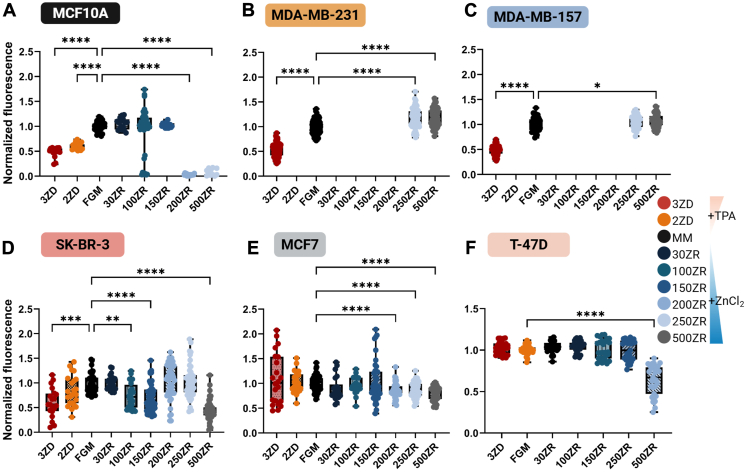
An optimal amount of zinc (Zn) is essential for proliferation of human cells; Zn levels that are too high or too low cause cell cycle exit. Tumors of the breast have been characterized by high levels of total Zn. Given the role of Zn in proliferation of human cells and elevation of zinc in breast cancer tumors, we examined the concentration of total and labile Zn across a panel of five breast cancer cell lines compared to the normal MCF10A cell line. We found that three cell lines (MDA-MB-231, MDA-MB-157, and SK-Br-3) showed elevated labile Zn in the cytosol, while T-47D showed significantly lower Zn, and MCF7 showed no change compared to MCF10A cells. There was no change in total Zn across the cell lines, as measured by ICP-MS, but we did observe a difference in the cells ability to accumulate Zn when Zn in the media was elevated. Therefore, we examined how proliferation of each cell line was affected by increases and decreases in the media. We found striking differences, where three cancer cell lines (MDA-MB-231, MDA-MB-157, and MCF7) showed robust proliferation in high Zn at concentrations that killed MCF10A, T-47D, and SK-Br-3 cells. We also discovered that four of the five cancer cell lines demonstrate compromised proliferation and increased cell death in low Zn, suggesting these cells may be addicted to Zn. Overall, our study suggests significant differences in Zn homeostasis and regulation in different types of breast cancer cells, with consequences for both proliferation and cell viability.
适量的锌(Zn)对于人类细胞的增殖至关重要;锌水平过高或过低都会导致细胞周期停滞。乳腺癌肿瘤的特征是总锌含量较高。鉴于锌在人类细胞增殖中的作用以及乳腺癌肿瘤中锌含量的升高,我们检测了五种乳腺癌细胞系与正常MCF10A细胞系相比的总锌和不稳定锌的浓度。我们发现,三种细胞系(MDA-MB-231、MDA-MB-157和SK-Br-3)的细胞质中不稳定锌含量升高,而T-47D的锌含量显著降低,与MCF10A细胞相比,MCF7没有变化。通过电感耦合等离子体质谱法(ICP-MS)测量,各细胞系的总锌含量没有变化,但当培养基中的锌含量升高时,我们确实观察到细胞积累锌的能力存在差异。因此,我们研究了培养基中锌含量的增加和减少如何影响每种细胞系的增殖。我们发现了显著差异,三种癌细胞系(MDA-MB-231、MDA-MB-157和MCF7)在高锌浓度下能强劲增殖,而这种浓度会杀死MCF10A、T-47D和SK-Br-3细胞。我们还发现,五种癌细胞系中有四种在低锌条件下增殖受损且细胞死亡增加,这表明这些细胞可能对锌成瘾。总体而言,我们的研究表明不同类型的乳腺癌细胞在锌稳态和调节方面存在显著差异,并对增殖和细胞活力产生影响。