Anderson Anna M, Redmond Anthony C, Joseph Judith, McHugh Gretl A
Leeds Institute of Rheumatic and Musculoskeletal Medicine, University of Leeds, Leeds, UK.
National Institute for Health and Care Research (NIHR) Leeds Biomedical Research Centre, Leeds, UK.
BMC Musculoskelet Disord. 2025 Jul 4;26(1):652. doi: 10.1186/s12891-025-08673-1.
Interest in using digital interventions to provide pre-operative total knee replacement (TKR) education and prehabilitation (health/wellbeing optimization) support is growing. Patient engagement with digital interventions tends to be poor; therefore, exploring the intended users' perspectives during digital intervention development is vital. This study was part of a project focused on developing a pre-operative TKR education and prehabilitation digital intervention, the 'Virtual Knee School' (VKS), and aimed to explore patients' perspectives of potential barriers/facilitators to engagement with the VKS to inform its development.
This United Kingdom-based, qualitative descriptive study involved 14 purposively selected patients who were awaiting/had undergone TKR. Three online focus groups were conducted to explore patients' perspectives of barriers and facilitators to engagement with the behaviors targeted by the VKS and digital features that could address the barriers/facilitators. The focus groups were audio-recorded, professionally transcribed, and analyzed inductively using reflexive thematic analysis. Three Patient and Public Involvement representatives were involved in aspects such as reviewing the recruitment materials and/or plain English summary of the study findings.
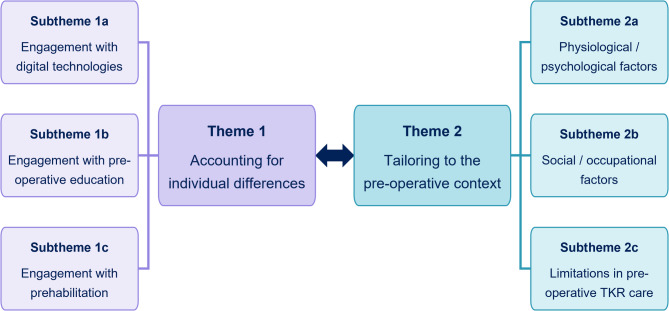
Two intersecting themes were developed. Theme 1, 'Accounting for individual differences', suggests pre-operative TKR digital interventions should account for the impact of individual differences on engagement with digital technologies, pre-operative education and prehabilitation. Most participants felt a pre-operative TKR digital intervention would be valuable; however, a couple of older participants appeared reluctant to use digital technologies. Participants' perspectives of specific digital features and pre-operative TKR education and prehabilitation also varied widely. Theme 2, 'Tailoring to the pre-operative context' highlights the importance of tailoring pre-operative TKR digital interventions to pre-operative contextual features, including physiological/psychological factors, social/occupational factors and limitations in pre-operative TKR care provision. Various digital features that could address these factors were identified.
This study's findings suggest pre-operative TKR digital interventions should account for individual differences and be tailored to the pre-operative TKR context. Given that some patients are reluctant to use digital technologies, also offering pre-operative TKR support in non-digital formats is essential. The findings have been used to inform a VKS prototype and could also be used to inform the development of other pre-operative TKR digital interventions.
利用数字干预措施提供术前全膝关节置换(TKR)教育和术前康复(健康/福祉优化)支持的兴趣日益浓厚。患者对数字干预措施的参与度往往较低;因此,在数字干预措施开发过程中探索目标用户的观点至关重要。本研究是一个专注于开发术前TKR教育和术前康复数字干预措施“虚拟膝关节学校”(VKS)项目的一部分,旨在探索患者对参与VKS的潜在障碍/促进因素的看法,以为其开发提供参考。
这项基于英国的定性描述性研究涉及14名经过有目的选择的正在等待/已经接受TKR的患者。进行了三个在线焦点小组讨论,以探讨患者对参与VKS所针对行为的障碍和促进因素以及可解决这些障碍/促进因素的数字功能的看法。焦点小组讨论进行了录音、专业转录,并使用反思性主题分析进行归纳分析。三名患者和公众参与代表参与了诸如审查招募材料和/或研究结果的简明英语摘要等方面的工作。
形成了两个相互交叉的主题。主题1“考虑个体差异”表明,术前TKR数字干预措施应考虑个体差异对数字技术参与度、术前教育和术前康复的影响。大多数参与者认为术前TKR数字干预措施会有价值;然而,一些年长的参与者似乎不愿意使用数字技术。参与者对特定数字功能以及术前TKR教育和术前康复的看法也存在很大差异。主题2“根据术前情况进行调整”强调了根据术前情况特征调整术前TKR数字干预措施的重要性,这些特征包括生理/心理因素、社会/职业因素以及术前TKR护理提供方面的限制。确定了各种可解决这些因素的数字功能。
本研究结果表明,术前TKR数字干预措施应考虑个体差异,并根据术前TKR情况进行调整。鉴于一些患者不愿意使用数字技术以非数字形式提供术前TKR支持也至关重要。这些发现已被用于为VKS原型提供参考,也可用于为其他术前TKR数字干预措施的开发提供参考。