Ma Tian, Zeng Yijie, Pei Wenda, Li Chao, Li Yuancheng
College of Artificial Intelligence & Computer Science, Xi'an University of Science and Technology, Xi'an Shaanxi, China.
PLoS One. 2025 Jul 7;20(7):e0327498. doi: 10.1371/journal.pone.0327498. eCollection 2025.
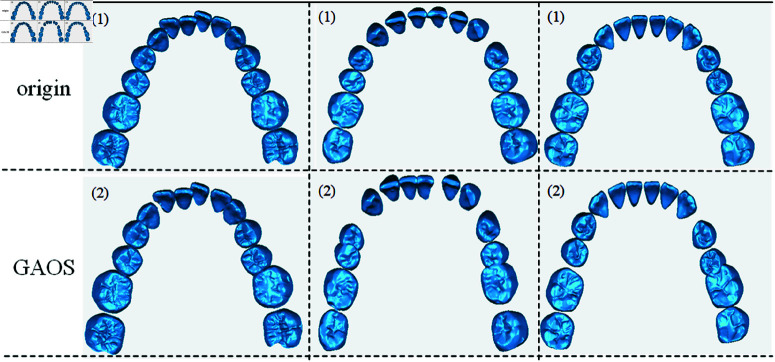
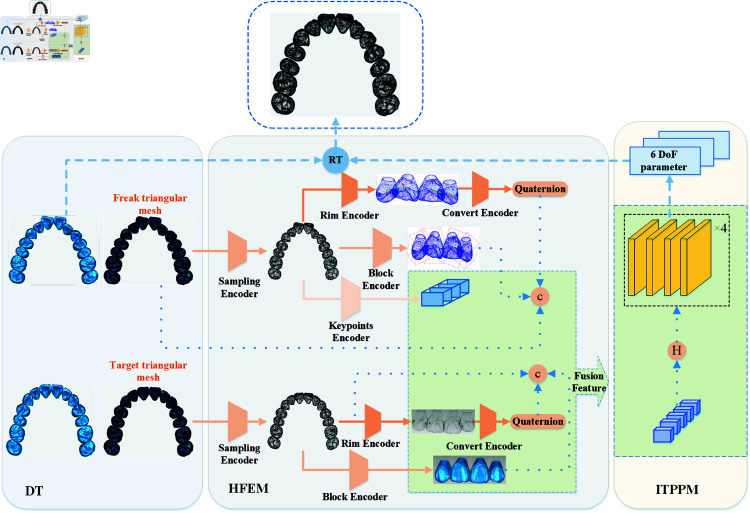
A multi-layer feature optimization Transformer-based tooth position prediction method is proposed to address the problems of difficult access to high-precision medical data and the difficulty of capturing and representing hierarchical features and spatial relationships among teeth by current methods. First, a geometric adaptive optimization strategy and a physiological adaptive reconstruction strategy are designed for real-time adaptation to the complexity of different clinical environments and enhanced pose invariance by integrating the physiological characteristics and anatomical structure of teeth. Then, a hierarchical feature tooth position prediction network was designed to solve the problems of weak ability of MLPs to process high-dimensional data and low accuracy of prediction transformation matrix by extracting hierarchical geometric features of teeth. Finally, a jointly supervised loss function is constructed, which can simultaneously capture the intrinsic differences, spatial relationships and uncertainties of the tooth position prediction disorder distribution, and can effectively supervise the tooth spatial structure relationships and prevent tooth collisions and misalignments. The experimental results show that the accuracy of the proposed method is improved by 2.87% and the rotation and translation errors are reduced by 28.28% and 37.53%, respectively, compared with the current method.
提出了一种基于多层特征优化Transformer的牙齿位置预测方法,以解决当前方法难以获取高精度医学数据以及难以捕捉和表示牙齿之间的层次特征和空间关系的问题。首先,设计了一种几何自适应优化策略和一种生理自适应重建策略,通过整合牙齿的生理特征和解剖结构,实时适应不同临床环境的复杂性并增强姿态不变性。然后,设计了一个层次特征牙齿位置预测网络,通过提取牙齿的层次几何特征来解决多层感知器(MLP)处理高维数据能力弱以及预测变换矩阵精度低的问题。最后,构建了一个联合监督损失函数,它可以同时捕捉牙齿位置预测紊乱分布的内在差异、空间关系和不确定性,并能有效监督牙齿空间结构关系,防止牙齿碰撞和错位。实验结果表明,与当前方法相比,该方法的准确率提高了2.87%,旋转误差和平移误差分别降低了28.28%和37.53%。