Beatty Norman L, Bhosale Chanakya R, White Zoe S, Torhorst Carson W, Wilson Kristen N, Dorleans Rayann, Stenn Tanise M S, Killets Keswick C, Curtis-Robles Rachel, Burkett-Cadena Nathan, Nováková Eva, Hamer Gabriel L, Hamer Sarah A, Wisely Samantha M
Division of Infectious Diseases and Global Medicine, Department of Medicine, University of Florida College of Medicine, Gainesville, Florida, United States of America.
Emerging Pathogens Institute, University of Florida, Gainesville, Florida, United States of America.
PLoS Negl Trop Dis. 2025 Jul 7;19(7):e0012920. doi: 10.1371/journal.pntd.0012920. eCollection 2025 Jul.
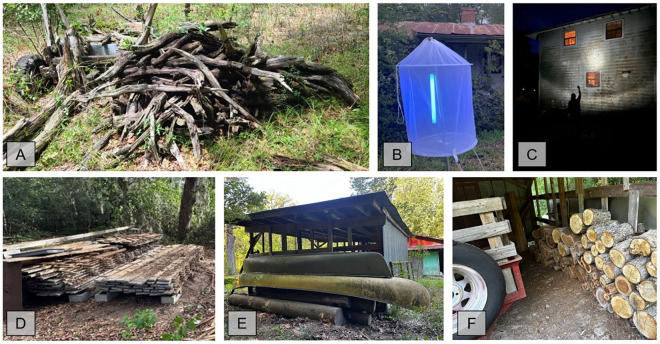
Triatomine bugs (Hemiptera, Reduviidae, Triatominae) are blood-sucking vectors of the protozoan parasite, Trypanosoma cruzi, which causes Chagas disease, a significant source of human morbidity and mortality in the Americas. Autochthonous transmission of Chagas disease in the United States is considered rare, despite evidence of Triatoma species harboring T. cruzi, invading homes, and biting occupants. In the southeastern United States, Triatoma sanguisuga is considered common, yet its distribution, host use, and T. cruzi infection are practically unknown in this region.
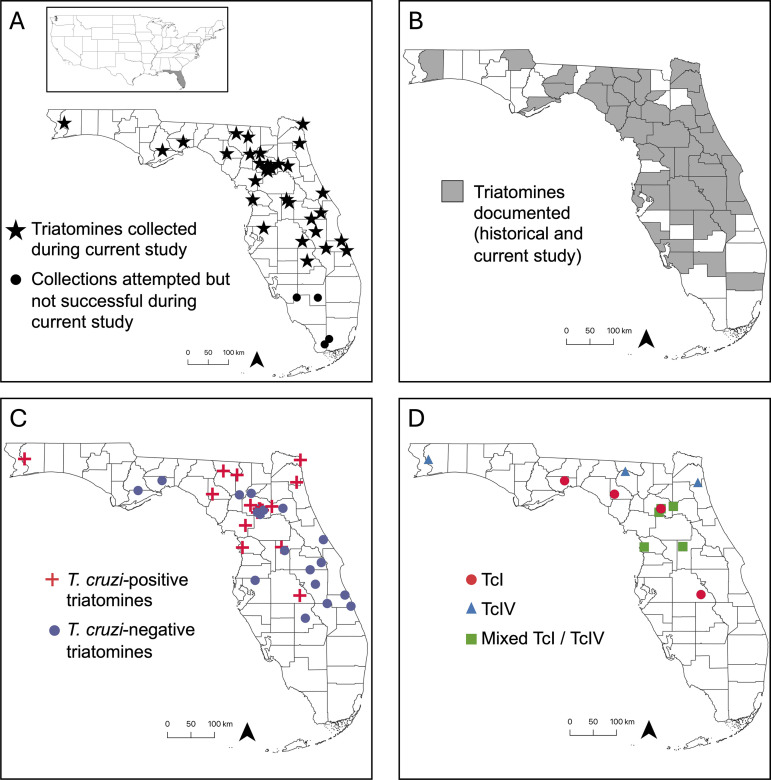
METHODOLOGY/PRINCIPLE FINDINGS: Using field sampling and community science programs from 2013 to 2023, we collected triatomines from peridomestic and domestic settings, identified them to species, analyzed for bloodmeals, and screened for T. cruzi infection and Discrete Typing Units (DTUs) TcI - TcVI utilizing molecular techniques. Triatoma sanguisuga (n = 310) were collected from 23 counties throughout the state, particularly in northern and central Florida. More than one third (34.6%) of T. sanguisuga were found inside a human dwelling, and 39.2% were collected by community members. T. cruzi infection was observed in 29.5% (88/298) of tested triatomines, with infection found in 12 of the 23 counties where triatomines had been collected. DTU-typing was successful for 47 of the T. cruzi-positive triatomines: 74.5% were infected with DTU TcI, 21.3% were infected with DTU TcIV, and 4.3% were co-infected with TcI and TcIV. Bloodmeal analysis of 144 T. sanguisuga found broad host use, including mammals (60%), ectothermic vertebrates (37%), and cockroaches (2.5%). Human blood meals contributed nearly a quarter (23%) of bloodmeals, indicating significant vector-human contact.
CONCLUSION/SIGNIFICANCE: Our field data from Florida demonstrate that T. sanguisuga is present near, and sometimes in, human dwellings, feeds upon humans, and is infected with multiple DTUs of T. cruzi. This indicates that the environment in the southeastern United States is suitable for autochthonous transmission of Chagas disease or that the human risk for T. cruzi infection is possible. The roles of ectotherms in T. sanguisuga and T. cruzi ecology also warrant further investigation.
锥蝽(半翅目,猎蝽科,锥蝽亚科)是原生动物寄生虫克氏锥虫的吸血传播媒介,克氏锥虫可引发恰加斯病,是美洲地区人类发病和死亡的重要原因。尽管有证据表明某些锥蝽属物种携带克氏锥虫、侵入家庭并叮咬居住者,但恰加斯病在美国的本地传播被认为较为罕见。在美国东南部,美洲大锥蝽被认为较为常见,但该地区关于其分布、宿主利用情况以及克氏锥虫感染情况实际上却几乎一无所知。
方法/主要发现:利用2013年至2023年的野外采样和社区科学项目,我们从住宅周边和住宅环境中收集锥蝽,鉴定其物种,分析血餐情况,并利用分子技术筛查克氏锥虫感染以及离散分型单元(DTUs)TcI - TcVI。在全州23个县收集到了美洲大锥蝽(n = 310),特别是在佛罗里达州北部和中部。超过三分之一(34.6%)的美洲大锥蝽是在人类住所内发现的,39.2%是由社区成员收集到的。在298只接受检测的锥蝽中,有29.5%(88/298)被观察到感染了克氏锥虫,在收集到锥蝽的23个县中的12个县发现了感染情况。对47只克氏锥虫呈阳性的锥蝽成功进行了DTU分型:74.5%感染了DTU TcI,21.3%感染了DTU TcIV,4.3%同时感染了TcI和TcIV。对144只美洲大锥蝽的血餐分析发现其宿主利用范围广泛,包括哺乳动物(60%)、变温脊椎动物(37%)和蟑螂(2.5%)。人类血餐占血餐总量的近四分之一(23%),表明锥蝽与人类有显著接触。
结论/意义:我们来自佛罗里达州的野外数据表明,美洲大锥蝽存在于人类住所附近,有时也在住所内,以人类为食,并感染了多种克氏锥虫DTUs。这表明美国东南部的环境适合恰加斯病的本地传播,或者人类有感染克氏锥虫的风险。变温动物在美洲大锥蝽和克氏锥虫生态中的作用也值得进一步研究。