Wang Lina, Huang Qian, Zhang Yiqiu, Liu Jie, Chen Chaoran
Department of Gynecology, Huaihe Hospital, Henan University, Kaifeng, China.
Central Sterile Supply Department, Huaihe Hospital, Henan University, Kaifeng, China.
BMC Nurs. 2025 Jul 7;24(1):863. doi: 10.1186/s12912-025-03533-8.
Nurses are the core workforce responsible for coordinating and delivering patient care, playing a critical role in ensuring patient safety and enhancing healthcare quality. However, when confronted with multiple patient demands, scarce medical resources, and heavy workloads, nurses' subjective perceptions of workload may trigger specific psychological response mechanisms, which in turn negatively affect their work status and nursing behavior.
This study aimed to explore the impact of nurses' perceived workload on missed nursing care and presenteeism, and to examine the mediating roles of occupational stress and emotional intelligence in these relationships.
A cross-sectional study design was employed. Between May and October 2024, 730 questionnaires were distributed, with 706 valid responses collected, resulting in an effective response rate of 96.7%. Descriptive statistics and Pearson correlation analyses were conducted using SPSS 27.0. Structural equation modeling was performed using AMOS 25.0, and mediation effects were tested via the bootstrap method.
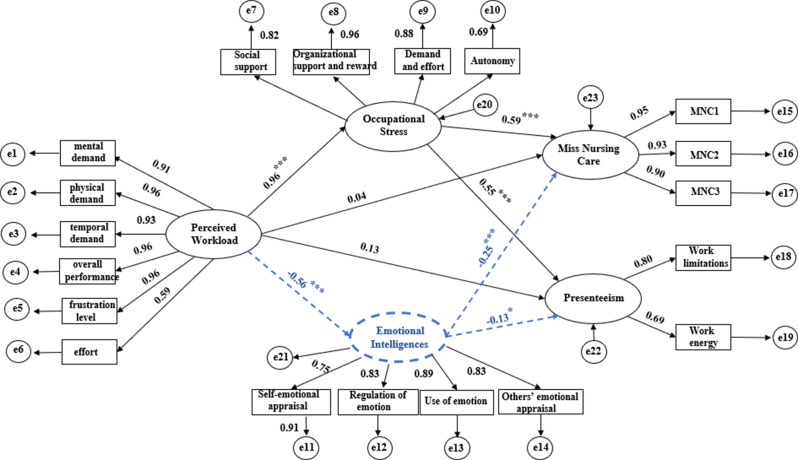
The results showed that nurses' perceived workload was not directly associated with missed nursing care(β = 0.04, P>0.05) or presenteeismββ = 0.13, P>0.05). However, occupational stress played a significant mediating role in the relationship between perceived workload and missed nursing care (PW → OS, β = 0.96, P < 0.001; OS → MNC, β = 0.59, P < 0.001), as well as in the relationship between perceived workload and presenteeism (PW → OS, β = 0.96, P < 0.001; OS → PRE, β = 0.55, P < 0.001). Similarly, emotional intelligence served as a significant mediator in the relationship between perceived workload and missed nursing care (PW → EI, β = -0.56, P < 0.001; EI → MNC, β = -0.25, P < 0.001), and also in the relationship between perceived workload and presenteeism (PW → EI, β = -0.56, P < 0.001; EI → PRE, β = -0.13, P < 0.001).
Nurses' perceived workload does not directly lead to missed nursing care or presenteeism; rather, it mainly influences their work status and nursing behavior indirectly through either occupational stress or emotional intelligence.
When optimizing the work environment and human resource allocation, nursing managers should not only focus on the distribution of objective workload but also pay close attention to nurses' perceived workload and the development of their psychological coping mechanisms.
护士是负责协调和提供患者护理的核心劳动力,在确保患者安全和提高医疗质量方面发挥着关键作用。然而,面对患者的多种需求、稀缺的医疗资源和繁重的工作量,护士对工作量的主观认知可能会触发特定的心理反应机制,进而对其工作状态和护理行为产生负面影响。
本研究旨在探讨护士感知到的工作量对护理缺失和出勤主义的影响,并检验职业压力和情商在这些关系中的中介作用。
采用横断面研究设计。2024年5月至10月期间,发放了730份问卷,收集到706份有效回复,有效回复率为96.7%。使用SPSS 27.0进行描述性统计和Pearson相关性分析。使用AMOS 25.0进行结构方程建模,并通过Bootstrap方法检验中介效应。
结果表明,护士感知到的工作量与护理缺失(β = 0.04,P > 0.05)或出勤主义(β = 0.13,P > 0.05)没有直接关联。然而,职业压力在感知到的工作量与护理缺失的关系中起显著中介作用(PW → OS,β = 0.96,P < 0.001;OS → MNC,β = 0.59,P < 0.001),在感知到的工作量与出勤主义的关系中也起显著中介作用(PW → OS,β = 0.96,P < 0.001;OS → PRE,β = 0.55,P < 0.001)。同样,情商在感知到的工作量与护理缺失的关系中起显著中介作用(PW → EI,β = -0.56,P < 0.001;EI → MNC,β = -0.25,P < 0.001),在感知到的工作量与出勤主义的关系中也起显著中介作用(PW → EI,β = -0.56,P < 0.001;EI → PRE,β = -0.13,P < 0.001)。
护士感知到的工作量不会直接导致护理缺失或出勤主义;相反,它主要通过职业压力或情商间接影响其工作状态和护理行为。
在优化工作环境和人力资源配置时,护理管理者不仅应关注客观工作量的分配,还应密切关注护士感知到的工作量及其心理应对机制的发展。