Li Zhenhua, Yang Wenjian, Wu Gang, Chang Ti-Cheng, Cheng Zhongshan, Devidas Meenakshi, Shago Mary, Carroll Andrew J, Heerema Nyla A, Gastier-Foster Julie M, Wood Brent L, Sanclemente Lauren, Raetz Elizabeth A, Hunger Stephen P, Loh Mignon L, Feingold Eleanor, Rosser Tracie C, Allen Emily G, Sherman Stephanie L, Rabin Karen R, Lupo Philip J, Yang Jun J
Department of Pharmacy and Pharmaceutical Sciences, St. Jude Children's Research Hospital, Memphis, TN, USA.
Center for Applied Bioinformatics, St. Jude Children's Research Hospital, Memphis, TN, USA.
Nat Commun. 2025 Jul 9;16(1):6316. doi: 10.1038/s41467-025-61413-w.
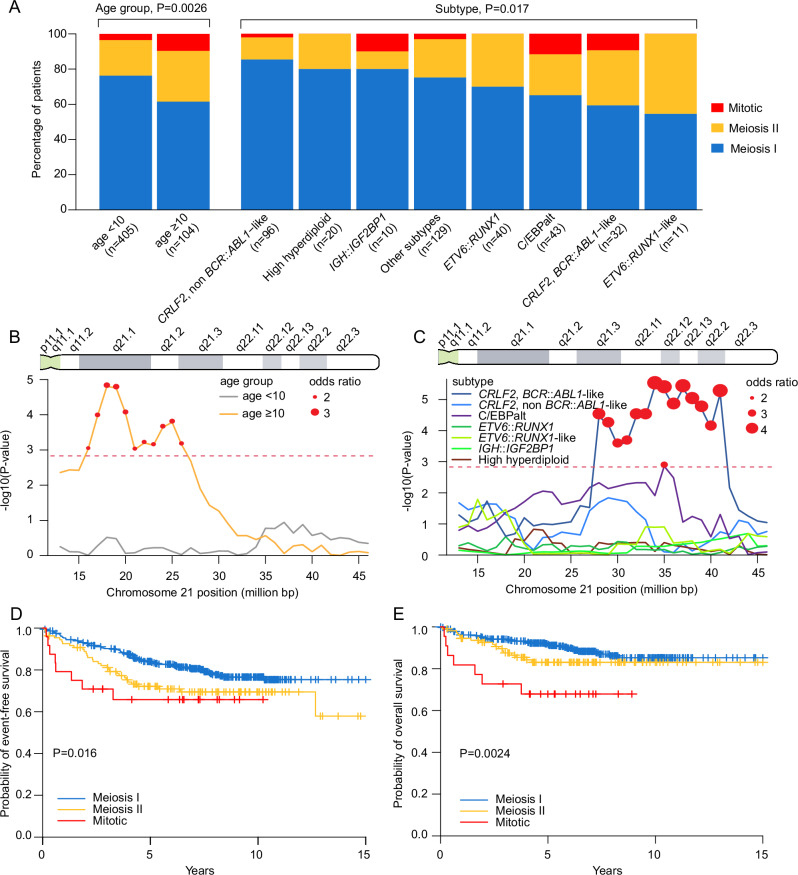
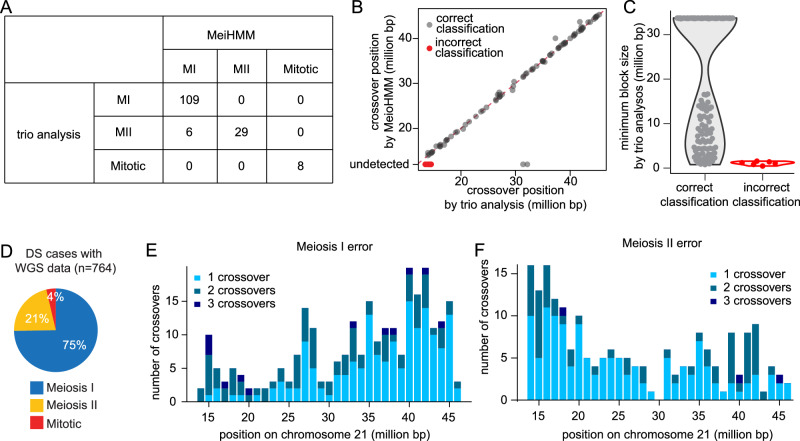
Errors in chromosome segregation during gametogenesis, such as nondisjunction (NDJ) errors, have severe consequences in human reproduction, and a better understanding of their etiology is of fundamental interest in genetics. Mapping NDJ errors to meiotic/mitotic stages typically requires proband-parent comparison, limiting its applicability. Herein, we develop Mis-segregation Error Identification through Hidden Markov Models (MeiHMM), a method for inferring NDJ error stage and crossover events based on only genomic data of trisomic probands. Guided by triallelic genotype/haplotype configurations, MeiHMM discerns the allelic origin at each locus, which informs NDJ error during gamete formation, without identifying the parental origin of the trisomy. In 152 Down syndrome (DS) cases, MeiHMM achieved an accuracy of 96.1% in classifying NDJ errors, with a sensitivity of 91.6% in crossover identification, compared to proband-parents trio analysis. 17% of Meiosis II errors were misclassified as Meiosis I, mainly due to small proximal crossover events. Applying MeiHMM to 509 children with DS-associated childhood leukemia, we demonstrate that NDJ error is associated with the age of disease onset, somatic genomic abnormalities, and prognosis. Thus, MeiHMM is an effective method for trisomic NDJ error classification and crossover identification that can be applied broadly to study the etiology of congenital aneuploidy conditions.
配子发生过程中的染色体分离错误,如不分离(NDJ)错误,在人类生殖中具有严重后果,更好地了解其病因是遗传学的基本兴趣所在。将NDJ错误映射到减数分裂/有丝分裂阶段通常需要先证者与父母进行比较,这限制了其适用性。在此,我们开发了通过隐马尔可夫模型识别错配错误(MeiHMM),这是一种仅基于三体先证者的基因组数据推断NDJ错误阶段和交叉事件的方法。在三等位基因基因型/单倍型配置的指导下,MeiHMM识别每个位点的等位基因起源,这为配子形成过程中的NDJ错误提供信息,而无需确定三体的亲本起源。在152例唐氏综合征(DS)病例中,与先证者-父母三联体分析相比,MeiHMM在分类NDJ错误方面的准确率达到96.1%,在交叉识别方面的灵敏度达到91.6%。17%的减数分裂II期错误被误分类为减数分裂I期,主要是由于近端小交叉事件。将MeiHMM应用于509例与DS相关的儿童白血病患儿,我们证明NDJ错误与疾病发病年龄、体细胞基因组异常和预后相关。因此,MeiHMM是一种有效的三体NDJ错误分类和交叉识别方法,可广泛应用于研究先天性非整倍体疾病的病因。