Liu Xiao, Qu Honglin, Li Jingmin, Sun Xuhong, Wang Zhenlin, Wang Dong, Bai Xianyong, Li Xiaoyan
Department of Histology and Embryology, School of Basic Medical Sciences, Binzhou Medical University, Yantai, China.
Department of Human Anatomy, School of Basic Medical Sciences, Binzhou Medical University, Yantai, China.
Front Oncol. 2025 Jun 24;15:1584811. doi: 10.3389/fonc.2025.1584811. eCollection 2025.
Cuproptosis, a novel cell death pathway mediated by ferredoxin 1 (FDX1) and protein lipoylation, has emerged as a valuable target in cancer therapy. Although the findings of previous research have indicated a potential correlation between p53 and cuproptosis, the precise role and underlying mechanisms of p53 in cuproptosis, particularly within the context of hepatocellular carcinoma (HCC), remain unclear.
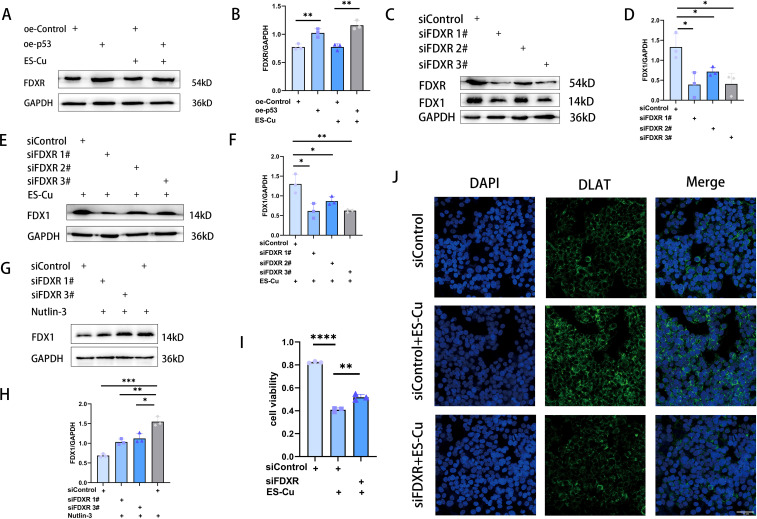
To evaluate cuproptosis, three HCC cell lines (HepG2, PLC/PRF/5, and Hep3B2.1-7) with distinct p53 statuses were treated with elesclomol-Cu. p53 overexpression/knockdown, siRNA-mediated ferredoxin reductase (FDXR)/FDX1 knockdown, and the p53 activators CP-31398 and nutlin-3 were employed to elucidate the associated molecular mechanisms. Cell viability, protein expression [FDX1, dihydrolipoyl transacetylase (DLAT), FDXR], and DLAT oligomerization were assessed via Cell Counting Kit-8 (CCK-8), western blotting, and immunofluorescence analyses. A PLC/PRF/5 xenograft mouse model was used to assess combined the therapeutic efficacy of elesclomol-Cu and CP-31398.
Elesclomol-Cu triggered cuproptosis in HCC cells, as evidenced by a dose-dependent suppression of proliferation, FDX1 upregulation, DLAT oligomerization, and rescue by the copper chelator tetrathiomolybdate (TTM). p53 activation enhanced FDXR expression, promoting FDX1 upregulation and subsequent DLAT oligomerization, thereby sensitizing HCC cells to elesclomol-Cu, whereas FDXR knockdown reversed these effects, demonstrating its role in p53-mediated potentiation of cuproptosis sensitivity. In mutant p53-R249S cells, CP-31398 functioned synergistically with elesclomol-Cu to suppress proliferation. , elesclomol-Cu and CP-31398 combination therapy significantly reduced tumor growth and Ki67 expression whilst upregulating FDXR levels.
These findings revealed that p53 enhances elesclomol-Cu-induced cuproptosis in HCC via FDXR-mediated FDX1 upregulation. This study provides mechanistic insights into p53's role in cuproptosis and may serve as a basis for targeting copper metabolism in therapeutic strategies for HCC.
铜死亡是一种由铁氧化还原蛋白1(FDX1)和蛋白质脂酰化介导的新型细胞死亡途径,已成为癌症治疗中有价值的靶点。尽管先前的研究结果表明p53与铜死亡之间存在潜在关联,但p53在铜死亡中的精确作用和潜在机制,尤其是在肝细胞癌(HCC)背景下,仍不清楚。
为评估铜死亡,用依斯氯醇 - 铜处理三种具有不同p53状态的肝癌细胞系(HepG2、PLC/PRF/5和Hep3B2.1 - 7)。采用p53过表达/敲低、小干扰RNA介导的铁氧化还原酶(FDXR)/FDX1敲低以及p53激活剂CP - 31398和Nutlin - 3来阐明相关分子机制。通过细胞计数试剂盒 - 8(CCK - 8)、蛋白质印迹和免疫荧光分析评估细胞活力、蛋白质表达[FDX1、二氢硫辛酰胺转乙酰基酶(DLAT)、FDXR]以及DLAT寡聚化。使用PLC/PRF/5异种移植小鼠模型评估依斯氯醇 - 铜和CP - 31398联合治疗的疗效。
依斯氯醇 - 铜在肝癌细胞中引发铜死亡,表现为增殖的剂量依赖性抑制、FDX1上调、DLAT寡聚化以及被铜螯合剂四硫代钼酸盐(TTM)挽救。p53激活增强FDXR表达,促进FDX1上调及随后的DLAT寡聚化,从而使肝癌细胞对依斯氯醇 - 铜敏感,而FDXR敲低逆转了这些效应,证明其在p53介导的增强铜死亡敏感性中的作用。在突变型p53 - R249S细胞中,CP - 31398与依斯氯醇 - 铜协同作用抑制增殖。依斯氯醇 · 铜和CP - 31398联合治疗显著降低肿瘤生长和Ki67表达,同时上调FDXR水平。
这些发现表明,p53通过FDXR介导的FDX1上调增强依斯氯醇 - 铜诱导的肝癌细胞铜死亡。本研究为p53在铜死亡中的作用提供了机制性见解,并可能作为肝癌治疗策略中靶向铜代谢的基础。