Sahutoglu Tuncay, Perazella Mark A
Section of Nephrology, Internal Medicine, University of Health Sciences, Mehmet Akif Inan Training and Research Hospital, Şanlıurfa, Türkiye.
Section of Nephrology, Yale University School of Medicine, New Haven, Connecticut, USA.
Kidney Int Rep. 2025 Apr 1;10(6):1643-1656. doi: 10.1016/j.ekir.2025.03.050. eCollection 2025 Jun.
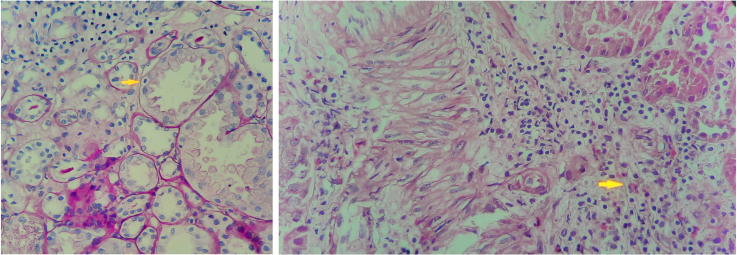
Acute tubulointerstitial nephritis (ATIN) is a leading cause of acute kidney injury (AKI) and acute kidney disease. It is characterized by interstitial inflammation and tubular injury, often triggered by medications, infections, or autoimmune disorders. Prompt diagnosis and treatment are crucial to prevent irreversible kidney damage; however, nonspecific clinical and laboratory findings pose diagnostic challenges. Although kidney biopsy remains the gold standard, its invasive nature and potential complications necessitate the exploration of alternative noninvasive strategies. Emerging biomarkers offer promising noninvasive tools for diagnosing ATIN and differentiating it from other causes of AKI and acute kidney disease. Biomarker applications, as an alternative, are viewed through the lens of distinct immune reaction subtypes, including variations in type IV hypersensitivity mechanisms. Biomarkers such as urinary CXC chemokine ligand (CXCL)9 and cytokines such as tumor necrosis factor (TNF)-α and interleukin (IL)-9 reflect T-cell polarization and specific inflammatory pathways, shedding light on T helper (Th)1- and Th2-mediated immune responses. Among these, the urinary CXCL9-to-creatinine ratio demonstrates high sensitivity and specificity, with well-defined thresholds guiding clinical decisions. Urinary retinol-binding protein and serum C-reactive protein (CRP) have also been explored, particularly in immune checkpoint inhibitor (ICPI)-associated AKI. However, their nonspecificity and overlap with other AKI etiologies limit their utility in isolating ATIN-specific pathways. This review highlights the need for integrating biomarker-based approaches with a broader understanding of immune heterogeneity and histologic correlation to improve diagnostic precision. Future studies should focus on validating biomarker panels that capture diverse inflammatory endotypes, enabling early diagnosis and personalized management. By acknowledging the complexity of immune reactions underlying ATIN, this approach aims to enhance clinical decision-making while minimizing the need for invasive diagnostics, ultimately improving patient outcomes.
急性肾小管间质性肾炎(ATIN)是急性肾损伤(AKI)和急性肾脏病的主要病因。其特征为间质炎症和肾小管损伤,常由药物、感染或自身免疫性疾病引发。及时诊断和治疗对于预防不可逆的肾损伤至关重要;然而,非特异性的临床和实验室检查结果带来了诊断挑战。尽管肾活检仍是金标准,但其侵入性及潜在并发症促使人们探索替代性的非侵入性策略。新兴的生物标志物为诊断ATIN以及将其与AKI和急性肾脏病的其他病因相鉴别提供了有前景的非侵入性工具。作为一种替代方法,生物标志物的应用是通过不同免疫反应亚型的视角来看待的,包括IV型超敏反应机制的变化。诸如尿CXC趋化因子配体(CXCL)9等生物标志物以及肿瘤坏死因子(TNF)-α和白细胞介素(IL)-9等细胞因子反映了T细胞极化和特定的炎症途径,揭示了辅助性T(Th)1和Th2介导的免疫反应。其中,尿CXCL9与肌酐的比值显示出高敏感性和特异性,具有明确的阈值指导临床决策。尿视黄醇结合蛋白和血清C反应蛋白(CRP)也已得到研究,特别是在免疫检查点抑制剂(ICPI)相关的AKI中。然而,它们的非特异性以及与其他AKI病因的重叠限制了其在分离ATIN特异性途径方面的效用。本综述强调需要将基于生物标志物的方法与对免疫异质性和组织学相关性的更广泛理解相结合,以提高诊断准确性。未来的研究应专注于验证能够捕捉多种炎症亚型的生物标志物组合,实现早期诊断和个性化管理。通过认识到ATIN潜在的免疫反应复杂性,这种方法旨在加强临床决策,同时尽量减少侵入性诊断的需求,最终改善患者预后。