Parpa Koulla, Paludo Ana C, Govindasamy Karuppasamy, Badicu Georgian, Michaelides Marcos
School of Sciences, University of Central Lancashire - Cyprus Campus, Larnaka, 7080, Cyprus.
School of Sciences, University of Central Lancashire - Cyprus Campus, University Avenue 12-14, Pyla, Larnaka, 7080, Cyprus.
Sci Rep. 2025 Jul 9;15(1):24675. doi: 10.1038/s41598-025-10747-y.
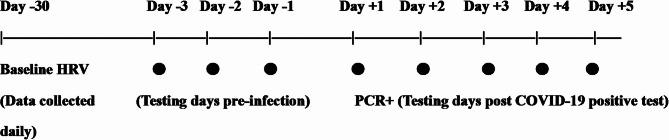
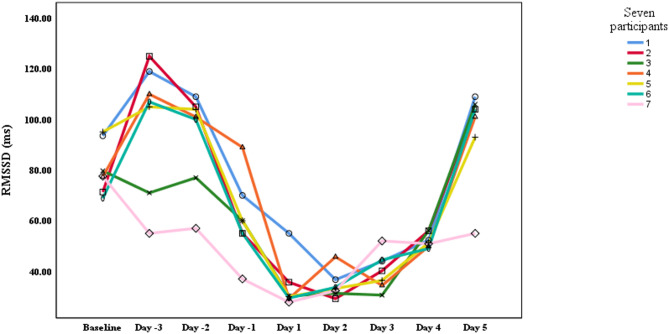
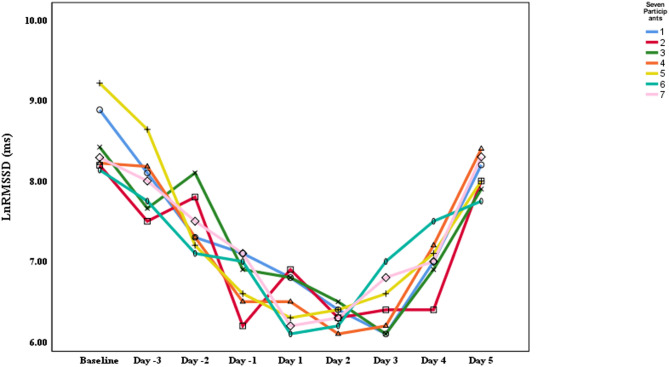
The purpose of this study is to examine the impact of COVID-19 infection on heart rate variability (HRV) in female soccer players, with a focus on identifying changes in autonomic regulation before, during, and after a COVID-19 positive test. Seven elite female soccer players (age: 20.14 ± 6.41 years, height: 162.43 ± 4.32 cm, weight: 51.73 ± 5.65 kg) were included in the analysis after consistently recording their HRV during the specified period. Morning HRV measures were completed using photoplethysmography via the HRV4 training smartphone application, a validated tool for field-based monitoring, along with self-reported data. The players were tracked for at least 30 consecutive days before testing positive for COVID-19 using a polymerase chain reaction (PCR) test. They were also requested to record their HRV while they had COVID-19 until a negative PCR result was obtained. The study presents data on RMSSD, LnRMSSD and HR for the 30 days prior to COVID-19, as well as for the 3 days (day - 3), 2 days (day - 2), and 1 day (day - 1) leading up to COVID-19. Also, data for the first 5 days following a positive COVID-19 test are included. The results of this study indicated that LnRMSSD measurements were significantly lower 2 days (day - 2) and 1 day (day - 1) before the onset of COVID-19, as well as during the first four days following a positive COVID-19 test, compared to baseline. In addition, RMSSD measurements were significantly lower during the first 4 days after a positive COVID-19 test, while resting heart rate was significantly higher during the first and second days following a positive COVID-19 test, compared to baseline. Our findings suggest that reductions in LnRMSSD, reflecting decreased parasympathetic activity, may serve as early indicators of COVID-19 infection in elite female soccer players, potentially allowing for pre-symptomatic detection through daily HRV monitoring.
本研究的目的是考察新型冠状病毒肺炎(COVID-19)感染对女子足球运动员心率变异性(HRV)的影响,重点是确定COVID-19检测呈阳性之前、期间和之后自主神经调节的变化。在特定时间段内持续记录7名精英女子足球运动员(年龄:20.14±6.41岁,身高:162.43±4.32厘米,体重:51.73±5.65千克)的HRV后,将其纳入分析。通过HRV4训练智能手机应用程序使用光电容积脉搏波描记法完成早晨HRV测量,该应用程序是一种经过验证的用于现场监测的工具,同时还收集自我报告的数据。在使用聚合酶链反应(PCR)检测COVID-19呈阳性之前,对这些运动员连续追踪至少30天。还要求他们在感染COVID-19期间记录HRV,直到获得PCR阴性结果。该研究呈现了COVID-19之前30天以及COVID-19前3天(第-3天)、2天(第-2天)和1天(第-1天)的RMSSD、LnRMSSD和心率(HR)数据。此外,还包括COVID-19检测呈阳性后的前5天的数据。本研究结果表明,与基线相比,LnRMSSD测量值在COVID-19发病前2天(第-2天)和1天(第-1天)以及COVID-19检测呈阳性后的前四天显著降低。此外,与基线相比,COVID-19检测呈阳性后的前4天RMSSD测量值显著降低,而静息心率在COVID-19检测呈阳性后的第一天和第二天显著升高。我们的研究结果表明,反映副交感神经活动降低的LnRMSSD降低可能是精英女子足球运动员感染COVID-19的早期指标,有可能通过每日HRV监测实现症状前检测。