
[膈神经冷冻疗法预防电视辅助胸腔镜肺叶切除术中的长期漏气]
[Phrenic Nerve Cryotherapy for Preventing Prolonged Air Leak During VATS Lobectomy].
作者信息
Meng Qingyu, Wu Yongkun, Wang Yufei, Guo Zhanlin
机构信息
The First Clinical Medical College, Inner Mongolia Medical University, Hohhot 010059, China.
Department of Thoracic Surgery, The Affiliated Hospital of Inner Mongolia Medical University, Hohhot 010050, China.
出版信息
Zhongguo Fei Ai Za Zhi. 2025 Jun 20;28(6):405-414. doi: 10.3779/j.issn.1009-3419.2025.102.23.
BACKGROUND
Video-assisted thoracoscopic surgery (VATS) lobectomy is the primary surgical treatment for lung cancer. A significant factor affecting postoperative recovery is prolonged air leak (PAL). Despite numerous clinical strategies could prevent and manage postoperative PAL, its incidence remains high. Phrenic nerve cryotherapy (PNC) temporarily inhibits phrenic nerve function, causing diaphragm elevation, which reduces thoracic cavity volume, enhances pleural apposition, and mitigates air leakage. This study investigates the efficacy of PNC in preventing postoperative PAL during VATS lobectomy.
METHODS
A total of 108 eligible lung cancer patients who underwent surgery at the Department of Thoracic Surgery, The Affiliated Hospital of Inner Mongolia Medical University, from June 2023 to January 2025, were enrolled and randomly assigned to the control group (n=54) and the experimental group (n=54). The patients in both the two groups received VATS lobectomy and systematic lymph node dissection, with the experimental group also undergoing PNC during the operation. The baseline characteristics, intraoperative, postoperative indicators and dynamic changes in air leakage between the two groups were compared.
RESULTS
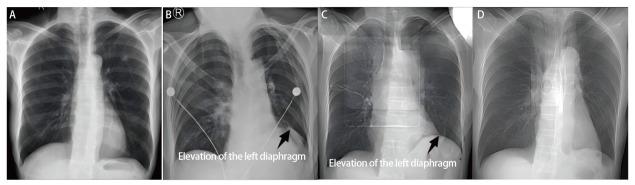
The baseline clinical characteristics were comparable between the two groups (P>0.05). The incidence of pulmonary air leakage at 24 h after surgery (31.5% vs 29.6%) and the incidence of postoperative PAL (20.4% vs 14.8%) showed no significant differences between the two groups (P>0.05). The intraoperative air leak test to 24 hours after surgery revealed that air leakage ceased in 8 cases (32.0%) in the control group, compared to 14 cases (46.7%) in the experimental group. Moreover, during the progression from air leakage at 24 hours post-surgery to postoperative PAL, air leakage ceased in 6 cases (35.3%) in the control group and 8 cases (50.0%) in the experimental group, with a statistically significant difference (P<0.001). Compared to the control group, the patients in the experimental group exhibited more pronounced postoperative diaphragmatic elevation that recovered to a slightly higher than preoperative level by 3 mon after surgery.
CONCLUSIONS
The combination of PNC and active lung repair can serve as an important intervention for patients at high risk of intraoperative air leakage, reducing the occurrence of postoperative PAL.
背景
电视辅助胸腔镜手术(VATS)肺叶切除术是肺癌的主要外科治疗方法。影响术后恢复的一个重要因素是持续漏气(PAL)。尽管有许多临床策略可预防和处理术后PAL,但其发生率仍然很高。膈神经冷冻疗法(PNC)可暂时抑制膈神经功能,导致膈肌抬高,从而减小胸腔容积,增强胸膜贴合,减轻漏气。本研究探讨PNC在VATS肺叶切除术中预防术后PAL的疗效。
方法
选取2023年6月至2025年1月在内蒙古医科大学附属医院胸外科接受手术的108例符合条件的肺癌患者,随机分为对照组(n=54)和试验组(n=54)。两组患者均接受VATS肺叶切除术和系统性淋巴结清扫,试验组在手术过程中还接受PNC。比较两组患者的基线特征、术中及术后指标以及漏气的动态变化。
结果
两组患者的基线临床特征具有可比性(P>0.05)。术后24小时肺漏气发生率(31.5%对29.6%)和术后PAL发生率(20.4%对14.8%)在两组之间无显著差异(P>0.05)。术中漏气试验至术后24小时显示,对照组有8例(32.0%)漏气停止,试验组为14例(46.7%)。此外,在从术后24小时漏气进展至术后PAL的过程中,对照组有6例(35.3%)漏气停止,试验组为8例(50.0%),差异有统计学意义(P<0.001)。与对照组相比,试验组患者术后膈肌抬高更明显,术后3个月恢复至略高于术前水平。
结论
PNC与积极的肺修复相结合可作为术中漏气高危患者的重要干预措施,减少术后PAL的发生。


 Zotero 插件