Tapia Medina Merida Galilea, Cosío-Guirado Raquel, Peró-Cebollero Maribel, Cañete-Massé Cristina, Villuendas-González Erwin Rogelio, Guàrdia-Olmos Joan
Department of Social Psychology and Quantitative Psychology, University of Barcelona, Barcelona, Spain.
Institute of Complex Systems, University of Barcelona, Barcelona, Spain.
Front Neurosci. 2025 Jun 26;19:1576932. doi: 10.3389/fnins.2025.1576932. eCollection 2025.
In recent years, interest has grown in brain connectivity during infancy and adolescence, particularly in understanding neurodevelopment. Research is focusing on how brain network complexity evolves, providing insight into developmental neural connectivity. While some studies highlight key periods of brain maturation, findings remain inconsistent, leaving the neural correlates of typical development uncertain. This meta-analysis aims to identify brain regions and functional connectivity networks that show age-related activation patterns. Our goal is to clarify how neural wiring and complexity change with age, using seed-based d mapping (SDM) to analyze resting-state functional connectivity.
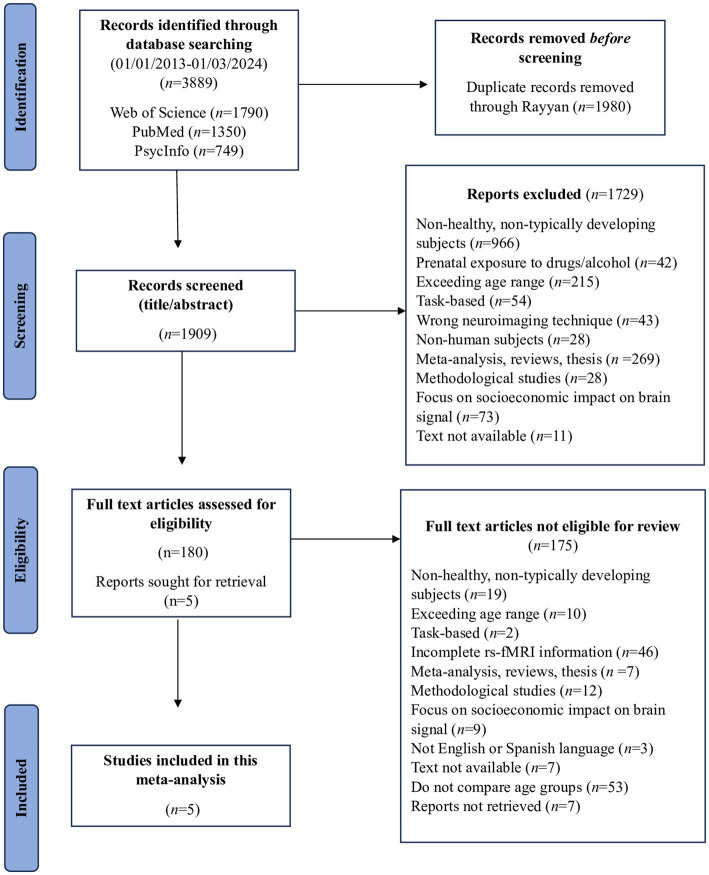
We reviewed studies employing resting-state functional magnetic resonance imaging (rs-fMRI) to examine brain connectivity in typically developing children and adolescents. After thoroughly application of the rigorous inclusion criteria, five studies published between 2013 and 2024 remained selected for this analysis. While this is a small number, this limitation reflects our unwavering commitment to methodological rigor and the current scarcity of available literature, ensuring that only high-quality studies were considered.
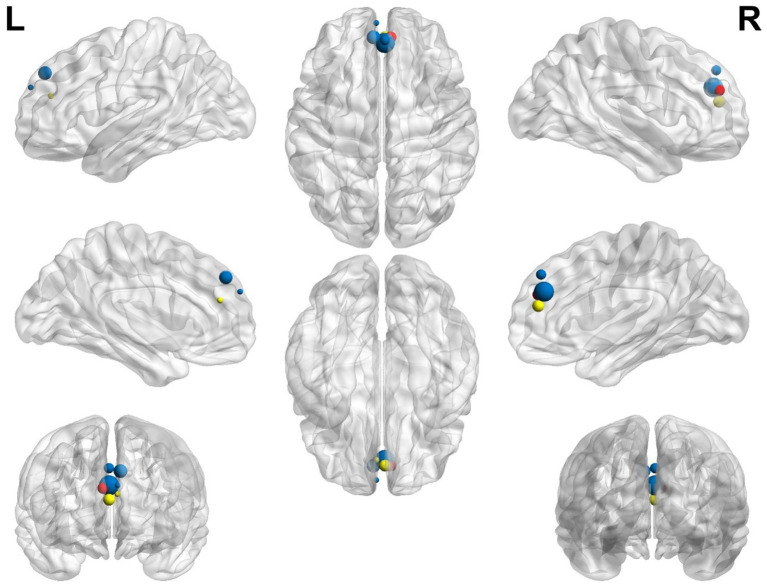
Consistent increases in seed-based connectivity involving the left frontal and prefrontal cortices were observed, particularly the left superior frontal gyrus and bilateral anterior cingulate cortex. These areas showed increased connectivity in older compared to younger participants.
The left frontal and prefrontal cortices, which are critical for executive function, attention, and intelligence, appear to strengthen their connectivity during childhood and adolescence. These observations provide a preliminary glimpse into typical brain maturation. However, due to the small number of studies and heterogeneity in age comparisons. No clinical implications can be drawn at this stage, and further research is required to confirm these developmental trends.
近年来,人们对婴儿期和青少年期的脑连接性越来越感兴趣,尤其是在理解神经发育方面。研究聚焦于脑网络复杂性如何演变,以深入了解发育中的神经连接性。虽然一些研究强调了脑成熟的关键时期,但研究结果仍不一致,使得典型发育的神经关联尚不确定。这项荟萃分析旨在识别显示与年龄相关激活模式的脑区和功能连接网络。我们的目标是通过基于种子的d映射(SDM)分析静息态功能连接,阐明神经布线和复杂性如何随年龄变化。
我们回顾了采用静息态功能磁共振成像(rs-fMRI)来检查典型发育儿童和青少年脑连接性的研究。在严格应用严格的纳入标准后,2013年至2024年间发表的五项研究仍被选入本分析。虽然数量较少,但这一局限性反映了我们对方法严谨性的坚定承诺以及当前可用文献的稀缺性,确保只考虑高质量的研究。
观察到涉及左侧额叶和前额叶皮质的基于种子的连接性持续增加,特别是左侧额上回和双侧前扣带回皮质。与年轻参与者相比,这些区域在年长参与者中显示出更强的连接性。
对执行功能、注意力和智力至关重要的左侧额叶和前额叶皮质,在儿童期和青少年期似乎加强了它们的连接性。这些观察结果初步揭示了典型的脑成熟过程。然而,由于研究数量较少且年龄比较存在异质性,现阶段无法得出临床意义,需要进一步研究来证实这些发育趋势。