Chen Liucheng, Wang Zhiyuan, Zhang Ji, Meng Ying, Wang Xuelian, Zhao Cancan, Shen Longshan
Department of Radiology, The First Affiliated Hospital, Bengbu Medical University, Bengbu, Anhui, China.
Department of Radiology, The Second Affiliated Hospital, Bengbu Medical University, Bengbu, Anhui, China.
Front Oncol. 2025 Jun 26;15:1554899. doi: 10.3389/fonc.2025.1554899. eCollection 2025.
Machine learning methods play an important role in predicting the efficacy of chemoradiotherapy in patients with nasopharyngeal carcinoma (NPC). This study explored the predictive value of machine learning models based on multimodal magnetic resonance imaging (MRI) radiomic features for the efficacy in patients with advanced NPC after clinical chemoradiotherapy.
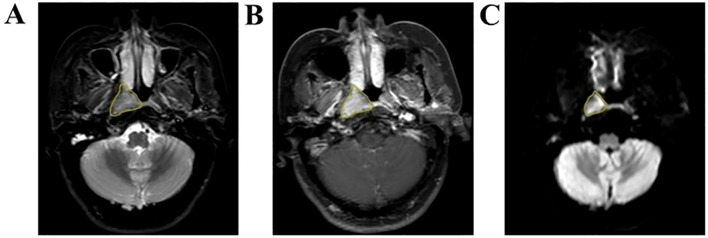
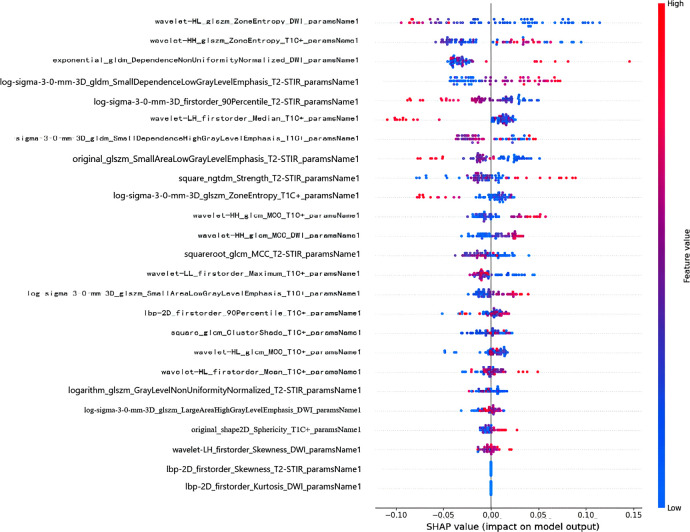
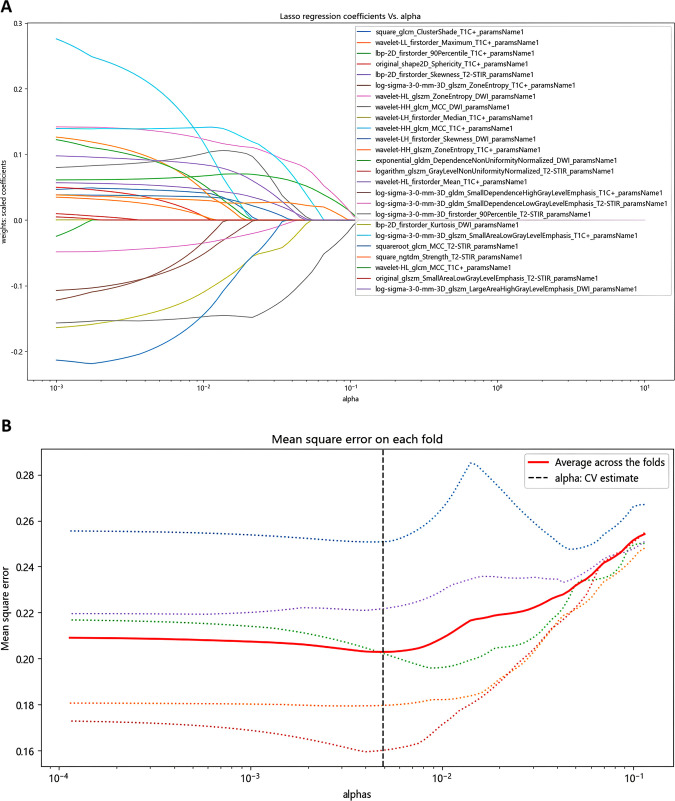
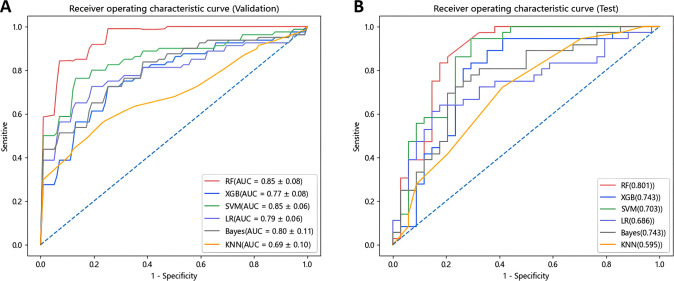
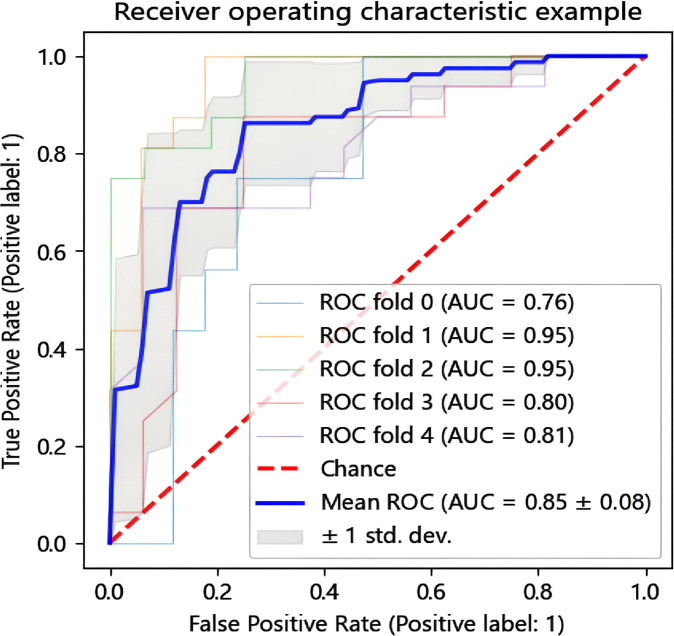
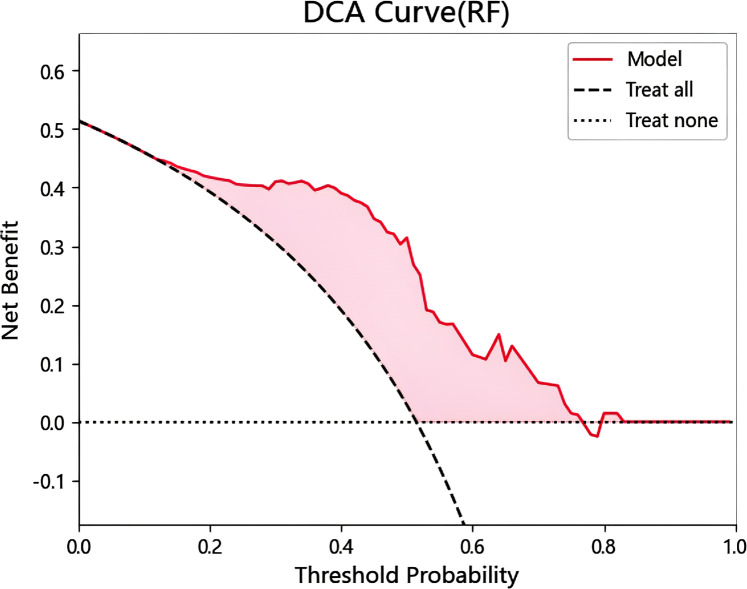
A retrospective analysis was conducted on data from 160 diagnosed patients with NPC confirmed by pathology at the First Affiliated Hospital of Bengbu Medical College. Patients were divided into effective group (n=116) and noneffective group (n=44) according to the Response Evaluation Criteria in Solid Tumors 1.1 (RECIST 1.1). After the overall Synthetic Minority Over-sampling Technique (SMOTE) sample balance, the proportion of effective group and invalid group is 1:1, both 116 cases, the total sample number is 232 cases. The region of interest (ROI) depicting the maximum solid component of the tumor on T2-weighted imaging short time inversion recovery (T2WI-STIR), contrast-enhanced T1-weighted imaging (CE-T1WI), and diffusion-weighted imaging (DWI) images was delineated, and radiomic features were extracted. Feature selection was performed through least absolute shrinkage and selection operator (LASSO) ridge regression, and based on the selected features, six machine learning models including random forest (RF), Extreme Gradient Boosting (XGBoost), support vector machine (SVM), logistic regression (LR), Light Gradient Boosting Machine (LGB) and K-nearest neighbor (KNN) were constructed. The model performance of the training set was verified by using the 5-fold cross-validation method, and the effect evaluation and performance visualization were performed on the test set. After that, the SHAP plot was established based on the feature weights, and finally the benefit degree of patients was analyzed using the DCA curve.
A total of 3375 radiomic features were extracted, and 25 important features were selected after feature extraction to establish six machine learning models. The RF model exhibited the highest performance, achieving an AUC of 0.801, accuracy of 0.800, precision of 0.844, recall of 0.750, and F1 score of 0.794 within the test set. DCA results showed that patients could get good benefits.
The machine learning model based on multimodal MRI radiomic features may serve as a promising tool for predicting the efficacy of chemoradiotherapy in patients with advanced NPC.
机器学习方法在预测鼻咽癌(NPC)患者放化疗疗效方面发挥着重要作用。本研究探讨基于多模态磁共振成像(MRI)影像组学特征的机器学习模型对晚期NPC患者临床放化疗疗效的预测价值。
对蚌埠医学院第一附属医院160例经病理确诊的NPC患者的数据进行回顾性分析。根据实体瘤疗效评价标准1.1(RECIST 1.1)将患者分为有效组(n = 116)和无效组(n = 44)。经总体合成少数过采样技术(SMOTE)样本平衡后,有效组与无效组比例为1:1,均为116例,总样本数为232例。在T2加权成像短时反转恢复(T2WI-STIR)、对比增强T1加权成像(CE-T1WI)和扩散加权成像(DWI)图像上勾勒出描绘肿瘤最大实性成分的感兴趣区(ROI),并提取影像组学特征。通过最小绝对收缩和选择算子(LASSO)岭回归进行特征选择,并基于所选特征构建包括随机森林(RF)、极端梯度提升(XGBoost)、支持向量机(SVM)、逻辑回归(LR)、轻梯度提升机(LGB)和K近邻(KNN)在内的6种机器学习模型。采用5折交叉验证法验证训练集的模型性能,并对测试集进行效果评估和性能可视化。之后,基于特征权重建立SHAP图,最后使用决策曲线分析(DCA)曲线分析患者的获益程度。
共提取3375个影像组学特征,特征提取后选择25个重要特征建立6种机器学习模型。RF模型表现出最高性能,在测试集中AUC为0.801,准确率为0.800,精确率为0.844,召回率为0.750,F1分数为0.794。DCA结果显示患者可获得良好获益。
基于多模态MRI影像组学特征的机器学习模型可能是预测晚期NPC患者放化疗疗效的一种有前景的工具。