Ochirbat Enkhlin, Yang Junwhee, Chattopadhyay Aritra Nath, Park Jungmi, Jiang Mingdi, Paczesny Jan, Rotello Vincent M
Institute of Physical Chemistry, Polish Academy of Sciences Kasprzaka 44/52 01224 Warsaw Poland
Department of Chemistry, University of Massachusetts Amherst 710 N. Pleasant St Amherst MA 00103 USA
Sens Diagn. 2025 Jul 2. doi: 10.1039/d5sd00069f.
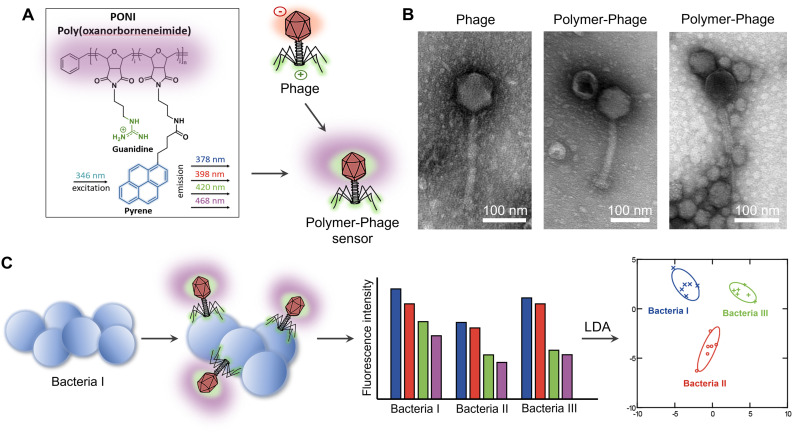
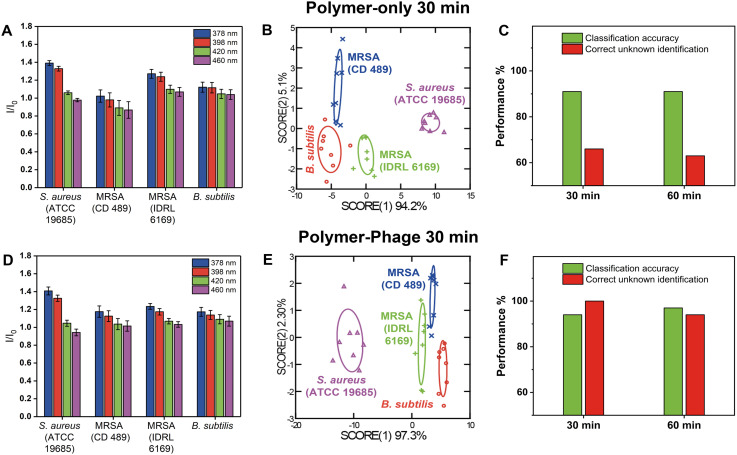
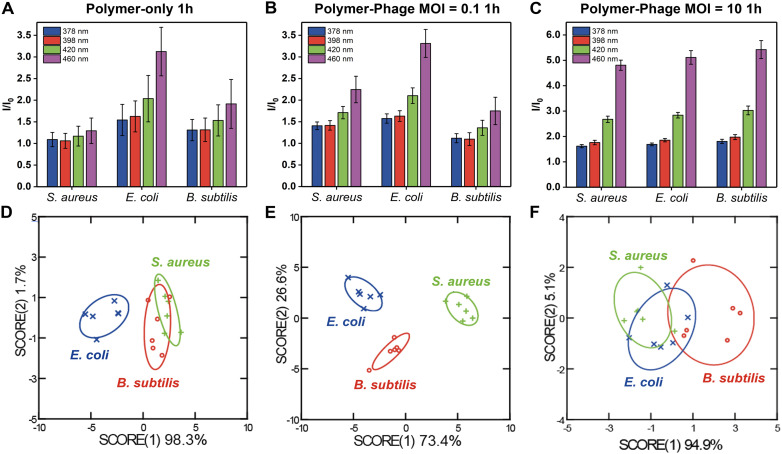
Pathogenic bacteria, such as methicillin-resistant (MRSA), pose significant challenges to public health due to their resistance to conventional antibiotics. Early and accurate identification of bacterial species and discrimination of their strains is critical for guiding effective treatments and infection control. In this study, we develop a polymer-phage sensor platform that integrates polymer-based fluorescence sensing with phage-host specificity for bacterial identification. The sensor successfully differentiates three bacterial species (, , and ) and closely related strains of (methicillin-sensitive (MSSA) and MRSA) with high classification accuracy (94-100%) and correct unknown identification rates (94-100%) under optimized conditions. By leveraging phage-host interactions and polymer binding properties, the polymer-phage sensor overcomes the limitations of traditional "lock-and-key" biosensors, offering enhanced specificity and reliability. This platform's rapid response time and adaptability make it a promising tool for clinical diagnostics and public health applications, particularly in combating antibiotic-resistant bacteria.
致病性细菌,如耐甲氧西林金黄色葡萄球菌(MRSA),由于其对传统抗生素具有抗性,给公共卫生带来了重大挑战。早期准确鉴定细菌种类并区分其菌株对于指导有效治疗和感染控制至关重要。在本研究中,我们开发了一种聚合物-噬菌体传感器平台,该平台将基于聚合物的荧光传感与噬菌体-宿主特异性相结合用于细菌鉴定。在优化条件下,该传感器成功区分了三种细菌种类( 、 和 )以及金黄色葡萄球菌的密切相关菌株(甲氧西林敏感金黄色葡萄球菌(MSSA)和MRSA),具有高分类准确率(94 - 100%)和正确未知识别率(94 - 100%)。通过利用噬菌体-宿主相互作用和聚合物结合特性,聚合物-噬菌体传感器克服了传统“锁钥”生物传感器的局限性,具有更高的特异性和可靠性。该平台的快速响应时间和适应性使其成为临床诊断和公共卫生应用中的一种有前途的工具,特别是在对抗抗生素耐药细菌方面。