Ming Liyan, Romelli Anna, Lifante José, Canton Patrizia, Lifante-Pedrola Ginés, Jaque Daniel, Ximendes Erving, Marin Riccardo
Nanomaterials for Bioimaging Group (nanoBIG), Departamento de Física de Materiales, Facultad de Ciencias, Universidad Autónoma de Madrid, Madrid, Spain.
Nanomaterials for Bioimaging Group (nanoBIG), Instituto Ramón y Cajal de Investigación Sanitaria (IRYCIS), Hospital Ramón y Cajal, Madrid, Spain.
Nat Commun. 2025 Jul 11;16(1):6429. doi: 10.1038/s41467-025-59681-7.
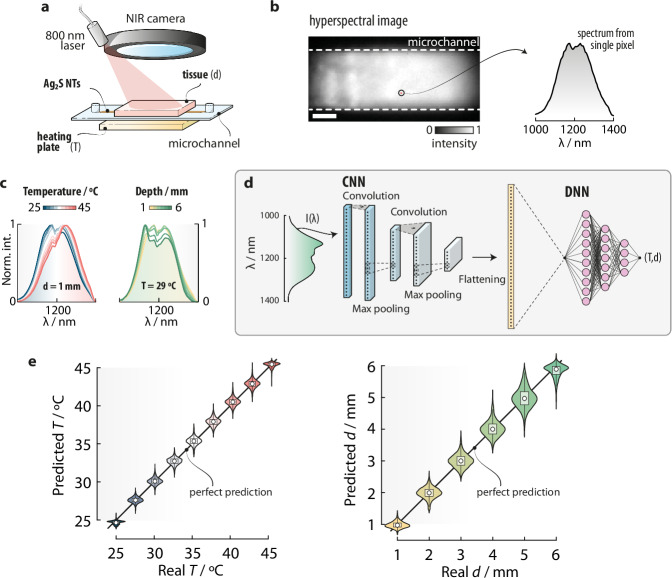
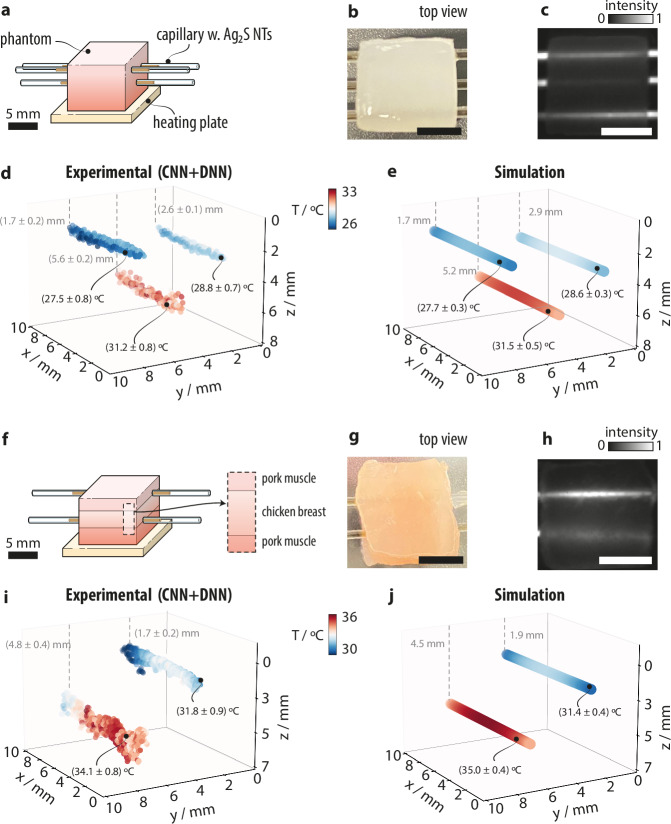
Luminescence thermometry affords remote thermal readouts with high spatial resolution in a minimally invasive way. This technology has advanced our understanding of biological mechanisms and physical processes from the macro- to the submicrometric scale. Yet, current approaches only allow obtaining 2D thermal images. This aspect limits the potential of this technology, given the inherent three-dimensional nature of heat diffusion processes. Despite initial attempts, a credible method that allows extracting 3D thermal images via luminescence is missing. Here, we design such a method combining AgS nanothermometers and machine learning algorithms. The approach leverages the distortions in the emission spectra of luminescent nanothermometers caused by changes in temperature and tissue-induced photon extinction. The optimized neural network-based algorithm can extract this information and provide 3D thermal images of complex nanothermometer patterns. Although tested for luminescence thermometry at the in vivo level, this method has far-reaching implications for luminescence-supported 3D sensing in biological systems in general.
发光测温技术能够以微创方式实现具有高空间分辨率的远程热读数。这项技术推动了我们对从宏观到亚微米尺度的生物机制和物理过程的理解。然而,目前的方法仅能获取二维热图像。鉴于热扩散过程固有的三维性质,这一方面限制了该技术的潜力。尽管有初步尝试,但仍缺少一种可靠的通过发光提取三维热图像的方法。在此,我们设计了一种结合硫化银纳米温度计和机器学习算法的方法。该方法利用了温度变化和组织引起的光子消光导致的发光纳米温度计发射光谱的畸变。经过优化的基于神经网络的算法能够提取此信息,并提供复杂纳米温度计图案的三维热图像。尽管该方法已在体内水平进行了发光测温测试,但总体而言,它对生物系统中基于发光的三维传感具有深远影响。