Rashid Fatini Dayana Binti, Mohd Roslan Siti Nabilah Binti, Lit Kai Jacky Tan, Ahmad Tajuddin Afida Binti, Ramanoon Siti Zubaidah, Othman Azalea Hani, Sadiq Mohammed Babatunde
Department of Farm and Exotic Animal Medicine and Surgery, Faculty of Veterinary Medicine, Universiti Putra Malaysia, Serdang 43400, Selangor, Malaysia.
Department of Veterinary Pathology and Microbiology, Faculty of Veterinary Medicine, Universiti Putra Malaysia, Serdang 43400, Selangor, Malaysia.
Animals (Basel). 2025 Jun 24;15(13):1858. doi: 10.3390/ani15131858.
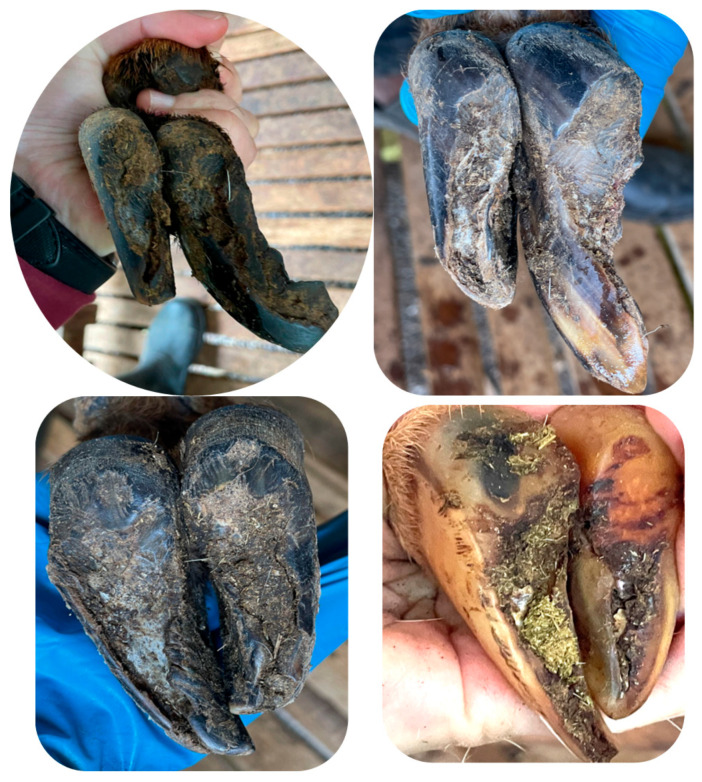
Hoof disorders in small ruminants pose significant challenges to animal welfare and farm productivity. This study presents the first attempt to determine the prevalence of lameness and hoof disorders and their associated risk factors in goat and sheep farms in Selangor, Malaysia. Locomotion scores were collected from 226 animals (126 sheep and 100 goats) across 10 farms. A hoof examination was conducted, and hoof lesions were identified through detailed photographic evaluation. On-farm assessments and interviews were conducted to gather information on management practices from the farms. Data were analysed using descriptive statistics, bivariate analysis, and logistic regression models. The prevalence of lameness was 42.8% (95% CI 34.2 to 51.9) in sheep and 23.0% (95% CI 16.3-38.4) in goats. Significant variation ( > 0.05) in lameness prevalence was observed across farms, ranging from 26.7% to 61.5% in sheep and 7.7% to 30.8% in goat farms. The majority of lameness and hoof lesions were observed in the hindlimbs of both species. The prevalence of hoof disorders was 91.3% (95% CI 84.6-95.4) in sheep and 43.0% in goats (95% CI 21.4-58.0). The predominant hoof disorders were overgrown wall horn, white line disease, sole bruise, and wall fissures. No hoof affections of infectious origin were observed in the sampled animals. Risk factors for lameness and hoof lesions in sheep included pregnancy, semi-intensive management, and breeds other than Damara. Higher odds of lameness were observed in exotic goat breeds and those with overgrown wall horns. In conclusion, this study revealed a high prevalence of lameness and hoof disorders in goat and sheep farms, highlighting the need to address these important welfare and economic issues. While the identified risk factors could be considered for the management of hoof disorders in small ruminant farms, a larger sample size that is representative of the sheep and goat population is recommended for more generalizable results.
小型反刍动物的蹄部疾病对动物福利和农场生产力构成了重大挑战。本研究首次尝试确定马来西亚雪兰莪州山羊和绵羊养殖场中跛足和蹄部疾病的患病率及其相关风险因素。从10个农场的226只动物(126只绵羊和100只山羊)收集了运动评分。进行了蹄部检查,并通过详细的照片评估确定了蹄部病变。在农场进行评估和访谈,以收集有关农场管理实践的信息。使用描述性统计、双变量分析和逻辑回归模型对数据进行了分析。绵羊跛足的患病率为42.8%(95%可信区间34.2至51.9),山羊为23.0%(95%可信区间16.3 - 38.4)。各农场间跛足患病率存在显著差异(>0.05),绵羊的患病率在26.7%至61.5%之间,山羊养殖场在7.7%至30.8%之间。两种动物的大多数跛足和蹄部病变都出现在后肢上。绵羊蹄部疾病的患病率为91.3%(95%可信区间84.6 - 95.4),山羊为43.0%(95%可信区间21.4 - 58.0)。主要的蹄部疾病是蹄壁角质过度生长、白线病、蹄底挫伤和蹄壁裂缝。在抽样动物中未观察到感染性蹄部疾病。绵羊跛足和蹄部病变的风险因素包括怀孕、半集约化管理以及除达马拉品种以外的其他品种。外来山羊品种以及蹄壁角质过度生长的山羊发生跛足的几率更高。总之,本研究揭示了山羊和绵羊养殖场中跛足和蹄部疾病的高患病率,凸显了解决这些重要的福利和经济问题的必要性。虽然在小型反刍动物农场管理蹄部疾病时可以考虑已确定的风险因素,但建议采用更大的样本量以代表绵羊和山羊群体,从而获得更具普遍性的结果。