Zhang Mengzhen, Zhang Ying, Lin Yeyun, Wang Yuhua, Zou Jishuang, Qiu Miaoen, Zhang Qingxu, Ye Jianghua, Jia Xiaoli, He Haibin, Wang Haibin, Zhang Qi
College of Resources and Environment, Fujian Agriculture and Forestry University, Fuzhou 350002, China.
College of Tea and Food Science, Wuyi University, Wuyishan 354300, China.
Foods. 2025 Jun 21;14(13):2169. doi: 10.3390/foods14132169.
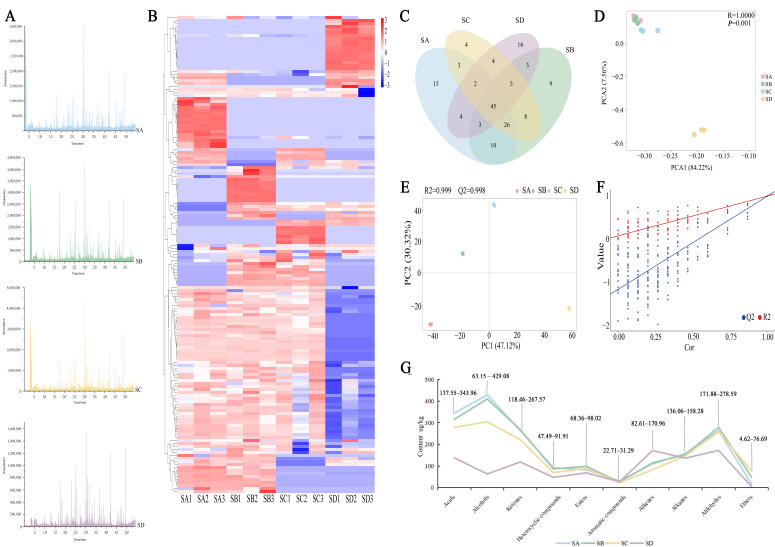
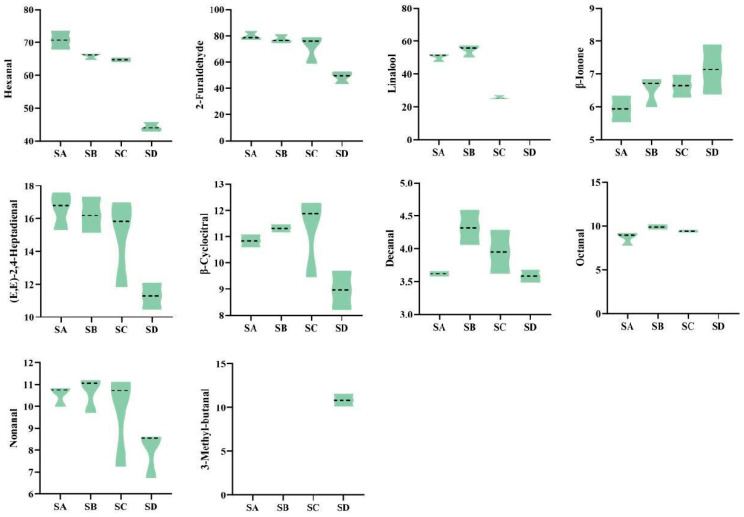
Wuyi Shuixian tea, a premium oolong tea known for its complex floral-fruity aroma, exhibits significant quality variations across different grades. This study systematically analyzed the aroma characteristics and key fragrant compounds of four grades (Grand Prize SA, First Prize SB, Outstanding Award SC, and Non-award SD) using headspace solid-phase microextraction-gas chromatography-mass spectrometry (HS-SPME-GC-MS), odor activity value (OAV) analysis, and multivariate statistical methods. A total of 159 volatile compounds were identified, with similar compound categories but distinct concentration gradients between grades. OAV-splitting analysis (based on OAV ≥ 1 as the threshold for aroma activity) identified β-ionone (fruity), octanal (fatty), and linalool (floral) as core aroma-active contributors, as their OAV values significantly exceeded 10 in awarded grades (SA, SB, SC), indicating dominant roles in sensory perception. Notably, linalool, a floral marker, showed a concentration gradient (SA > SB > SC) and was absent in SD, serving as a critical determinant of grade differentiation. Orthogonal partial least squares-discriminant analysis (OPLS-DA) further distinguished awarded grades (SA, SB, SC) by balanced fruity, floral, and woody notes, while SD lacked floral traits and exhibited burnt aromas. This classification was supported by hierarchical clustering analysis (HCA) of volatile profiles and principal component analysis (PCA). Electronic nose data validated these findings, showing strong correlations between sensor responses (W5S/W2W) and key compounds like hexanal and β-ionone. This study elucidates the molecular basis of aroma-driven quality grading in Wuyi Shuixian tea, providing a scientific framework for optimizing processing techniques and enhancing quality evaluation standards. The integration of chemical profiling with sensory attributes advances precision in tea industry practices, bridging traditional grading with objective analytical metrics.
武夷水仙茶是一种优质乌龙茶,以其复杂的花果香气而闻名,不同等级间品质差异显著。本研究采用顶空固相微萃取-气相色谱-质谱联用(HS-SPME-GC-MS)、气味活性值(OAV)分析和多元统计方法,系统分析了四个等级(特等SA、一等SB、优秀奖SC和无奖SD)的香气特征和关键香气成分。共鉴定出159种挥发性化合物,各等级间化合物类别相似,但浓度梯度不同。OAV拆分分析(以OAV≥1作为香气活性阈值)确定β-紫罗兰酮(果香)、辛醛(脂香)和芳樟醇(花香)为核心香气活性成分,因其在获奖等级(SA、SB、SC)中的OAV值显著超过10,表明它们在感官感知中起主导作用。值得注意的是,作为花香标志物的芳樟醇呈现浓度梯度(SA>SB>SC),且在SD等级中未检出,是等级分化的关键决定因素。正交偏最小二乘法判别分析(OPLS-DA)进一步通过平衡的果香、花香和木香香气区分获奖等级(SA、SB、SC),而SD等级缺乏花香特征并呈现焦香气味。挥发性成分的层次聚类分析(HCA)和主成分分析(PCA)支持了这一分类。电子鼻数据验证了这些发现,显示传感器响应(W5S/W2W)与己醛和β-紫罗兰酮等关键化合物之间存在强相关性。本研究阐明了武夷水仙茶香气驱动的品质分级的分子基础,为优化加工工艺和提高品质评价标准提供了科学框架。化学分析与感官特性的整合提高了茶叶行业实践的精度,将传统分级与客观分析指标联系起来。