Liao Ruiqi, Zhang Ruiqi, Li Xiaonan, Jiang Mingliang
Molecular Biology of Vegetable Laboratory, College of Horticulture, Shenyang Agricultural University, Shenyang 110866, China.
School of Agriculture, Jilin Agricultural Science and Technology College, Jilin 132101, China.
Plants (Basel). 2025 Jun 25;14(13):1947. doi: 10.3390/plants14131947.
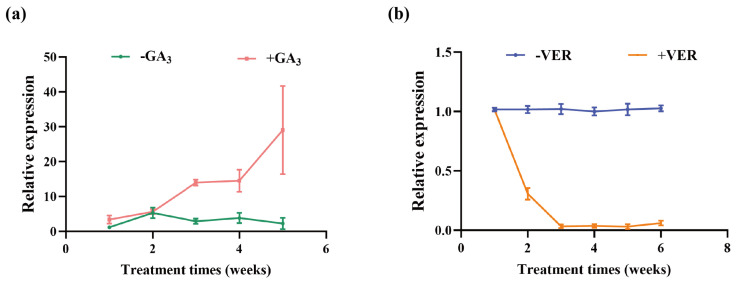
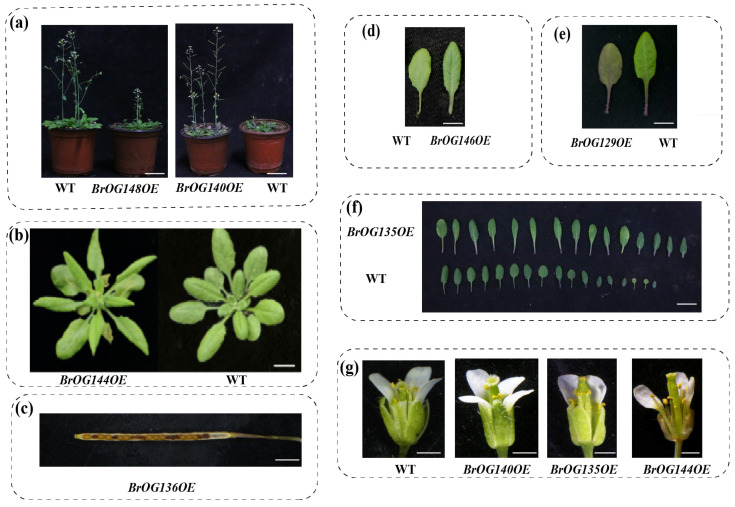
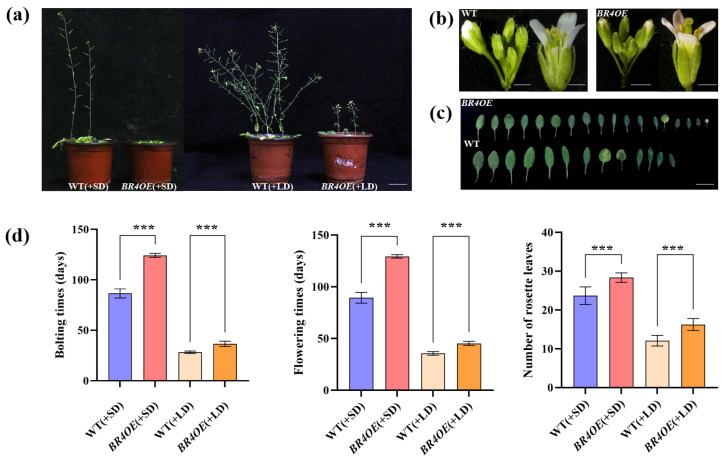
Orphan genes (), which are unique to a specific taxon and have no detectable sequence homology to any known genes across other species, play a pivotal role in governing species-specific phenotypic traits and adaptive evolution. In this study, 20 of Chinese cabbage (, ) were transferred into by genetic transformation to construct an overexpression library in which 50% of the transgenic lines had a delayed flowering phenotype, 15% had an early flowering phenotype, and 35% showed no difference in flowering time compared to control plants. There were many other phenotypes attached to these transgenic lines, such as leaf color, number of rosette leaves, and silique length. To understand the impact of on delayed flowering, , which showed the most significantly delayed flowering phenotype, was chosen for further analysis, and was renamed (). In , the expression of key flowering genes, including and , significantly decreased, and and expression increased. GUS staining revealed promoter activity mainly in the roots, flower buds and leaves. qRT-PCR showed that primarily functions in the flowers, flower buds, and leaves of Chinese cabbage. BR4 is a protein localized in the nucleus, cytoplasm, and cell membrane. The accelerated flowering time phenotype of was observed under gibberellin and vernalization treatments, indicating that regulates flowering time in response to these treatments. These results provide a foundation for elucidating the mechanism by which regulate delayed flowering and have significance for the further screening of bolting-resistant Chinese cabbage varieties.
孤儿基因()是特定分类群所特有的,与其他物种的任何已知基因均无可检测到的序列同源性,在控制物种特异性表型特征和适应性进化中起关键作用。在本研究中,通过遗传转化将20个大白菜(,)基因转入,构建过表达文库,其中50%的转基因株系表现出开花延迟表型,15%表现出开花提前表型,35%与对照植株相比开花时间无差异。这些转基因株系还附着有许多其他表型,如叶片颜色、莲座叶数量和角果长度。为了解对开花延迟的影响,选择表现出最显著开花延迟表型的进行进一步分析,并将其重新命名为()。在中,包括和在内的关键开花基因的表达显著降低,而和的表达增加。GUS染色显示启动子活性主要在根、花芽和叶片中。qRT-PCR表明主要在大白菜的花、花芽和叶片中发挥作用。BR4是一种定位于细胞核、细胞质和细胞膜的蛋白质。在赤霉素和春化处理下观察到的开花时间加速表型,表明响应这些处理调节开花时间。这些结果为阐明调节开花延迟的机制提供了基础,对进一步筛选抗抽薹大白菜品种具有重要意义。