Marín-García Pablo Jesús, Mateo-López Jorge, Cortés-García César, Llobat Lola, Huertas-Herrera Alejandro, Toro-Manríquez Mónica, Cambra-López María, Pascual Juan José, Hedemann Mette Skou
Department of Animal Production and Health, Veterinary Public Health and Food Science and Technology (PASAPTA), Facultad de Veterinaria, Universidad Cardenal Herrera-CEU, CEU Universities, 46113 Valencia, Spain.
Institute for Animal Science and Technology, Universitat Politècnica de València, Camino de Vera s/n, 46022 Valencia, Spain.
Int J Mol Sci. 2025 Jun 24;26(13):6047. doi: 10.3390/ijms26136047.
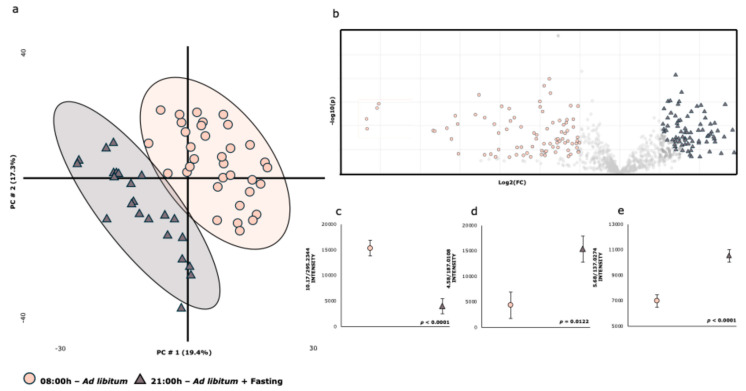
Environmental pollution remains a significant challenge in animal production. The "ideal protein" concept refers to an amino acid profile that precisely meets the animal's nutritional requirements, optimizing nutrient utilization and minimizing waste excretion. This study applied untargeted metabolomics to explore metabolic changes induced by limiting AA. Two experimental diets were used in 47-day-old growing rabbits: Met+ (with a methionine level balanced to its optimal utilization) and Met- (with a methionine level that was clearly limiting). A total of 68 blood samples were taken for untargeted metabolomics analysis and 88 were taken for targeted plasmatic urea nitrogen analysis, collected at 08:00 (in ad libitum feeding animals) and 21:00 (after a feeding event in 10 h fasting animals). Our results revealed that both sampling time and diet (at each time point) exerted a significant modulatory influence on the metabolome. Interestingly, the difference between the metabolomes obtained with the different diets was less pronounced at 08:00, likely due to the caecotrophy effect, compared to 21:00, when higher intake and lower caecotrophy frequency were observed. This study identifies pseudourine, citric acid, pantothenic acid, and enterolactone sulfate as promising metabolites that could be targeted in order to refine the ideal protein concept, thus improving nutrient efficiency and reducing the environmental impact of animal production.
环境污染仍然是动物生产中的一个重大挑战。“理想蛋白质”概念是指一种氨基酸谱,它能精确满足动物的营养需求,优化养分利用并最大限度地减少废物排泄。本研究应用非靶向代谢组学来探索限制氨基酸诱导的代谢变化。在47日龄的生长兔中使用了两种实验日粮:Met+(蛋氨酸水平平衡至最佳利用率)和Met-(蛋氨酸水平明显受限)。共采集了68份血样用于非靶向代谢组学分析,88份用于靶向血浆尿素氮分析,分别在08:00(自由采食动物)和21:00(10小时禁食动物进食后)采集。我们的结果表明,采样时间和日粮(在每个时间点)对代谢组均有显著的调节影响。有趣的是,与21:00相比,在08:00时不同日粮获得的代谢组之间的差异不太明显,这可能是由于盲肠营养效应,在21:00时观察到更高的摄入量和更低的盲肠营养频率。本研究确定了假尿嘧啶、柠檬酸、泛酸和硫酸肠内酯是有前景的代谢物,可作为靶点以完善理想蛋白质概念,从而提高养分效率并减少动物生产对环境的影响。