Nakayama Masaaki, Miyakawa Hiroyuki, Ohama Kazuya, Kimura Hirokazu
Division of Research Control, St Luke's International University, Tokyo 104-0044, Japan.
Head Office for Open Innovation Business Development Strategy, Tohoku University, Sendai 980-8575, Japan.
Int J Mol Sci. 2025 Jul 4;26(13):6472. doi: 10.3390/ijms26136472.
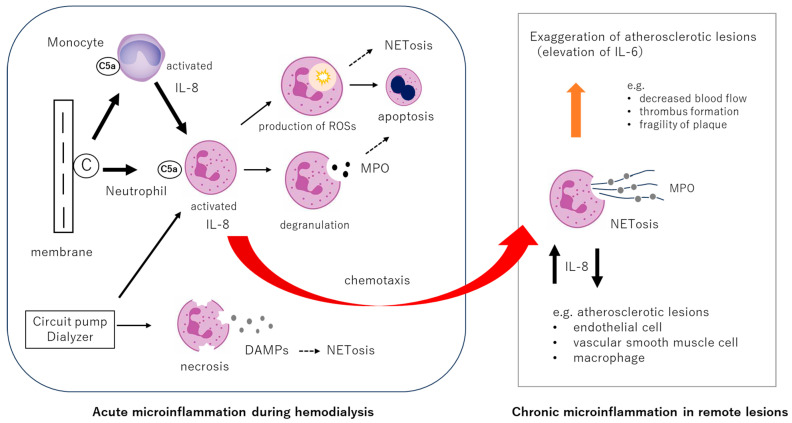
This review highlights recent insights into the pathophysiology and therapeutic strategies for improving biocompatibility in hemodialysis. Hemodialysis activates the innate immune system, particularly the complement cascade and neutrophils, leading to acute microinflammation. Interleukin-8 (IL-8), which increases during dialysis, promotes neutrophil chemotaxis and neutrophil extracellular trap (NET) formation, triggering myeloperoxidase (MPO) release and oxidative stress. Neutrophil accumulation in atherosclerotic plaques exacerbates vascular inflammation through IL-6 upregulation. Elevated levels of IL-8, MPO, and NET-related biomarkers are associated with increased all-cause and cardiovascular mortality in dialysis patients. Strategies to mitigate these effects include the use of advanced membrane materials (e.g., AN69, vitamin E-coated, polymethyl methacrylate), novel dialysis modalities (e.g., high-volume online hemodiafiltration, cool dialysate, hydrogen-enriched dialysate), and citrate-based anticoagulation. These approaches aim to suppress complement activation, reduce oxidative stress, and limit neutrophil-induced damage. Enhancing biocompatibility is crucial for reducing cardiovascular complications and improving outcomes in dialysis patients. Suppressing the innate immune response during dialysis may become a future cornerstone in extracorporeal blood purification therapy.
本综述重点介绍了近期对血液透析中生物相容性改善的病理生理学和治疗策略的见解。血液透析会激活先天性免疫系统,尤其是补体级联反应和中性粒细胞,从而导致急性微炎症。透析过程中增加的白细胞介素-8(IL-8)会促进中性粒细胞趋化作用和中性粒细胞胞外陷阱(NET)形成,触发髓过氧化物酶(MPO)释放和氧化应激。动脉粥样硬化斑块中的中性粒细胞积聚通过上调IL-6加剧血管炎症。IL-8、MPO和NET相关生物标志物水平升高与透析患者全因死亡率和心血管死亡率增加有关。减轻这些影响的策略包括使用先进的膜材料(如AN69、维生素E涂层、聚甲基丙烯酸甲酯)、新型透析方式(如高容量在线血液透析滤过、低温透析液、富氢透析液)和基于柠檬酸盐的抗凝。这些方法旨在抑制补体激活、减少氧化应激并限制中性粒细胞引起的损伤。提高生物相容性对于减少心血管并发症和改善透析患者的预后至关重要。在透析过程中抑制先天性免疫反应可能会成为未来体外血液净化治疗的基石。