Zirnbauer Rebecca, Ammon Daphni, Renner Annalena, Hartman Noam, Kalinina Polina, Starlinger Patrick, Stremitzer Stefan, Schwarz Christoph, Kaczirek Klaus, Bergmann Michael, Pils Dietmar, Laengle Johannes
Division of Visceral Surgery, Department of General Surgery, Comprehensive Cancer Center Vienna, Medical University of Vienna, Waehringer Guertel 18-20, 1090, Vienna, Austria.
Department of Pathology, Comprehensive Cancer Center Vienna, Medical University of Vienna, Waehringer Guertel 18-20, 1090, Vienna, Austria.
J Transl Med. 2025 Jul 12;23(1):786. doi: 10.1186/s12967-025-06850-3.
Colorectal liver metastases (CRLM) are the leading cause of colorectal cancer (CRC)-related mortality. Transfer RNA-derived fragments (tRFs), a novel class of small non-coding RNAs (sncRNA), regulate gene expression, stress response, and immune functions in cancer. While increasingly implicated in CRC progression, their prognostic significance in CRLM remains unknown. This study investigates the abundance and prognostic value of genomic (ge) and mitochondrial (mt) tRFs in CRLM.
Tumor samples from CRLM patients who underwent curative liver resection between January 2012 and December 2015 were retrospectively analyzed. Small RNA sequencing (sRNA-seq) quantified ge- and mt-tRF expression in tumor tissue. Event-free survival (EFS) was the primary outcome. Associations between tRF expression and EFS were evaluated using Cox regression, spline modeling, and network analysis.
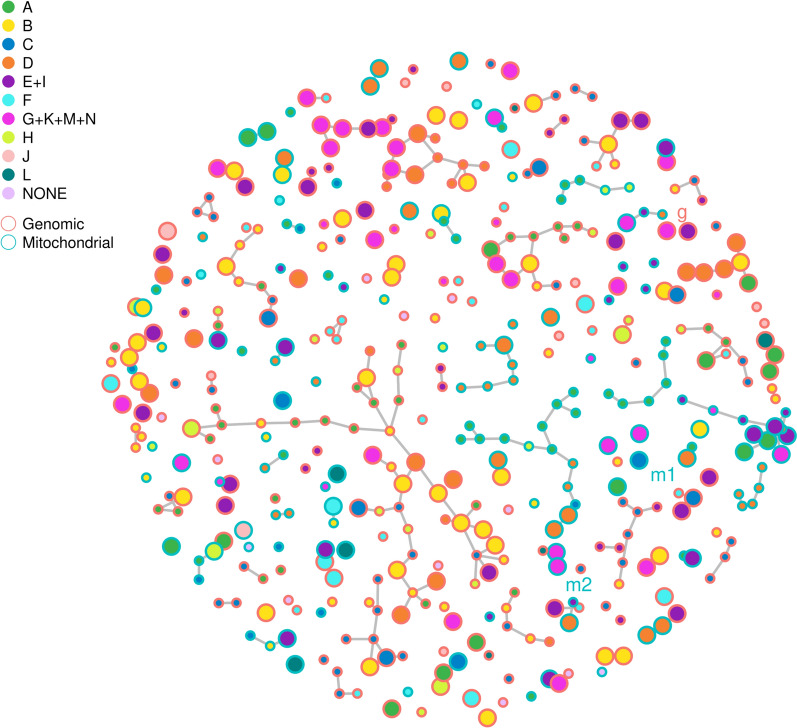
Among 588 screened samples, 40 met eligibility criteria (18 females [45%], median age 64 [42-79]). A total of 432 tRFs were identified, with ge-tRFs (67%) more abundant than mt-tRFs (33%). Spline regressions classified tRFs into ten prognostic groups. High ge-tRF abundance was predominantly associated with unfavorable EFS (FDR < 0.2; 94%), while mt-tRFs were significantly (p < 0.001; χ test) more often linked to favorable EFS (FDR < 0.2; 26%). Network analysis of tRF abundance correlations revealed higher intra-mitochondrial network density compared to the intra-genomic tRF network. No significant structural differences were observed between prognostically significant vs. non-significant or favorable vs. unfavorable tRFs. Key tRF candidates, including tRHalve3-His-CAU and tRNAleader-Gln-UUG (mt-tRFs), as well as tRFmisc-Tyr-GTA (ge-tRF), remained independent prognostic markers after adjusting for clinical covariates.
This study provides the first comprehensive characterization of tRF expression in CRLM, identifying distinct prognostic roles for ge- and mt-tRFs. While ge-tRFs correlated with poor prognosis, several mt-tRFs were linked to favorable outcomes, highlighting their potential as novel prognostic biomarkers and therapeutic targets.
结直肠癌肝转移(CRLM)是结直肠癌(CRC)相关死亡的主要原因。转运RNA衍生片段(tRFs)是一类新型的小非编码RNA(sncRNA),可调节癌症中的基因表达、应激反应和免疫功能。虽然它们越来越多地与CRC进展相关,但其在CRLM中的预后意义仍不清楚。本研究调查了CRLM中基因组(ge)和线粒体(mt)tRFs的丰度及预后价值。
回顾性分析2012年1月至2015年12月期间接受根治性肝切除术的CRLM患者的肿瘤样本。小RNA测序(sRNA-seq)定量肿瘤组织中ge-和mt-tRF的表达。无事件生存期(EFS)是主要结局。使用Cox回归、样条建模和网络分析评估tRF表达与EFS之间的关联。
在588个筛选样本中,40个符合纳入标准(18名女性[45%],中位年龄64岁[42 - 79岁])。共鉴定出432个tRFs,其中ge-tRFs(67%)比mt-tRFs(33%)更丰富。样条回归将tRFs分为十个预后组。高ge-tRF丰度主要与不良EFS相关(FDR < 0.2;94%),而mt-tRFs与良好EFS的关联更显著(p < 0.001;χ检验)(FDR < 0.2;26%)。tRF丰度相关性的网络分析显示,与基因组内tRF网络相比,线粒体内网络密度更高。在预后显著与不显著或良好与不良的tRFs之间未观察到明显的结构差异。关键tRF候选物,包括tRHalve3-His-CAU和tRNAleader-Gln-UUG(mt-tRFs),以及tRFmisc-Tyr-GTA(ge-tRF),在调整临床协变量后仍是独立的预后标志物。
本研究首次全面描述了CRLM中tRF的表达情况,确定了ge-和mt-tRFs不同的预后作用。虽然ge-tRFs与不良预后相关,但一些mt-tRFs与良好结局相关,突出了它们作为新型预后生物标志物和治疗靶点的潜力。