Department of Pathology, Changde Hospital, Xiangya School of Medicine, Central South University (The first people's hospital of Changde city), Changde, Hunan, 415000, China.
Department of Infectious Diseases, Guizhou Provincial people's Hospital, Guiyang, Guizhou, 550002, China.
J Exp Clin Cancer Res. 2024 Aug 17;43(1):230. doi: 10.1186/s13046-024-03132-6.
tRNA-derived small RNAs (tsRNAs) are newly discovered non-coding RNA, which are generated from tRNAs and are reported to participate in several biological processes in diseases, especially cancer; however, the mechanism of tsRNA involvement in colorectal cancer (CRC) and 5-fluorouracil (5-FU) is still unclear.
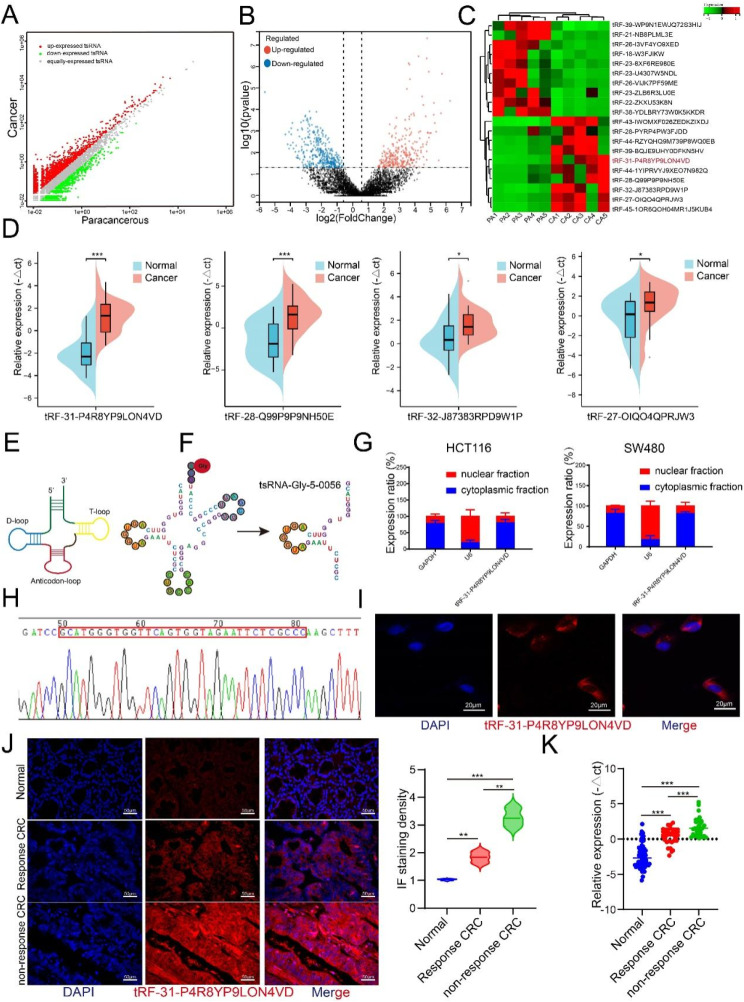
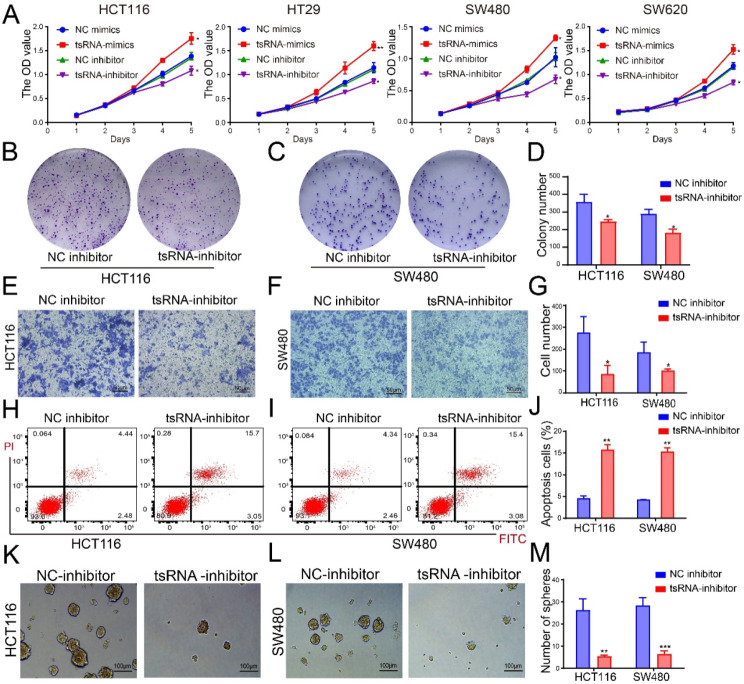
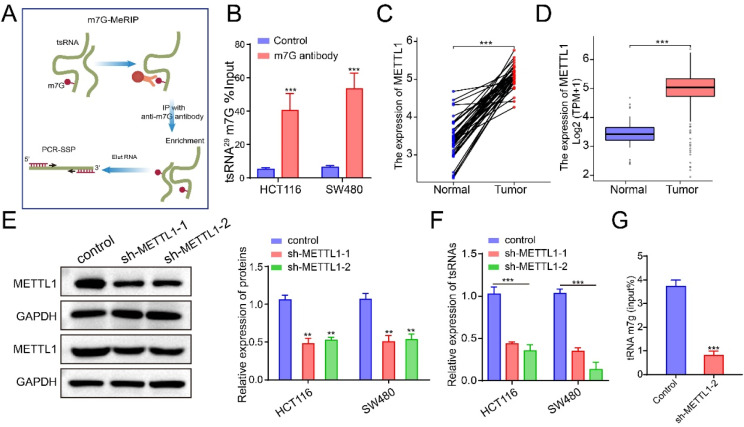
RNA sequencing was performed to identify differential expression of tsRNAs in CRC tissues. CCK8, colony formation, transwell assays, and tumor sphere assays were used to investigate the role of tsRNA-GlyGCC in 5-FU resistance in CRC. TargetScan and miRanda were used to identify the target genes of tsRNA-GlyGCC. Biotin pull-down, RNA pull-down, luciferase assay, ChIP, and western blotting were used to explore the underlying molecular mechanisms of action of tsRNA-GlyGCC. The MeRIP assay was used to investigate the N(7)-methylguanosine RNA modification of tsRNA-GlyGCC.
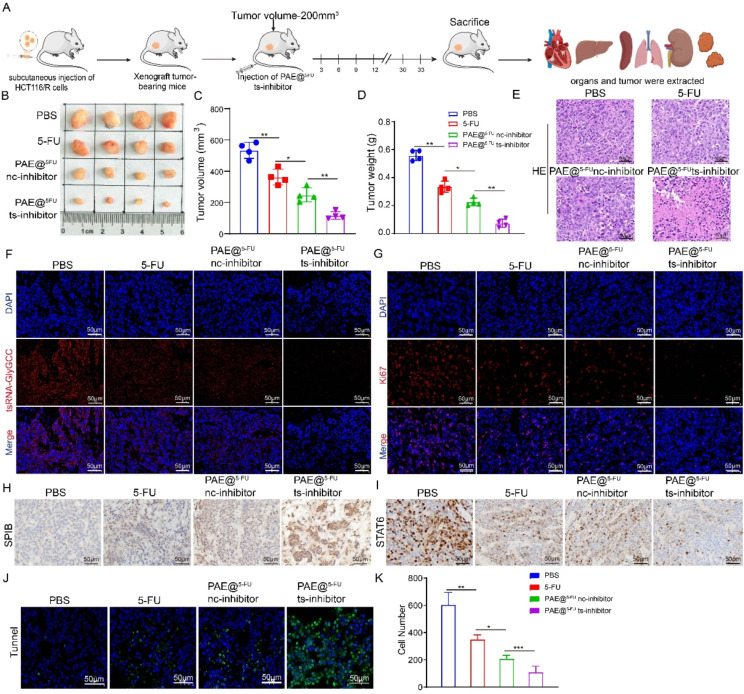
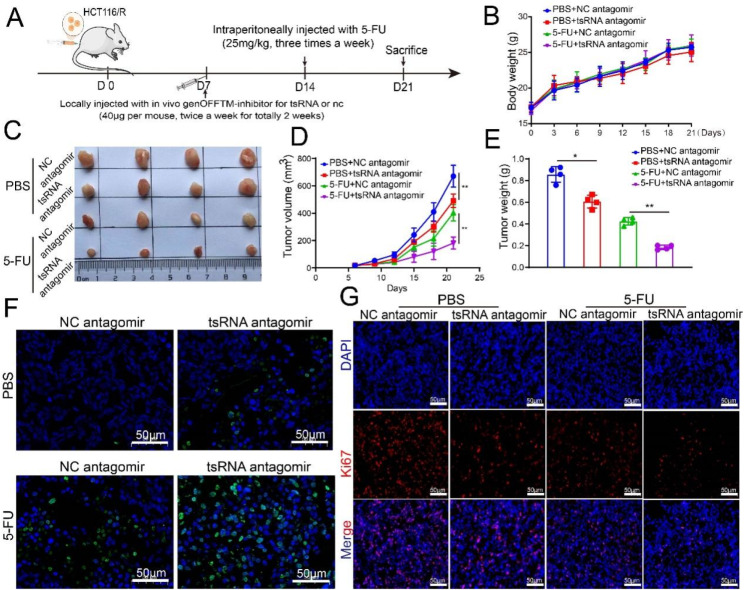
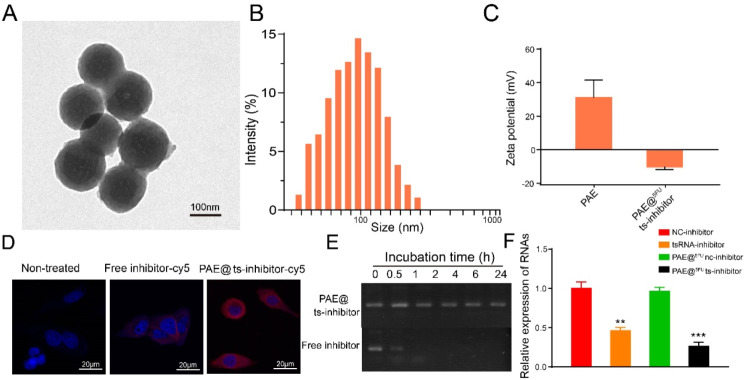
In this study, we uncovered the feature of tsRNAs in human CRC tissues and confirmed a specific 5' half tRNA, 5'tiRNA-Gly-GCC (tsRNA-GlyGCC), which is upregulated in CRC tissues and modulated by METTL1-mediated N(7)-methylguanosine tRNA modification. In vitro and in vivo experiments revealed the oncogenic role of tsRNA-GlyGCC in 5-FU drug resistance in CRC. Remarkably, our results showed that tsRNA-GlyGCC modulated the JAK1/STAT6 signaling pathway by targeting SPIB. Poly (β-amino esters) were synthesized to assist the delivery of 5-FU and tsRNA-GlyGCC inhibitor, which effectively inhibited tumor growth and enhanced CRC sensitive to 5-FU without obvious adverse effects in subcutaneous tumor.
Our study revealed a specific tsRNA-GlyGCC-engaged pathway in CRC progression. Targeting tsRNA-GlyGCC in combination with 5-FU may provide a promising nanotherapeutic strategy for the treatment of 5-FU-resistance CRC.
tRNA 衍生的小 RNA(tsRNA)是新发现的非编码 RNA,由 tRNA 产生,据报道参与疾病中的几种生物过程,尤其是癌症;然而,tsRNA 参与结直肠癌(CRC)和 5-氟尿嘧啶(5-FU)的机制仍不清楚。
采用 RNA 测序鉴定 CRC 组织中 tsRNA 的差异表达。CCK8、集落形成、transwell 测定和肿瘤球测定用于研究 tsRNA-GlyGCC 在 CRC 对 5-FU 耐药中的作用。TargetScan 和 miRanda 用于鉴定 tsRNA-GlyGCC 的靶基因。生物素下拉、RNA 下拉、荧光素酶测定、ChIP 和 Western blotting 用于探索 tsRNA-GlyGCC 的潜在作用机制。MeRIP 测定用于研究 tsRNA-GlyGCC 的 N(7)-甲基鸟苷 RNA 修饰。
在这项研究中,我们揭示了人类 CRC 组织中 tsRNAs 的特征,并证实了一种特定的 5' 半 tRNA,5'tiRNA-Gly-GCC(tsRNA-GlyGCC),在 CRC 组织中上调,并受 METTL1 介导的 N(7)-甲基鸟苷 tRNA 修饰调节。体外和体内实验揭示了 tsRNA-GlyGCC 在 CRC 中 5-FU 耐药中的致癌作用。值得注意的是,我们的结果表明,tsRNA-GlyGCC 通过靶向 SPIB 调节 JAK1/STAT6 信号通路。合成了聚(β-氨基酯)以辅助 5-FU 和 tsRNA-GlyGCC 抑制剂的递送,这有效地抑制了皮下肿瘤的生长,并增强了 CRC 对 5-FU 的敏感性,而没有明显的不良反应。
我们的研究揭示了 CRC 进展中一种特定的 tsRNA-GlyGCC 参与的途径。靶向 tsRNA-GlyGCC 与 5-FU 联合使用可能为治疗 5-FU 耐药性 CRC 提供一种有前途的纳米治疗策略。