Trusel Massimo, Zuo Junfeng, Alam Danyal H, Marks Ethan S, Koch Therese M I, Cao Jie, Pancholi Harshida, Cooper Brenton G, Zhang Wenhao, Roberts Todd F
Department of Neuroscience, UT Southwestern Medical Center, Dallas TX, USA.
Peking-Tsinghua Center for Life Sciences, Academy for Advanced Interdisciplinary Studies, Peking University, China.
bioRxiv. 2025 May 5:2025.05.04.652139. doi: 10.1101/2025.05.04.652139.
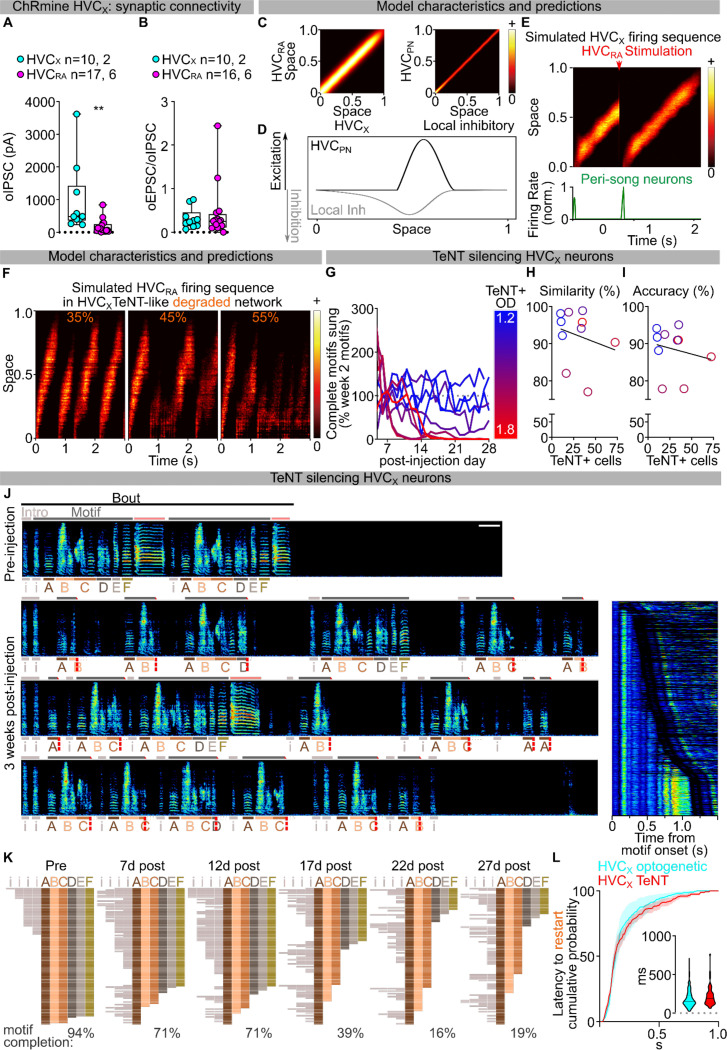
How brain circuits are organized to skillfully produce learned sequences of behaviors is still poorly understood. Here, we functionally examine how the 'cortical' song premotor region HVC, which is necessary for zebra finch song, controls the sequential production of learned song syllables. We find that HVC can generate the complete sequence of learned song syllables independently of its main synaptic input pathways. Thalamic input to HVC is permissive for song initiation but it is not required for transitions between syllables or completing song. We show that excitation of HVC neurons during song reliably causes vocalizations to skip back to the beginning of song, reminiscent of a skipping record. This restarting of syllable sequences can be induced at any moment in song and depends on local circuits within HVC. We identify and computationally model a synaptic network including intratelencephalic premotor and corticostriatal neurons within HVC that are essential for completing song syllable sequences. Together, our results show that the learned zebra finch song is controlled by a 'cortical' sequence-generating network in HVC that, once started, can sustain production of all song syllables independent of major extrinsic input pathways. Thus, sequential neuronal activity can be organized to fuse well-learned vocal-motor sequences, ultimately achieving holistic control of this naturally learned behavior.
大脑回路是如何组织起来以巧妙地产生习得的行为序列的,目前仍知之甚少。在这里,我们从功能上研究了斑胸草雀鸣叫所必需的“皮质”鸣叫前运动区域HVC如何控制习得的鸣叫音节的顺序产生。我们发现,HVC能够独立于其主要突触输入通路产生习得的鸣叫音节的完整序列。丘脑对HVC的输入有利于鸣叫的起始,但在音节之间的转换或完成鸣叫时并非必需。我们表明,在鸣叫过程中HVC神经元的兴奋可靠地导致发声跳回到鸣叫的开头,这让人联想到一张跳针的唱片。这种音节序列的重新启动可以在鸣叫的任何时刻诱发,并且依赖于HVC内的局部回路。我们识别并通过计算模拟了一个突触网络,该网络包括HVC内的脑内前运动神经元和皮质纹状体神经元,它们对于完成鸣叫音节序列至关重要。总之,我们的结果表明,习得的斑胸草雀鸣叫由HVC中的一个“皮质”序列生成网络控制,一旦启动,该网络可以独立于主要的外部输入通路维持所有鸣叫音节的产生。因此,连续的神经元活动可以被组织起来,以融合学得很好的发声-运动序列,最终实现对这种自然习得行为的整体控制。