Ohara Hiroya, Yamanaka Masami, Inoue Kiyoko, Shimizu Hironori, Iguchi Naohiko, Tanaka Keiko, Gopalakrishnan Abilash Valsala, Vellingiri Balachandar, Kinoshita Masako
Department of Neurology, Minaminara General Medical Center, Nara, Japan.
Department of Clinical Laboratory, Minaminara General Medical Center, Nara, Japan.
Front Neurosci. 2025 Jun 27;19:1604552. doi: 10.3389/fnins.2025.1604552. eCollection 2025.
While low-frequency electroencephalographic (EEG) activity increases during hypoglycemia, the relationship between hypoglycemia and changes in epileptic activities has not been fully investigated. Recently, the American Clinical Neurophysiology Society's EEG Terminology 2021 defined criteria for Brief Potentially Ictal Rhythmic Discharges (BIRDs) including rhythmic fast activities. We evaluated the association between hypoglycemia and BIRDs.
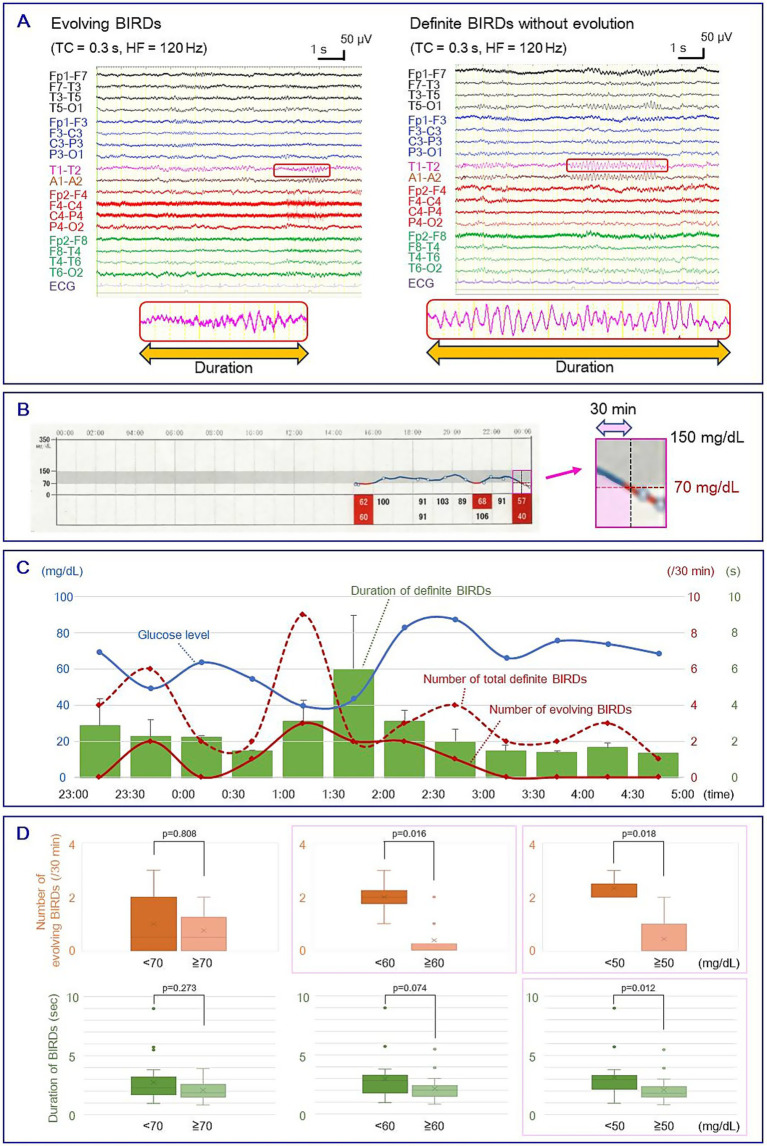
Data from a 27-year-old female with focal epilepsy and idiopathic hypoglycemia, who underwent scalp-recorded long-term video-EEG using the International 10-20 system with T1/T2 electrodes, were analyzed. Her anti-neuronal antibody test results were negative. EEG recordings over 6 h were retrospectively evaluated in longitudinal bipolar montages at 15 s per display screen. The number and duration of BIRDs were assessed in each 30 min epoch. Glucose levels were obtained using a flash glucose monitoring system, and the average glucose level for each epoch was calculated using the area under the curve (AUC), measured by pixel-counting software. The relationship between the number and duration of BIRD subtypes and average glucose levels was evaluated using cut-off values of 70, 60, and 50 mg/dL.
During the recording, the EEG showed focal slow activities, epileptic spikes, and BIRDs in the left temporal area, but no clinical or electrographic seizures were observed. The number of evolving BIRDs per epoch was significantly higher during more severe hypoglycemia when the cut-off values were set at 60 mg/dL (2.00 ± 0.71 vs. 0.38 ± 0.70, mean ± SD, < 0.05, Mann-Whitney U test) and 50 mg/dL (2.33 ± 0.47 vs. 0.44 ± 0.68, < 0.05). The total duration of definite BIRDs per epoch also showed a statistically significant difference when the cut-off was set at 50 mg/dL (3.15 ± 1.82 vs. 2.10 ± 1.00 s, < 0.05).
Maintaining glucose levels above 60 mg/dL appears important for the early termination of epileptic rhythmic discharges. Individuals with diabetes are at high risk of Alzheimer's disease (AD), and hippocampal hyperactivity contributes to epileptic seizures, amyloid deposition, and disease progression. Fluctuations in blood glucose levels, including episodes of hypoglycemia, increase the risk of dementia. The present findings suggest a potential causative role of hypoglycemia in AD and propose a precise method to correlate glucose levels with brain activities.
虽然低血糖期间低频脑电图(EEG)活动会增加,但低血糖与癫痫活动变化之间的关系尚未得到充分研究。最近,美国临床神经生理学会的《2021年EEG术语》定义了包括节律性快速活动在内的短暂潜在发作性节律性放电(BIRDs)的标准。我们评估了低血糖与BIRDs之间的关联。
分析了一名27岁患有局灶性癫痫和特发性低血糖的女性的数据,该女性使用带有T1/T2电极的国际10-20系统进行头皮记录的长期视频脑电图检查。她的抗神经元抗体检测结果为阴性。对6小时的脑电图记录进行回顾性评估,采用纵向双极导联,每个显示屏显示15秒。在每30分钟的时间段内评估BIRDs的数量和持续时间。使用闪光葡萄糖监测系统获取葡萄糖水平,并使用通过像素计数软件测量的曲线下面积(AUC)计算每个时间段的平均葡萄糖水平。使用70、60和50mg/dL的临界值评估BIRD亚型的数量和持续时间与平均葡萄糖水平之间的关系。
在记录过程中,脑电图显示左侧颞区有局灶性慢活动、癫痫棘波和BIRDs,但未观察到临床或脑电图发作。当临界值设定为60mg/dL(2.00±0.71对0.38±0.70,平均值±标准差,<0.05,曼-惠特尼U检验)和50mg/dL(2.33±0.47对0.44±0.68,<0.05)时,在更严重的低血糖期间,每个时间段演变的BIRDs数量显著更高。当临界值设定为50mg/dL时,每个时间段明确的BIRDs总持续时间也显示出统计学上的显著差异(3.15±1.82对2.10±1.00秒,<0.05)。
将血糖水平维持在60mg/dL以上似乎对癫痫节律性放电的早期终止很重要。糖尿病患者患阿尔茨海默病(AD)的风险很高,海马体过度活跃会导致癫痫发作、淀粉样蛋白沉积和疾病进展。血糖水平的波动,包括低血糖发作,会增加患痴呆症的风险。本研究结果表明低血糖在AD中可能具有致病作用,并提出了一种将血糖水平与大脑活动相关联的精确方法。