Vainio Lari, Mo Xinyuan, Vainio Martti
Department of Digital Humanities, Faculty of Arts,, University of Helsinki, Unioninkatu 38, Helsinki, Finland.
Psychol Res. 2025 Jul 14;89(4):124. doi: 10.1007/s00426-025-02158-5.
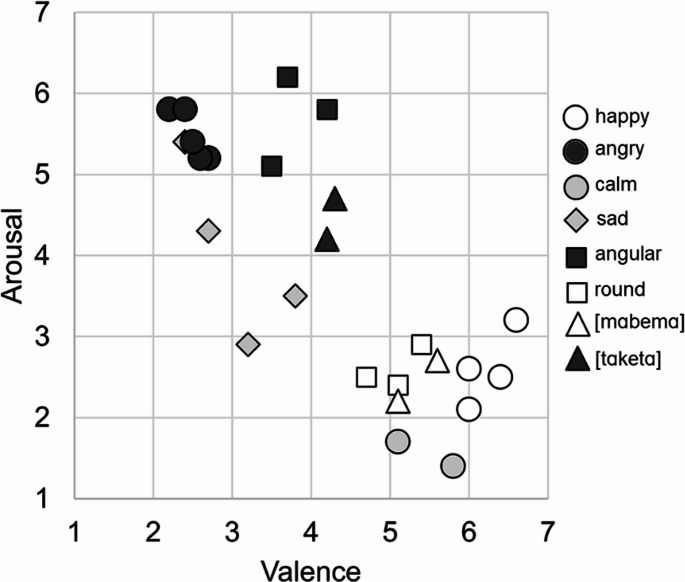
Research has shown that particular shapes and speech sounds have common higher-order emotional properties, which might mediate associating angular shapes with kiki-like words and round shapes with bouba-like words, resulting in the so-called kiki-bouba effect. However, research supporting this account has mostly recruited explicit association tests to investigate whether people link particular emotions with these shapes and pseudo-words. This study investigated whether the kiki-bouba effect, observed in the implicit association test, can be similarly based on these emotional mediation processes. We found that the explicit and implicit association tests robustly produced a link between angular shape and angry facial expressions, whereas the round shape was associated with happy and calm facial expressions. In contrast, aurally presented kiki and bouba-like words were associated with these facial expressions in the explicit association test but not in the implicit association test. These observations suggest that people process implicitly the emotional properties of angular/round shapes, while they do not automatically process the emotional properties of the perceived kiki/bouba-like words when the task emphasizes implicit association processes. Consequently, we propose that the kiki-bouba effect, which is observed in explicit association tests, can be partially based on emotional mediation processes. In contrast, the kiki-bouba effect, which is based on implicitly operating association processes, is not likely to be based on emotional mediation processes.
研究表明,特定的形状和语音具有共同的高阶情感属性,这可能介导了将棱角形状与类似“kiki”的词、圆形形状与类似“bouba”的词联系起来,从而产生了所谓的“kiki-bouba效应”。然而,支持这一观点的研究大多采用明确的联想测试,以调查人们是否将特定情感与这些形状和伪词联系起来。本研究调查了在隐性联想测试中观察到的“kiki-bouba效应”是否同样基于这些情感中介过程。我们发现,明确和隐性联想测试都有力地建立了棱角形状与愤怒面部表情之间的联系,而圆形形状与快乐和平静的面部表情相关联。相比之下,在明确联想测试中,听觉呈现的类似“kiki”和“bouba”的词与这些面部表情相关联,但在隐性联想测试中并非如此。这些观察结果表明,人们在隐性层面处理棱角/圆形形状的情感属性,而当任务强调隐性联想过程时,他们不会自动处理所感知的类似“kiki”/“bouba”的词的情感属性。因此,我们提出,在明确联想测试中观察到的“kiki-bouba效应”可能部分基于情感中介过程。相比之下,基于隐性运作的联想过程的“kiki-bouba效应”不太可能基于情感中介过程。