Hadaya Joseph, Boukens Bastiaan J D, Janse Michiel J, Cha Steven, Dajani Al-Hassan, Challita Ronald, Coronel Ruben, Ardell Jeffrey L, Shivkumar Kalyanam, Meijborg Veronique M F
UCLA Cardiac Arrhythmia Center and Neurocardiology Research Program of Excellence, David Geffen School of Medicine at UCLA, Los Angeles, CA, USA.
Laboratory of Experimental Cardiology, Department of Cardiology, LUMC, Leiden, The Netherlands.
Cardiovasc Res. 2025 Aug 14;121(9):1385-1391. doi: 10.1093/cvr/cvaf121.
Acute myocardial ischaemia causes fatal arrhythmias as result of a flow of 'injury current'. Left stellate ganglion stimulation (LSGS) modulates the injury current and is arrhythmogenic during left anterior ventricular wall ischaemia. The role of right stellate ganglion stimulation (RSGS) in arrhythmogenesis is unclear. We hypothesized that RSGS is proarrhythmic during left lateral ventricular wall ischaemia.
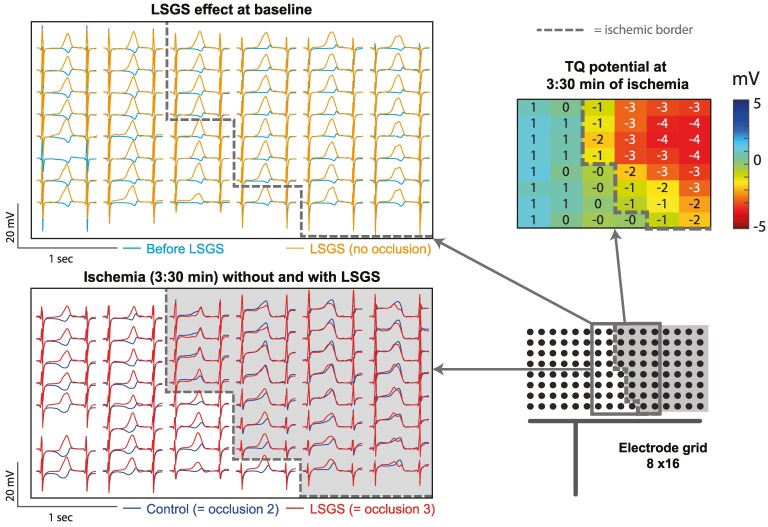
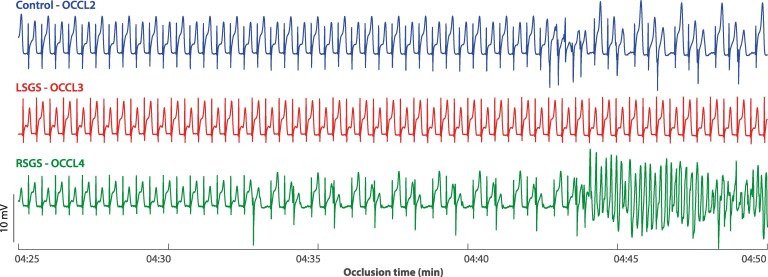
In 11 anaesthetized female pigs, ventricular repolarization was measured in unipolar epicardial electrograms from the left lateral ventricular wall. Seven subsequent episodes of acute ischaemia (5 min) were produced by occlusion of the circumflex coronary artery (CX), separated by 20 min of reperfusion. The second occlusion served as a control. After 3 min of ischaemia during the third occlusion, LSGS was initiated for 30 s. In the 4th occlusion, RSGS was performed. After decentralization of both left and right stellate ganglia and vagal nerves, LSGS and RSGS were initiated (6th and 7th occlusions). RSGS during ischaemia was more arrhythmogenic than LSGS or control with more spontaneous ventricular premature beats (3-5 min of ischaemia) and two instances of ventricular fibrillation. The LSGS-induced effect on repolarization was absent in myocardium that had been ischaemic for 3 min by CX occlusion.
LSGS-induced repolarization shortening is absent in ischaemic myocardium. RSGS was more arrhythmogenic following CX occlusion than LSGS or control. These data demonstrate that the arrhythmogenic influence of RSGS or LSGS is contingent on the location of ischaemic zone supporting the clinical findings that bilateral sympathectomy is superior to left sympathectomy alone.
急性心肌缺血会因“损伤电流”的流动而导致致命性心律失常。左星状神经节刺激(LSGS)可调节损伤电流,并且在左心室前壁缺血期间具有致心律失常作用。右星状神经节刺激(RSGS)在心律失常发生中的作用尚不清楚。我们假设RSGS在左心室侧壁缺血期间具有促心律失常作用。
在11只麻醉的雌性猪中,通过左心室侧壁单极心外膜电图测量心室复极。通过闭塞回旋支冠状动脉(CX)产生7次随后的急性缺血发作(5分钟),每次发作之间间隔20分钟的再灌注。第二次闭塞作为对照。在第三次闭塞缺血3分钟后,开始进行30秒的LSGS。在第四次闭塞时,进行RSGS。在左、右星状神经节和迷走神经去传入后,开始进行LSGS和RSGS(第六次和第七次闭塞)。缺血期间的RSGS比LSGS或对照更具致心律失常性,出现更多的自发性室性早搏(缺血3 - 5分钟)以及两例心室颤动。在因CX闭塞而缺血3分钟的心肌中,LSGS对复极的诱导作用消失。
缺血心肌中不存在LSGS诱导的复极缩短。CX闭塞后,RSGS比LSGS或对照更具致心律失常性。这些数据表明,RSGS或LSGS的致心律失常影响取决于缺血区域的位置,这支持了双侧交感神经切除术优于单纯左交感神经切除术的临床发现。