Peters Gjalt-Jorn, Kwasnicka Dominika, Ten Hoor Gill A, Crutzen Rik, Varol Tugce, Warner Lisa Marie, Algargoosh Mahdi, Ali Eskinder Eshetu, Anwar Mudassir, Asih Sali Rahadi, Baltas Zuhal Feryal, Berry Emma, Beyene Kebede, Campbell Katarzyna Anna, Carneiro Bruno Moreira, Castillo-Eito Laura, Chan Amy Hai Yan, Chan Samuel Suk-Hung, Cipolletta Sabrina, DeSmet Ann, Dewi Triana Kesuma, Dima Alexandra Lelia, Encantado Jorge, Epton Tracy, Figueiredo João, Fracaroli Gustavo DalCin, Gauchet Aurelie, Gebretekle Gebremedhin Beedemariam, Gérain Pierre, Godinho Cristina Albuquerque, Graham-Wisener Lisa, Green James A, Groarke Jenny M, Gültzow Thomas, Guven Elif Basak, Hermans Roel C J, Hermsen Sander, Inauen Jennifer, Kassianos Angelos P, Kazantseva Tatiana Valerievna, Keyaerts Els, König Laura Maria, Lange Daniela, Lauwerier Emelien, Lie Yongchan, Liem Andrian, Luszczynska Aleksandra, Marques Marta M, Moore Hannah Catherine, Noone Chris, Nurmi Johanna, Nurwanti Ratri, Ozbay Elif Suna, Palacz-Poborczyk Iga, Pedruzzi Rebecca Anne, Poppe Louise, Porter Lucy Mabel, Powell Daniel, Rinaldi Bruna Salati Nan, Ruffault Alexis, Schmitz Carsten, Scholz Urte, Schweitzer Ana-Maria, Ok Yasemin Selekoğlu, Shree Medha, Silva Carolina C, Sokang Yasinta Astin, Tam Albert W, Tang Mei Yee, Tomaino Silvia Caterina Maria, van Beurden Samantha Barbara, Verweij Stefan, Vluggen Stan, Watkins Rochelle E, Zörgő Szilvia, Roozen Sylvia
Open University of the Netherlands, Heerlen, Netherlands.
University of Melbourne, Parkville, Australia.
Behav Res Methods. 2025 Jul 14;57(8):223. doi: 10.3758/s13428-025-02743-x.
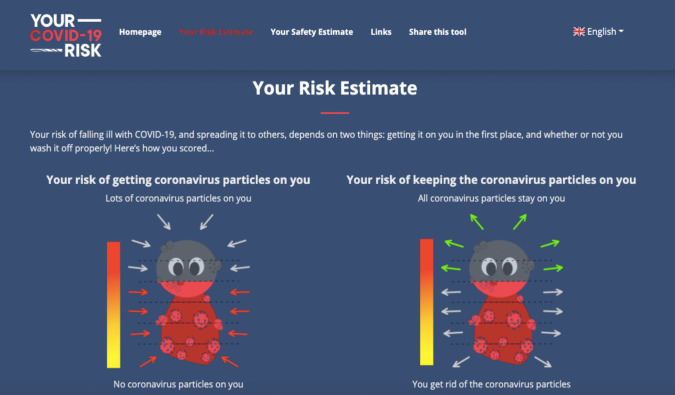
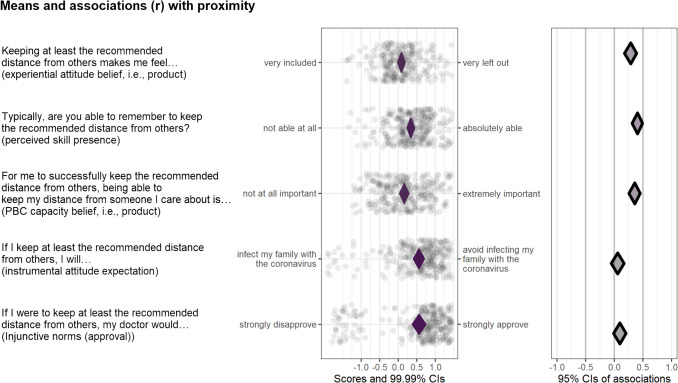
Tools that can be used to collect behavioural data during pandemics are needed to inform policy and practice. The objective of this project was to develop the Your COVID-19 Risk tool in response to the global spread of COVID-19, aiming to promote health behaviour change. We developed an online resource based on key behavioural evidence-based risk factors related to contracting and spreading COVID-19. This tool allows for assessing risk and provides instant support to protect individuals from infection. The Risk Estimation Questions assessed users' location, age, gender, work environment, day-to-day behaviours currently performed, and conditions under which these behaviours would change. Users were also asked to estimate how often they keep their distance from others in public and regularly wash their hands, and the procedures they follow to do so. A multidisciplinary research team of more than 150 international experts developed the tool. Over 60,000 users in more than 150 countries have assessed their risk and provided data. The majority of respondents reported that they almost always keep their distance from others in public places, and most participants reported washing their hands after touching public or shared surfaces or when entering buildings. The tool, data, and results were openly shared to support government and health agencies developing behaviour change interventions. This tool creates a blueprint for similar digital infrastructure that can be replicated and used in future pandemics.
在大流行期间可用于收集行为数据的工具对于为政策和实践提供信息至关重要。本项目的目标是针对新冠病毒的全球传播开发“你的新冠风险”工具,旨在促进健康行为的改变。我们基于与感染和传播新冠病毒相关的关键行为循证风险因素开发了一个在线资源。该工具能够评估风险,并提供即时支持以保护个人免受感染。风险评估问题涉及用户的所在地、年龄、性别、工作环境、当前的日常行为以及这些行为发生改变的条件。用户还被要求估计他们在公共场合与他人保持距离以及定期洗手的频率,以及他们遵循的洗手程序。一个由150多名国际专家组成的多学科研究团队开发了该工具。150多个国家的6万多名用户评估了他们的风险并提供了数据。大多数受访者表示,他们在公共场所几乎总是与他人保持距离,并且大多数参与者表示在接触公共或共享表面后或进入建筑物时会洗手。该工具、数据和结果被公开分享,以支持政府和卫生机构制定行为改变干预措施。此工具为类似的数字基础设施创建了一个蓝图,可在未来的大流行中进行复制和使用。