Sun Meng, Wu Tong, Wang Ruoyu, Ma Yuxin, Han Yaxin, Hou Yanmei, Zhang Zhaofeng
Department of Nutrition and Food Hygiene, School of Public Health Peking University Beijing China.
Hyproca Nutrition Co., Ltd Changsha City Hunan Province China.
Food Sci Nutr. 2025 Jul 14;13(7):e70540. doi: 10.1002/fsn3.70540. eCollection 2025 Jul.
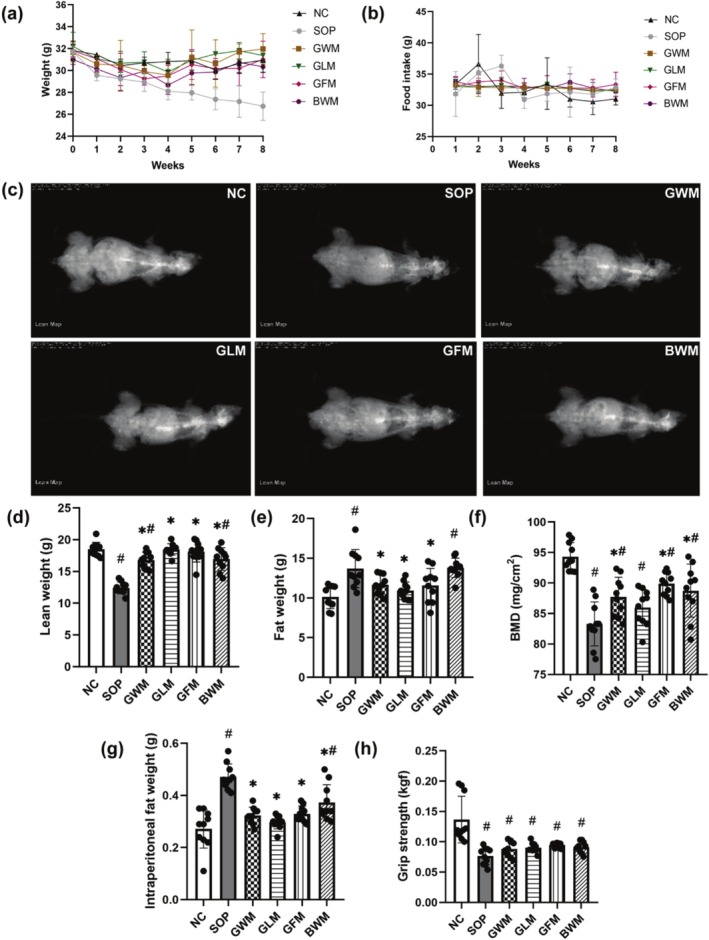
Sarcopenia, characterized by progressive loss of muscle mass and strength, poses a significant public health challenge. However, the specific role of dairy products in preventing sarcopenia is not well understood. This study investigated the effects of different dairy products on muscle metabolism, focusing on the differences between goat and bovine milk, the impact of dairy fat content, and the potential synergistic effects of vitamin D and calcium. Sixty male C57BL/6 mice (8 months old) were randomly divided into six groups and orally administered with 7 g/kg/day of goat whole milk (GWM), goat low-fat milk (GLM), goat fortified vitamin D and calcium low-fat milk (GFM), or bovine whole milk (BWM), respectively. Sarcopenia was induced using intraperitoneal dexamethasone injections (5 mg/kg) for 8 weeks. Grip strength, bone mineral density (BMD), fat and lean weight, muscle morphology, autophagy, inflammation, host metabolism, and gut microbiota were assessed. Sarcopenic mice exhibited decreased lean weight and grip strength. While all dairy products increased lean weight, they did not affect grip strength significantly. At the molecular level, all dairy products activated the PI3K/Akt/mTOR pathway, reduced AMPK phosphorylation, and enhanced muscle regeneration, with GFM being most effective in upregulating MyoG expression. Dairy intake also promoted autophagy by increasing LC3B expression and reducing p62 levels while significantly lowering inflammation markers, including CRP, IL-1β, IL-6, and TNF-α. Gut microbiota analysis revealed that all dairy interventions enriched beneficial genera, with present in all groups and and enriched in goat milk groups. Notably, GLM and GFM increased , which may contribute to muscle health benefits. These findings suggest that dairy consumption, particularly GFM, improves muscle mass, regulates autophagy, reduces inflammation, and modulates gut microbiota composition, providing experimental evidence for sarcopenia prevention and management.
肌肉减少症以肌肉质量和力量的逐渐丧失为特征,对公众健康构成重大挑战。然而,乳制品在预防肌肉减少症中的具体作用尚未得到充分了解。本研究调查了不同乳制品对肌肉代谢的影响,重点关注山羊奶和牛奶之间的差异、乳制品脂肪含量的影响以及维生素D和钙的潜在协同作用。将60只8月龄雄性C57BL/6小鼠随机分为6组,分别口服7 g/kg/天的山羊全脂奶(GWM)、山羊低脂奶(GLM)、山羊强化维生素D和钙低脂奶(GFM)或牛奶全脂奶(BWM)。通过腹腔注射地塞米松(5 mg/kg)8周诱导肌肉减少症。评估握力、骨密度(BMD)、脂肪和瘦体重、肌肉形态、自噬、炎症、宿主代谢和肠道微生物群。肌肉减少症小鼠的瘦体重和握力下降。虽然所有乳制品都增加了瘦体重,但它们对握力没有显著影响。在分子水平上,所有乳制品均激活PI3K/Akt/mTOR通路,降低AMPK磷酸化,并增强肌肉再生,其中GFM在上调MyoG表达方面最有效。摄入乳制品还通过增加LC3B表达和降低p62水平促进自噬,同时显著降低炎症标志物,包括CRP、IL-1β、IL-6和TNF-α。肠道微生物群分析显示,所有乳制品干预措施都丰富了有益菌属,所有组中都存在 ,山羊奶组中 和 丰富。值得注意的是,GLM和GFM增加了 ,这可能有助于肌肉健康。这些发现表明,食用乳制品,尤其是GFM,可改善肌肉质量,调节自噬,减轻炎症,并调节肠道微生物群组成,为肌肉减少症的预防和管理提供了实验证据。