Maity Shiny, Sheppard Jackson, Russell Hannah, Han Chungta, Epstein Leah, Johnson Bruce A, Price Brad, Han Ruixian, Potnuru Lokeswara Rao, Cui Jinlei, Sherwin Mark S, Shea Joan-Emma, Lovett Janet E, Gardner Kevin H, Han Songi
Department of Chemistry, Northwestern University, Evanston, IL 60208, USA.
Department of Chemistry and Biochemistry, University of California, Santa Barbara, CA 93106, USA.
bioRxiv. 2025 Jun 25:2025.06.19.660617. doi: 10.1101/2025.06.19.660617.
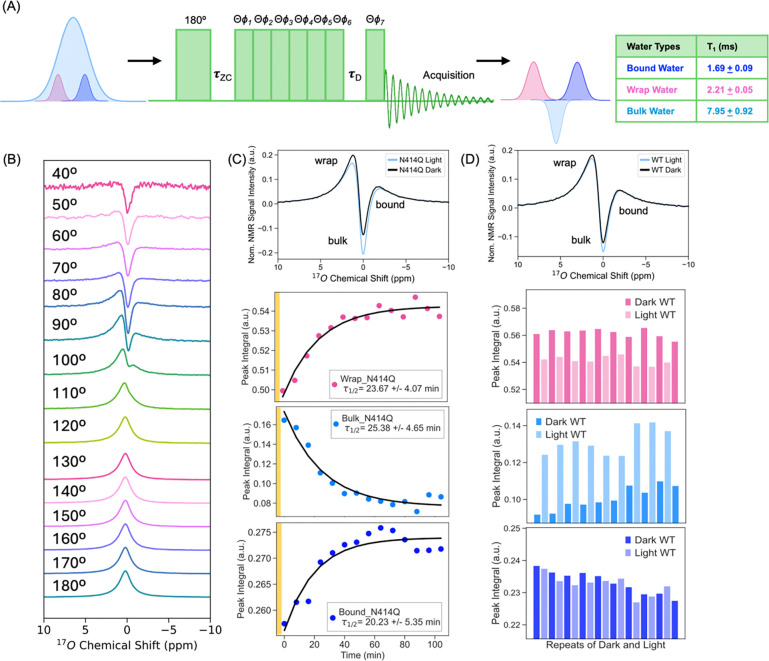
How proteins transduce environmental signals into mechanical motion remains a central question in biology. This study tests the hypothesis that blue light activation of AsLOV2 gives rise to concerted water movement that induce protein conformational extensions. Using electron and nuclear magnetic resonance spectroscopy, along with atomistic molecular dynamics simulations at high pressure, we find that activation, whether initiated by blue light or high pressure, is accompanied by selective expulsion of low-entropy, tetrahedrally coordinated "wrap" water from hydrophobic regions of the protein. These findings suggest that interfacial water serves as functional constituents to help reshape the protein's free energy landscape during activation. Our study highlights hydration water as an active medium with the capacity to drive long-range conformational changes underlying protein mechanics and offers a new conceptual understanding for engineering externally controllable protein actuators for biomedical studies to smart materials.
蛋白质如何将环境信号转化为机械运动仍然是生物学中的一个核心问题。本研究检验了以下假设:蓝光激活AsLOV2会引发协同的水运动,从而诱导蛋白质构象伸展。通过电子和核磁共振光谱,以及高压下的原子分子动力学模拟,我们发现,无论是由蓝光还是高压引发的激活,都伴随着低熵、四面体配位的“包裹”水从蛋白质疏水区域的选择性排出。这些发现表明,界面水作为功能性成分,有助于在激活过程中重塑蛋白质的自由能景观。我们的研究强调了水合水是一种活性介质,具有驱动蛋白质力学中潜在的长程构象变化的能力,并为工程化用于生物医学研究至智能材料的外部可控蛋白质致动器提供了新的概念理解。