Leiva Orly, Liu Olivia, Kanelidis Anthony, Swat Stanley, Gozdecki Leo, Belkin Mark, Grinstein Jonathan, Kalantari Sara, Kim Gene, DeCara Jeanne, Chung Ben, Patel Anand, Odenike Olatoyosi, Yang Eric H, Bloom Michelle, Alvarez-Cardona Jose, How Joan, Hobbs Gabriela
Section of Cardiology-Heart Failure, University of Chicago, Chicago, Illinois, USA.
Division of Cardiology, Department of Medicine, New York University Grossman School of Medicine, New York, New York, USA.
JACC CardioOncol. 2025 Aug;7(5):538-553. doi: 10.1016/j.jaccao.2025.05.010. Epub 2025 Jul 15.
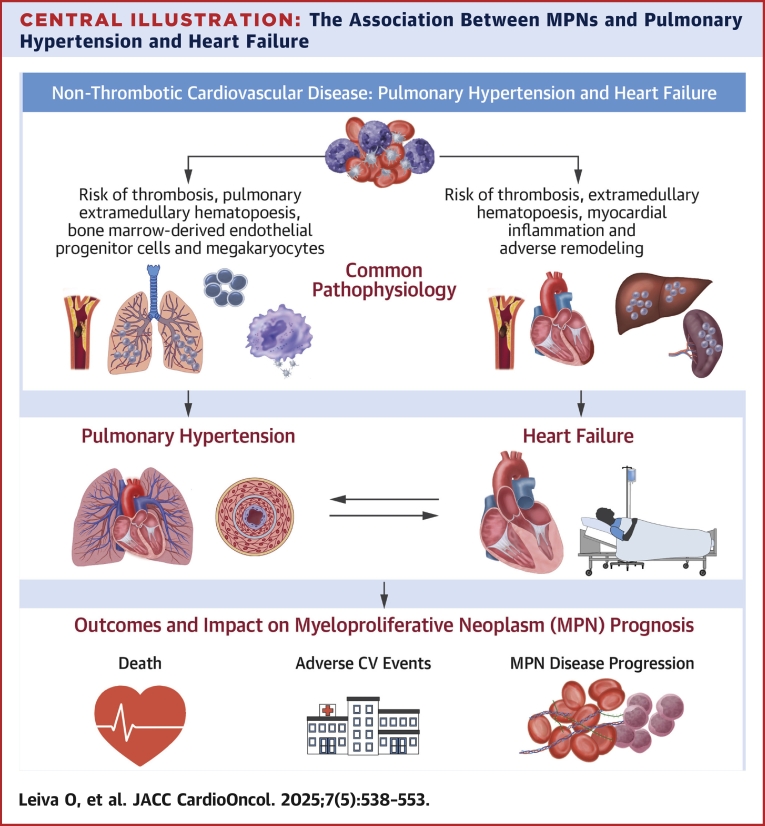
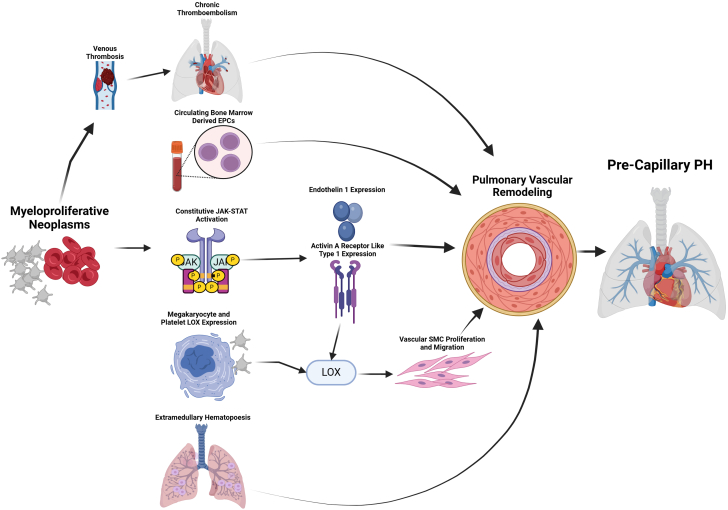
Patients with myeloproliferative neoplasms (MPNs) are at increased risk for cardiovascular disease. Although thrombosis is a well-recognized complication, emerging evidence indicates that nonthrombotic conditions, including heart failure (HF) and pulmonary hypertension (PH), are also prevalent and associated with adverse cardiovascular and hematologic outcomes. Clinical and preclinical data suggest a shared pathophysiology linking MPNs to the development and progression of cardiomyopathy, HF, and both precapillary and postcapillary PH. Recent studies further support a bidirectional relationship, in which HF and PH are associated with hematologic progression and vice versa. Elucidating the mechanisms underlying these interactions may uncover novel therapeutic targets and inform clinical management. Here, the authors review the pathophysiology and impact of HF and PH in patients with MPNs.
骨髓增殖性肿瘤(MPN)患者患心血管疾病的风险增加。尽管血栓形成是一种公认的并发症,但新出现的证据表明,包括心力衰竭(HF)和肺动脉高压(PH)在内的非血栓性疾病也很常见,且与不良心血管和血液学结局相关。临床和临床前数据表明,MPN与心肌病、HF以及毛细血管前和毛细血管后PH的发生和发展存在共同的病理生理学联系。最近的研究进一步支持了一种双向关系,即HF和PH与血液学进展相关,反之亦然。阐明这些相互作用背后的机制可能会发现新的治疗靶点并为临床管理提供依据。在此,作者综述了HF和PH在MPN患者中的病理生理学及影响。