Grech Allison M, Kizirian Nathalie, Haghighi Marjan Mosalman, Sharma Sweekriti, Nasir Reeja, Muirhead Roslyn, Zankl Angelika, Collins Clare, Holmes Andrew, Gordon Adrienne
Faculty of Medicine and Health, Central Clinical School, University of Sydney, Camperdown, NSW, 2006, Australia.
Charles Perkins Centre, University of Sydney, Camperdown, NSW, 2006, Australia.
BMC Pregnancy Childbirth. 2025 Jul 16;25(1):767. doi: 10.1186/s12884-025-07850-3.
“BABY1000” was a pilot prospective birth cohort study based in Sydney, Australia, which aimed to identify factors before and during pregnancy that impact child and long-term health and assess study feasibility and acceptability. The COVID-19 pandemic and associated public health orders affected study protocols. This sub-study aimed to explore feasibility and acceptability of BABY1000 within this context.
Recruitment of women commenced before conception or during early pregnancy attending clinics at a major hospital in Sydney. Data collection extended from recruitment, across pregnancy at 12-, 20-, 28- and 36-weeks’ gestation, and postnatally (in both mothers and children) until the child’s second birthday. Feasibility was assessed using routinely collected data on recruitment, retention, and completion. BABY1000 participants were invited to complete an online acceptability survey, including the State-Trait Anxiety Inventory, and to participate in focus group discussions. Paired t-tests were used to compare sub-study respondents to the wider cohort of participants to assess for demographic drivers of feasibility. Chi-squared tests were used to examine associations between high anxiety and demographic characteristics, study acceptability, and the perceived impact of COVID-19 on study participation.
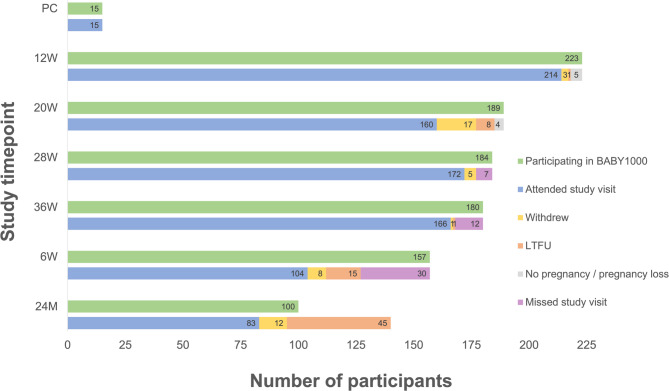
From 225 women recruited, 180 (80%) remained enrolled at the end of pregnancy, with 100 (44%) remaining in the study until 24-months. Participant retention and data completeness were most challenging after birth. Eighty-seven mothers completed the acceptability survey and 22 parents participated in focus groups. Most participants found the study protocol to be acceptable and comfortable. A “high” anxiety score was not associated with study acceptability or willingness to participate, although metrics of both feasibility and acceptability were negatively impacted by the COVID-19 pandemic.
Whilst public health orders associated with the COVID-19 pandemic impacted feasibility and acceptability of the BABY1000 cohort, this sub-study found it is both feasible and acceptable to collect comprehensive biological, questionnaire, and health data from early pregnancy to two years. Study designs which tailor resources to where participant attrition can be predicted and have capacity to adapt to changing circumstances will be best placed to contribute to understanding of the Developmental Origins of Health and Disease.
The online version contains supplementary material available at 10.1186/s12884-025-07850-3.
“BABY1000”是一项在澳大利亚悉尼开展的前瞻性试点出生队列研究,旨在确定怀孕前和怀孕期间影响儿童及长期健康的因素,并评估研究的可行性和可接受性。新冠疫情及相关公共卫生指令影响了研究方案。本亚研究旨在探讨在此背景下BABY1000的可行性和可接受性。
在悉尼一家大型医院的诊所招募孕前或孕早期的女性。数据收集从招募开始,贯穿孕期12周、20周、28周和36周,以及产后(包括母亲和儿童)直至儿童两岁生日。使用关于招募、留存和完成情况的常规收集数据评估可行性。邀请BABY1000参与者完成一项在线可接受性调查,包括状态-特质焦虑量表,并参与焦点小组讨论。使用配对t检验比较亚研究受访者与更广泛的参与者队列,以评估可行性的人口统计学驱动因素。使用卡方检验检查高焦虑与人口统计学特征、研究可接受性以及新冠疫情对研究参与的感知影响之间的关联。
在招募的225名女性中,180名(80%)在孕期结束时仍参与研究,100名(44%)在研究中持续到24个月。出生后参与者留存率和数据完整性最具挑战性。87名母亲完成了可接受性调查,22名家长参与了焦点小组讨论。大多数参与者认为研究方案是可接受且舒适的。“高”焦虑评分与研究可接受性或参与意愿无关,尽管可行性和可接受性指标均受到新冠疫情的负面影响。
虽然与新冠疫情相关的公共卫生指令影响了BABY1000队列的可行性和可接受性,但本亚研究发现,从孕早期到两岁收集全面的生物学、问卷和健康数据是可行且可接受的。能够根据可预测的参与者流失情况调整资源并适应不断变化的情况的研究设计,将最有助于促进对健康与疾病发育起源的理解。
在线版本包含可在10.1186/s12884-025-07850-3获取的补充材料。