Kudu Emre, Kucukardali Ahmet Enes, Altun Mustafa, Öztürk Ümit, Altunbaş Erhan, Karacabey Sinan, Sanri Erkman, Denizbasi Arzu
Department of Emergency Medicine, Marmara University School of Medicine, Istanbul, Türkiye.
Department of Emergency Medicine, Marmara University Pendik Training and Research Hospital, Istanbul, Türkiye.
BMC Emerg Med. 2025 Jul 16;25(1):129. doi: 10.1186/s12873-025-01289-7.
The rapid and accurate diagnosis of non-ST-segment elevation myocardial infarction (NSTEMI) is critical to improving patient outcomes and reducing emergency department (ED) overcrowding. The European Society of Cardiology (ESC) 0/1-hour algorithm, utilizing high-sensitivity cardiac troponin T (hs-cTnT) levels, has demonstrated high diagnostic performance internationally. This study aimed to evaluate its diagnostic accuracy in a high-volume ED setting in Türkiye.
This single-center retrospective cohort study was conducted at Marmara University Pendik Training and Research Hospital, Türkiye, from September 1 to December 31, 2022. Adults presenting with acute chest discomfort and undergoing hs-cTnT testing per the ESC 0/1-hour algorithm were included. Patients with ST-segment elevation, missing data, pregnancy, or those discharged against medical advice were excluded. The primary outcome was NSTEMI diagnosis; the secondary outcome was major adverse cardiac events (MACE) within 30 days.
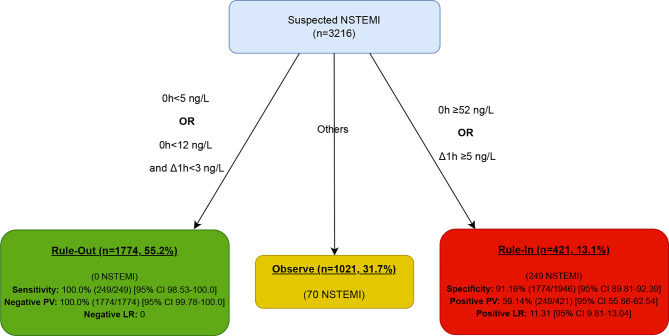
Of 3,529 eligible patients, 3,216 were included. The mean age of the patients was 53.9 ± 16.4 years, and 58.3% were male. NSTEMI was diagnosed in 319 patients (9.9%). According to the ESC algorithm, 54.4% of patients were classified as "rule-out," 31.3% as "observe," and 12.3% as "rule-in." The sensitivity and negative predictive value (NPV) for NSTEMI in the "rule-out" group were both 100%. In the "rule-in" group, the specificity was 91.16%, and the positive predictive value (PPV) was 59.14%. MACE occurred in 13.6% (436 patients) within 30 days: 0.7% in the "rule-out" group, 13.9% in the "observe" group, and 67.0% in the "rule-in" group.
The ESC 0/1-hour algorithm is highly effective for ruling out NSTEMI in Türkiye, demonstrating excellent sensitivity and NPV. While it facilitates early discharge of low-risk patients, enhancements are needed for risk stratification in intermediate-risk groups. Its implementation could optimize ED resource utilization and improve clinical outcomes.
Not applicable.
非ST段抬高型心肌梗死(NSTEMI)的快速准确诊断对于改善患者预后和缓解急诊科(ED)拥挤状况至关重要。欧洲心脏病学会(ESC)的0/1小时算法利用高敏心肌肌钙蛋白T(hs-cTnT)水平,已在国际上显示出较高的诊断性能。本研究旨在评估其在土耳其一家大容量急诊科环境中的诊断准确性。
本单中心回顾性队列研究于2022年9月1日至12月31日在土耳其马尔马拉大学彭迪克培训与研究医院进行。纳入因急性胸痛就诊并按照ESC 0/1小时算法进行hs-cTnT检测的成年人。排除ST段抬高、数据缺失、妊娠或违反医嘱出院的患者。主要结局为NSTEMI诊断;次要结局为30天内的主要不良心脏事件(MACE)。
在3529名符合条件的患者中,3216名被纳入研究。患者的平均年龄为53.9±16.4岁,58.3%为男性。319名患者(9.9%)被诊断为NSTEMI。根据ESC算法,54.4%的患者被分类为“排除”,31.3%为“观察”,12.3%为“纳入”。“排除”组中NSTEMI的敏感性和阴性预测值(NPV)均为100%。在“纳入”组中,特异性为91.16%,阳性预测值(PPV)为59.14%。30天内13.6%(436名患者)发生MACE:“排除”组为0.7%,“观察”组为13.9%,“纳入”组为67.0%。
ESC 0/1小时算法在土耳其排除NSTEMI方面非常有效,显示出出色的敏感性和NPV。虽然它有助于低风险患者的早期出院,但中风险组的风险分层仍需改进。其实施可优化急诊科资源利用并改善临床结局。
不适用。